Understanding Infant Ear Hygiene: A Gentle Approach
Meena, 45, a homemaker from Jaipur, observed a significant accumulation of ear discharge in her 8-month-old son, Rohan. Concerned about his auditory abilities and potential discomfort, she felt unsure of the correct steps. Much like many new parents, Meena wrestled with the question: How do I manage my infant's ears safely?
To be frank, the ears are delicate structures, and improper hygiene can result in more detriment than benefit. The truth is, an infant's ear passage is minuscule and highly sensitive. Overly vigorous cleaning attempts can drive secretions deeper, irritate the skin, or even harm the eardrum.
So what does this imply for you? It signifies approaching infant ear hygiene with utmost care and a delicate touch.
What many overlook is that ear secretions (cerumen) are not merely an inconvenience; they serve as a natural shield. They capture airborne particles, detritus, and microorganisms, preventing their ingress towards the eardrum.
They also possess antibacterial qualities and maintain the ear passage's moisture. A healthy quantity of ear secretions is standard and advantageous for infants.
Why Infants Require Ear Care (and When to Be Concerned)
The Innate Mechanism of Ear Secretion Clearance
The human ear is equipped with an impressive self-cleansing system. Minute filaments lining the ear passage, coupled with the natural movements of the jaw during feeding and vocalization, aid in the gradual outward migration of ear secretions.
Recovery is rarely linear.
This slow, consistent process typically averts excessive accumulation. For the majority of infants, the ear's inherent function is adequate.
When Accumulation Becomes a Problem
Nevertheless, in certain instances, ear secretions can gather excessively, leading to impaction. This may occur if the infant generates more secretions than usual, or if the natural outward movement is impeded, possibly by cotton applicators or other items introduced into the ear. Indicators of excessive ear secretion accumulation in infants can include:
- Restlessness or fretfulness
- Challenges with slumber
- Pulling at the ear
- Diminished auditory perception or difficulty responding to sounds
- A sensation of fullness within the ear
- Occasionally, an unpleasant aroma or exudate
But why does this occur? Factors such as a constricted ear passage, frequent use of auditory aids (though less common in infants), or even specific dermatological conditions can contribute to secretion impaction.
The Indian Academy of Paediatrics (IAP) observes that while infrequent, substantial ear secretion accumulation can affect a child's auditory development, underscoring the significance of vigilant observation.
Safe Ear Care Practices for Your Infant
The paramount guideline for attending to an infant's ears is straightforward: minimal intervention is best. The external portion of the ear is the sole area requiring your attention. Refrain from introducing any implements into the ear passage itself. Here is how to proceed safely:
Attending to the External Ear
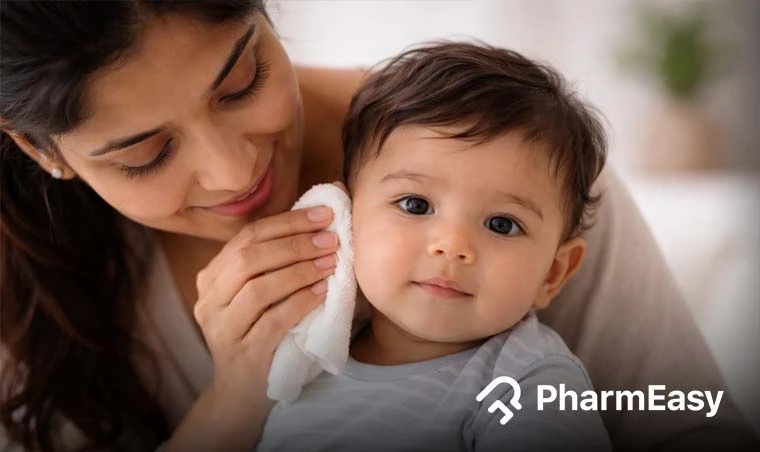
Following a bath, when the skin is pliable, use a soft, damp washcloth or a cotton sphere moistened with tepid water. Gently cleanse the visible portions of your infant's external ear – the auricle and the region posterior to it. Be thorough yet gentle. For any creases or folds, employ the corner of the washcloth or a cotton swab with extreme caution on the outer folds exclusively, ensuring it does not approach the ear passage aperture.
Here's the critical point: many caregivers instinctively reach for cotton swabs for the external ear. While they can be useful for the outermost folds, they present a substantial hazard if used deeper. A study published in the Indian Journal of Otology highlighted that accidental injuries to the ear passage are frequently associated with the improper use of cotton swabs, even in children.
What NOT to Do: Avoiding Typical Errors
It is imperative to comprehend which practices to eschew. Introducing cotton swabs, hairpins, keys, or any other articles into your infant's ear passage is strictly forbidden. This action can:
- Propel secretions further inward, precipitating an impaction.
- Abraide or injure the delicate lining of the ear passage.
- Perforate the eardrum, resulting in meaningful auditory loss and infection.
- Introduce pathogenic organisms, instigating infection.
The World Health Organization (WHO) stresses that ear secretion removal should only be undertaken by a medical practitioner when clinically warranted. For infants, this directive is even more crucial. Consider it akin to polishing the exterior of a delicate musical instrument; you would not probe its internal mechanisms.
Most people overlook this completely.
When to Seek Expert Assistance
Should you suspect your infant has excessive ear secretion accumulation causing distress or auditory difficulties, do not attempt home-based remedies involving insertion. Instead, arrange a consultation with your pediatrician or an otolaryngologist.
They possess the appropriate instruments and proficiency to safely examine and cleanse your infant's ears.
Medical Ear Cleansing Techniques
Healthcare providers may employ several methods to extract impacted ear secretions:
- Auricular Drops: Occasionally, a physician may endorse specific ear drops (such as carbamide peroxide or mineral oil) to soften the secretions. These are typically administered for a few days preceding a follow-up visit. The International Diabetes Federation (IDF) and other health organizations frequently advise prudence with self-administration, reinforcing the need for professional guidance.
- Lavage (Syringing): Employing a specialized syringe, a gentle stream of lukewarm water or saline solution is introduced into the ear passage to dislodge the secretions. This procedure necessitates precision and is conducted under aseptic conditions.
- Aspiration: A small, delicate aspiration device can be utilized to carefully extract softened secretions from the ear passage.
- Curettage: A diminutive, curved instrument known as a curette may be employed to manually scoop out the secretions.
These techniques are generally secure when performed by trained professionals. A recent report from AIIMS indicated a reduction in ear-related complications among children undergoing professional ear cleansing compared to those with attempted home removal.
Dispelling Misconceptions Regarding Infant Ear Care
Numerous myths persist concerning infant ear care. A prevalent misunderstanding is the necessity of using cotton swabs to 'dry' the ear passage post-bathing. This is superfluous and perilous. The ear passage typically dries autonomously, and as previously stated, swabs should never be inserted deeply.
Another myth suggests that ear candles offer a safe method for removing secretions. This is entirely fallacious and hazardous; ear candling can inflict burns, eardrum perforation, and even blockages from the candle's residual wax. The Indian Medical Association (IMA) strongly discourages this practice.
It sounds simple. It rarely is.
The reality is, nature has endowed our bodies with efficient mechanisms for managing ear secretions. Excessive interference can disrupt this equilibrium.
Consider the occasions during festivals like Diwali, where elaborate rituals are observed. Similarly, a gentle, methodical approach to cleansing the infant's *external* ear is all that is required, bypassing the intricate internal structures.
Prioritizing Safety and Gentleness
Attending to your infant's ears need not be a source of apprehension. By comprehending the ear's natural cleansing processes and adhering to secure methodologies—focusing exclusively on the external ear with a moist cloth—you can effectively maintain hygiene. Remember, the ear passage is self-cleansing.
If you observe indications of excessive secretion accumulation or if your infant appears distressed, do not hesitate to seek professional medical counsel. Over 101 million Indians have diabetes (ICMR, 2023), a statistic illustrating how chronic ailments demand expert management; likewise, ear health in infants is best overseen with professional guidance when issues arise.
Crucial Points:
- Infant ear secretions are natural and protective; excessive accumulation is infrequent but warrants attention.
- Clean only the visible external ear with a moist cloth; never introduce implements into the ear passage.
- Cotton swabs are risky and should be avoided within the ear passage.
- Seek professional medical aid if you suspect ear secretion impaction or if your infant exhibits signs of discomfort or auditory impairment.
- Ear candling is hazardous and should be entirely eschewed.
Always consult a qualified physician before making any health-related decisions.