

Emergency & Help
24/7 Emergency & General Advisory
🚨 24/7 Medical Emergency
Non-Emergency Advisory
10:00 AM – 6:00 PM, Mon–Sat
For appointments & general queries.
24/7 Emergency & General Advisory
🚨 24/7 Medical Emergency
Non-Emergency Advisory
10:00 AM – 6:00 PM, Mon–Sat
For appointments & general queries.
Explore the coverage of gender affirming surgeries under Indian government healthcare schemes like Ayushman Bharat. Understand medical necessity, potential costs, and steps to claim.

Gender affirming surgery (GAS) is a critical component of gender transition for many transgender and gender non-conforming individuals. In India, the landscape of healthcare coverage, particularly for specialized procedures like GAS, is evolving. This guide aims to provide a comprehensive overview of whether government healthcare schemes in India cover the costs associated with gender affirming surgeries, exploring the nuances of eligibility, coverage, and potential out-of-pocket expenses.
India has made significant strides in recognizing the rights and healthcare needs of the transgender community. The Transgender Persons (Protection of Rights) Act, 2019, is a landmark legislation that aims to protect the rights of transgender individuals and ensure their inclusion in society. While this act provides a legal framework, the practical implementation of comprehensive healthcare, including surgical interventions, is still a developing area.
Several government healthcare schemes are in place in India to provide affordable medical care to its citizens. The extent to which these schemes cover gender affirming surgeries can vary significantly. It is crucial to understand the specifics of each scheme:
Ayushman Bharat is a flagship scheme of the Government of India that aims to achieve Universal Health Coverage. It provides health insurance coverage of up to ₹5 lakh per family per year for secondary and tertiary care hospitalization. While AB-PMJAY covers a wide range of medical procedures, its coverage for gender affirming surgeries is not explicitly detailed in all public documents. However, there have been instances and discussions suggesting that certain procedures related to gender affirmation might be covered if they are deemed medically necessary and fall under the defined benefit packages. The classification of GAS as a 'medically necessary' procedure is often a key factor.
Many Indian states have their own health insurance schemes tailored to the needs of their residents. These schemes may offer different benefit packages and coverage limits. It is advisable for individuals to check the specific guidelines and empanelled hospitals under their respective state health insurance programs. Some states might be more progressive in their approach to covering gender-affirming care.
Various other government health programs and initiatives focus on specific health needs. While direct coverage for GAS might not be a primary focus, understanding the broader healthcare infrastructure and potential for inclusion is important. The Ministry of Health and Family Welfare, along with other government bodies, continuously works towards improving healthcare access.
The concept of 'medical necessity' is central to insurance coverage. For gender affirming surgeries, this typically means that the procedure is essential for the physical and mental well-being of the individual, often as part of a comprehensive gender transition plan. This usually involves:
The specific criteria for medical necessity can vary between different healthcare providers and insurance policies. It is essential to obtain thorough documentation from your medical team.
Even with government schemes, there might be certain costs that are not fully covered. These can include:
It is vital to have a clear understanding of the total estimated cost and the coverage provided by the scheme before proceeding with the surgery.
Navigating insurance coverage can be complex. Here are practical steps to determine if your gender affirming surgery can be covered by a government scheme:
It is essential to consult with healthcare professionals at every stage of your gender transition journey. Specifically, regarding surgical interventions:
Despite progress, challenges remain. Awareness about transgender health needs among healthcare providers and insurance administrators can be inconsistent. The lack of explicit inclusion of GAS in all policy documents creates ambiguity. However, with increasing advocacy and legal recognition, the future outlook for government coverage of gender affirming surgeries in India is hopeful. Continued efforts in policy reform, increased awareness, and the expansion of services under schemes like Ayushman Bharat are expected to improve access to these vital procedures.
A1: Generally, gender affirming surgeries are not considered purely cosmetic. When performed as part of a medically necessary transition for gender dysphoria, they are often classified as reconstructive or medically necessary procedures. However, the specific classification can depend on the insurance policy and the documentation provided.
A2: Government healthcare schemes in India are typically for Indian citizens. Eligibility criteria usually include proof of Indian citizenship and residency. Non-residents may need to explore private health insurance options or international patient services.
A3: If your claim for coverage is denied, you have the right to appeal the decision. Gather all relevant medical documentation, including letters of medical necessity and any previous correspondence with the insurance provider. You can also seek assistance from legal aid services or LGBTQ+ advocacy groups to navigate the appeals process.
A4: While some government hospitals are equipped to handle complex surgeries, specialized gender affirming surgeries might be more readily available in larger, tertiary care government hospitals or through specific empanelled private hospitals. It is crucial to verify the availability of such services and the empanelment status with the relevant government schemes.
A5: You can often find lists of experienced surgeons through LGBTQ+ community organizations, online forums, and by consulting with medical professionals who specialize in transgender healthcare. It is important to research the surgeon's experience, qualifications, and patient reviews.
This section adds practical context and preventive advice to help readers make informed healthcare decisions. It is important to verify symptoms early, consult qualified doctors, and avoid self-medication for persistent health issues.
Maintaining healthy routines, following prescribed treatment plans, and attending regular checkups can improve outcomes. If symptoms worsen or red-flag signs appear, immediate medical evaluation is recommended.
Track symptoms and duration.
Follow diagnosis and treatment from a licensed practitioner.
Review medication side effects with your doctor.
Seek urgent care for severe warning signs.
Visit Hospital
Near You
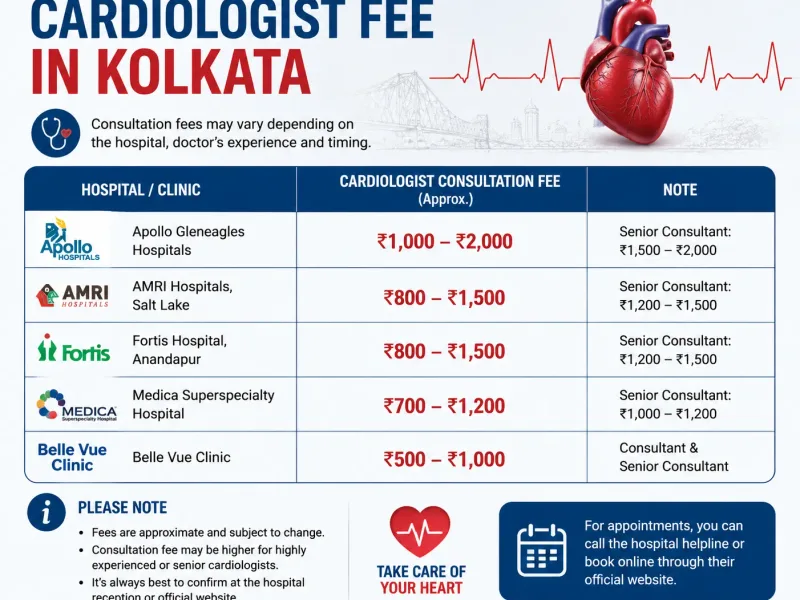
Learn about cardiologist fee in Kolkata, consultation charges, factors affecting costs, and tips to choose the right heart specialist.
May 29, 2026
A simple guide to the best shortness of breath specialist in Kolkata, including causes, symptoms, treatment options, and expert medical advice.
May 29, 2026

Find the best chest pain doctor in Kolkata. Learn causes, symptoms, tests, and treatment options from top heart specialists in simple English.
May 29, 2026