

Emergency & Help
24/7 Emergency & General Advisory
🚨 24/7 Medical Emergency
Non-Emergency Advisory
10:00 AM – 6:00 PM, Mon–Sat
For appointments & general queries.
24/7 Emergency & General Advisory
🚨 24/7 Medical Emergency
Non-Emergency Advisory
10:00 AM – 6:00 PM, Mon–Sat
For appointments & general queries.
Learn how Medicare Parts A, B, and D, along with Medicare Advantage plans, cover grief counseling and other essential mental health services for beneficiaries navigating loss.

Losing a loved one is an incredibly difficult experience, and navigating the grieving process can be overwhelming. Many people find solace and support through grief counseling, also known as bereavement counseling. If you're a Medicare beneficiary, you might be wondering if this essential mental health service is covered. The good news is that Medicare generally covers grief counseling, along with a range of other mental health services. This guide will break down how Medicare Parts A, B, and D, as well as Medicare Advantage plans, can help you access the support you need during this challenging time. We'll also touch upon what to expect regarding costs and how to find services.
Grief is a natural response to loss. While most commonly associated with the death of a loved one, grief can also stem from other significant life changes, such as the end of a relationship, job loss, or a major health diagnosis. Grief counseling provides a safe space to process these emotions, develop coping strategies, and navigate the complex journey of healing. It's not about 'getting over' your grief, but rather learning to live with your loss in a healthy way.
Imagine this scenario: Mrs. Sharma's husband of 50 years recently passed away. She's finding it hard to sleep, has lost her appetite, and feels a profound sense of loneliness. Her daughter, concerned, suggests she speak with a counselor. Mrs. Sharma is hesitant, worried about the cost, but her daughter reassures her that Medicare might help.
Original Medicare, which includes Part A and Part B, covers many mental health services, including grief counseling. The specifics of coverage depend on whether the counseling is provided in an inpatient or outpatient setting.
Medicare Part A primarily covers inpatient hospital services. If you require inpatient care for mental health services, including intensive grief counseling, Part A can help. However, there's a limit: Part A will cover up to 190 days of inpatient grief counseling services. After this period, you may need to make other arrangements for continued care.
Medicare Part B covers outpatient services. This is where most grief counseling sessions take place. Part B covers services like:
A significant advantage of Part B is that there’s generally no restriction on the number of outpatient mental health counseling sessions it will cover, as long as they are medically necessary. This means you can receive ongoing support as you need it.
Medicare Advantage plans (Part C) are offered by private insurance companies approved by Medicare. These plans must cover everything that Original Medicare (Parts A and B) covers. Importantly, any mental health services covered under Parts A and B, including grief counseling, will also be covered by your Medicare Advantage plan.
Some Medicare Advantage plans may offer additional benefits beyond Original Medicare. This could include coverage for services like telehealth mental health appointments or a wider network of providers. If you are on an Advantage plan, it's always a good idea to check your plan's specific benefits for mental health coverage.
During the grieving process, your doctor might prescribe medications, such as antidepressants or anti-anxiety drugs, to help manage symptoms. Medicare Part D, which provides prescription drug coverage, can help with these costs. Common medications covered include antidepressants, antipsychotics, and anticonvulsants. Always check your specific Part D plan's formulary (a list of covered medications) to confirm coverage for any prescribed drugs.
While Medicare covers a significant portion of grief counseling services, there are still some out-of-pocket costs to be aware of:
It's important to note that these costs can vary, and some Medicare Advantage plans might offer lower deductibles or copayments. Always confirm the costs with your specific plan and healthcare provider.
You don't need to meet specific, rigid eligibility criteria for Medicare to cover grief counseling. The primary requirement is that the counseling is deemed medically necessary by your healthcare provider. You and your doctor or mental health professional will work together to determine what mental health services, including grief counseling, best suit your needs during the grieving process. This could include individual or group therapy, medication, or even partial hospitalization if necessary.
Finding the right support is the first step. Here’s how you can start:
While grief is a normal process, it's important to seek professional help if you experience any of the following:
Remember, seeking help is a sign of strength. Grief counseling can provide invaluable support as you navigate loss and work towards healing.
Yes, Medicare generally covers therapy for grief as a mental health service under Parts A and B, and subsequently under Medicare Advantage plans.
Medicare covers a wide range of mental health services, including depression screenings, psychotherapy, medication management, partial hospitalization, and inpatient mental health care, in addition to grief counseling.
While Medicare covers the services, you may still be responsible for deductibles, coinsurance (typically 20% for outpatient services), and premiums. The exact cost depends on your specific Medicare plan (Original Medicare or Medicare Advantage) and the services you receive.
Visit Hospital
Near You
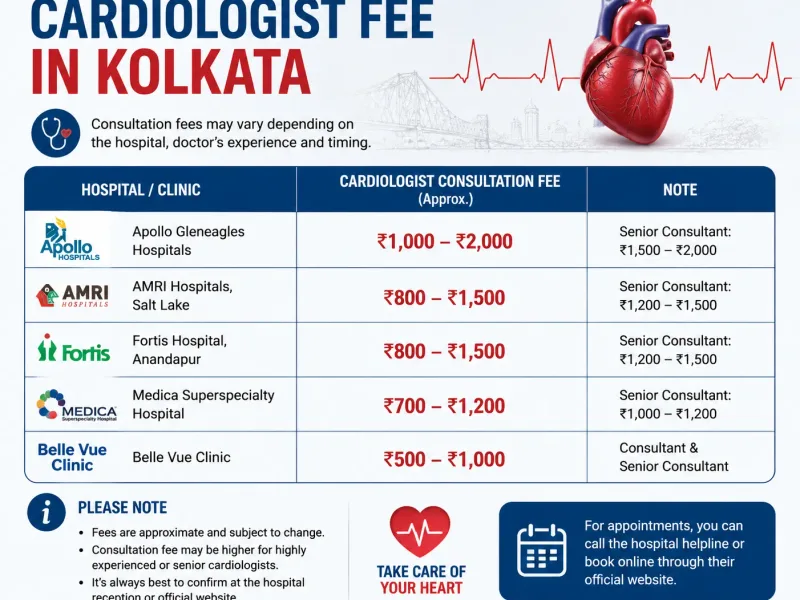
Learn about cardiologist fee in Kolkata, consultation charges, factors affecting costs, and tips to choose the right heart specialist.
May 29, 2026
A simple guide to the best shortness of breath specialist in Kolkata, including causes, symptoms, treatment options, and expert medical advice.
May 29, 2026

Find the best chest pain doctor in Kolkata. Learn causes, symptoms, tests, and treatment options from top heart specialists in simple English.
May 29, 2026