

Emergency & Help
24/7 Emergency & General Advisory
🚨 24/7 Medical Emergency
Non-Emergency Advisory
10:00 AM – 6:00 PM, Mon–Sat
For appointments & general queries.
24/7 Emergency & General Advisory
🚨 24/7 Medical Emergency
Non-Emergency Advisory
10:00 AM – 6:00 PM, Mon–Sat
For appointments & general queries.
Explore ConnectiCare's Medicare Advantage plans for 2025 in Connecticut. Learn about Choice, Passage, and Flex plans, prescription drug coverage, costs, and extra benefits to make an informed healthcare decision.

Navigating Medicare Advantage plans can feel like trying to decipher a complex map, especially when you're looking for the best coverage options in Connecticut. ConnectiCare, a familiar name to many state residents for over 40 years, offers a range of Medicare Advantage (Part C) plans designed to provide comprehensive benefits. Understanding these plans is key to making informed decisions about your healthcare as you age. This guide aims to simplify the offerings from ConnectiCare for 2025, helping you find a plan that fits your needs and budget. What is Medicare Advantage? Before diving into ConnectiCare's specific plans, let's quickly recap what Medicare Advantage is. These plans are an alternative way to get your Medicare coverage. Offered by private insurance companies approved by Medicare, they bundle Medicare Part A (hospital insurance) and Part B (medical insurance) into one plan. Most Medicare Advantage plans also include prescription drug coverage (Part D). They often provide extra benefits not covered by Original Medicare, such as dental, vision, hearing, and wellness programs. ConnectiCare's Presence in Connecticut ConnectiCare has a long-standing commitment to serving Connecticut residents. They boast a network that includes 100% of Connecticut hospitals, ensuring that when you need hospital care, you're likely to have access to facilities within their network. This extensive network is a significant advantage for members, offering a wide choice of doctors, specialists, and hospitals across the state. ConnectiCare Medicare Advantage Plan Types for 2025 ConnectiCare offers several types of Medicare Advantage plans, each with different structures, costs, and coverage levels. Here's a breakdown: 1. ConnectiCare Choice Plans (HMO) ConnectiCare Choice plans are Health Maintenance Organization (HMO) plans. This means you generally must use doctors, hospitals, and other healthcare providers within the ConnectiCare network for your medical care to be covered. You'll typically need to choose a primary care physician (PCP) who coordinates your care and refers you to specialists when needed. While this structure emphasizes coordinated care, it requires careful attention to staying within the network. There are three levels of Choice plans: Plan 1, Plan 2, and Plan 3. All are available in all eight Connecticut counties. Plan 1 and Plan 3: These plans include Medicare Part D prescription drug coverage. Plan 2: This plan does not include prescription drug coverage. 2. ConnectiCare Passage Plan (HMO-POS) The ConnectiCare Passage plan is a unique offering available in all eight Connecticut counties. A key feature of this plan is its substantial $3,000 allowance for hearing aids, which can be a significant benefit for many seniors. Like other HMO plans, it generally requires you to use in-network providers, but it may offer some flexibility for out-of-network care, depending on the specific structure (often HMO-POS, meaning Health Maintenance Organization with Point of Service option). This plan also includes prescription drug coverage. 3. ConnectiCare Flex Plans (HMO-POS) ConnectiCare offers two Flex plan levels: Flex plan 2 and Flex plan 3. These are typically HMO-POS plans, providing the advantage of using out-of-network healthcare professionals throughout the United States, in addition to the in-network benefits. This offers greater flexibility if you travel or prefer a wider choice of providers. Both plans are available in all eight Connecticut counties. Flex Plan 3: The monthly premium for this plan can vary based on the county in which you reside. 4. Dual-Eligible Special Needs Plan (D-SNP) For Connecticut residents who qualify for both Medicare and the state's Medicaid program (HUSKY Health), ConnectiCare offers a Dual-Eligible Special Needs Plan (D-SNP). This specialized plan is designed to coordinate benefits and provide comprehensive coverage for individuals with both full Medicare and full Medicaid benefits. It is available in all eight Connecticut counties and includes prescription drug coverage, aiming to simplify healthcare for those who need it most. Prescription Drug Coverage with ConnectiCare Most ConnectiCare Medicare Advantage plans come with built-in Part D prescription drug coverage. This is a significant convenience, as it means you don't need to enroll in a separate Part D plan. ConnectiCare uses a formulary, which is a list of covered drugs, divided into tiers. The cost you pay for a prescription can depend on the drug's tier and whether you use a preferred or standard pharmacy. Using a ConnectiCare preferred pharmacy can often result in lower out-of-pocket costs. ConnectiCare's formulary can have up to six tiers, with varying copayments based on pharmacy choice. Important Note on Pharmacies: To maximize your coverage and minimize costs, it's important to use ConnectiCare in-network pharmacies. Always check the plan's formulary and pharmacy network to understand your prescription benefits fully. Understanding Costs: Premiums, Copays, and Deductibles The costs associated with ConnectiCare Medicare Advantage plans can vary. This includes: Monthly Premiums: While some plans might have a $0 monthly premium (beyond your regular Medicare Part B premium), others will have a monthly cost. As noted, Flex Plan 3 premiums can vary by county. Copayments: This is a fixed amount you pay for a covered healthcare service after you've met your deductible (if applicable). Examples include copays for doctor visits or prescription drugs. Deductibles: This is the amount you pay for covered healthcare services before your insurance plan starts to pay. Some plans may have deductibles for certain services or prescription drugs. It's essential to remember that copays, deductibles, and premiums can differ from county to county within Connecticut. Always refer to the specific plan details for the county you live in for accurate cost information. Extra Benefits Offered Beyond essential medical and prescription drug coverage, many ConnectiCare Medicare Advantage plans offer valuable extra benefits. These can include: Dental coverage (often with allowances for services) Vision care (including coverage for eye exams and glasses) Hearing aid allowances (like the significant $3,000 allowance in the Passage plan) Fitness programs (e.g., SilverSneakers or similar programs) Allowances for over-the-counter (OTC) medical items These additional benefits can significantly enhance your quality of life and help manage healthcare costs for services not covered by Original Medicare. When to Consult a Doctor or Review Your Plan Choosing a Medicare Advantage plan is a personal decision that depends on your health needs, preferred doctors, and budget. Consider the following: Network: Are your current doctors and preferred hospitals in the plan's network? For HMOs, this is particularly important. Prescription Drugs: If you take regular medications, check if they are on the plan's formulary and what the cost will be. Extra Benefits: Do the extra benefits like dental, vision, or fitness programs align with your needs? Costs: Compare premiums, deductibles, and copays across different plans and consider your expected healthcare usage. Scenario: Mrs. Gable, a 70-year-old resident of Hartford, recently received her Medicare plan options for 2025. She takes medication for high blood pressure and arthritis and sees a cardiologist and a physical therapist regularly. She's also interested in a plan that covers routine dental check-ups and perhaps a gym membership. Mrs. Gable needs to carefully review the ConnectiCare Choice, Passage, and Flex plans available in Hartford County. She must verify if her cardiologist and physical therapist are in-network for any HMO plans she considers. She'll also check the formulary for her blood pressure and arthritis medications and compare the dental and fitness benefits across the plans. Her goal is to find a plan that offers good prescription coverage, covers her preferred providers, and includes the wellness benefits she desires, all within her budget. Making Your Choice ConnectiCare offers a comprehensive suite of Medicare Advantage plans for Connecticut residents in 2025. By understanding the different plan types—Choice, Passage, and Flex—and considering factors like prescription drug coverage, provider networks, extra benefits, and costs, you can select the plan that best supports your health and well-being. Remember to always consult the official plan documents and speak with a licensed insurance agent or ConnectiCare representative if you have specific questions. Frequently Asked Questions (FAQ) Q1: Are ConnectiCare Medicare Advantage plans available outside of Connecticut? No, ConnectiCare Medicare Advantage plans are exclusively available to residents of Connecticut. Some network providers may extend into Western Massachusetts and four New York counties (Westchester, Orange, Putnam, and Rockland), but enrollment is restricted to Connecticut residents. Q2: Do all ConnectiCare Medicare Advantage plans include prescription drug coverage? Most ConnectiCare Medicare Advantage plans include Part D prescription drug coverage. However, Plan 2 of the ConnectiCare Choice plan does not include it. It's crucial to check the specific details of the plan you are considering. Q3: How do I know if my doctor is in the ConnectiCare network? You can typically find a provider directory on the ConnectiCare website or by calling their member services. It's always best to confirm directly with your doctor's office as well to ensure they are participating with the specific plan you choose. Q4: Can I use out-of-network providers with ConnectiCare plans? With HMO plans like the ConnectiCare Choice, you generally must stay in-network for coverage. However, HMO-POS plans, such as the Flex plans, often allow you to use out-of-network providers, though typically at a higher cost. The Passage plan may also offer some out-of-network flexibility. Always review the plan's Summary of Benefits to understand these details. Q5:
In summary, timely diagnosis, evidence-based treatment, and prevention-focused care improve long-term health outcomes.
Visit Hospital
Near You
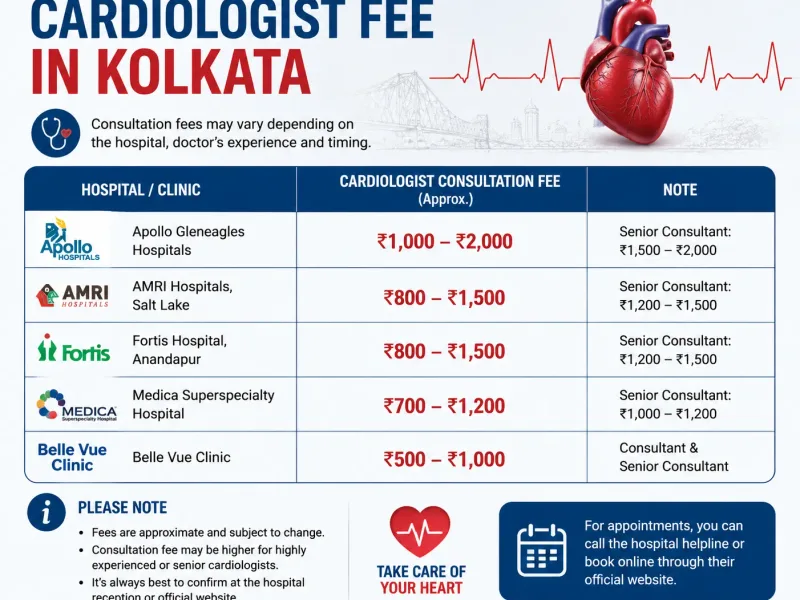
Learn about cardiologist fee in Kolkata, consultation charges, factors affecting costs, and tips to choose the right heart specialist.
May 29, 2026

A simple guide to the best shortness of breath specialist in Kolkata, including causes, symptoms, treatment options, and expert medical advice.
May 29, 2026

Find the best chest pain doctor in Kolkata. Learn causes, symptoms, tests, and treatment options from top heart specialists in simple English.
May 29, 2026