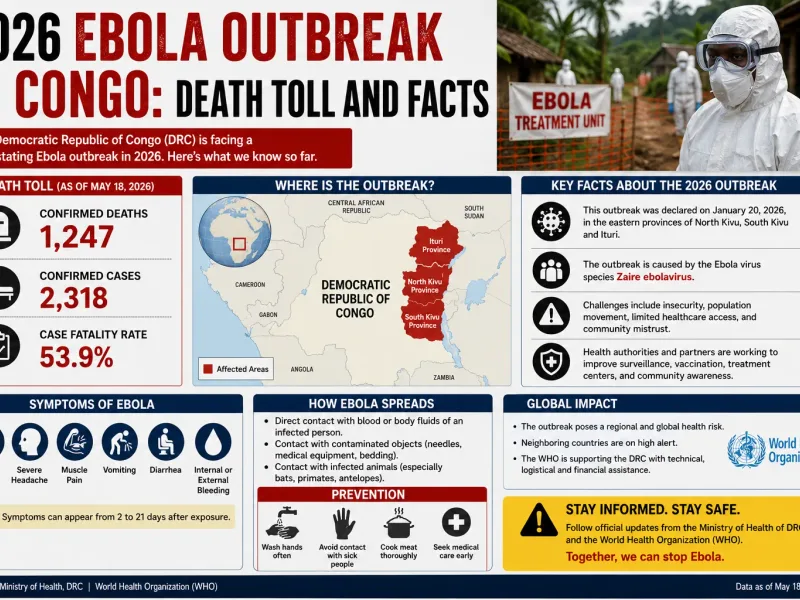
The Democratic Republic of the Congo is experiencing the deadliest Ebola outbreak it has faced in years, with more than 1,000 confirmed deaths and over 2,400 confirmed cases as of late July 2026. The outbreak is caused by the Bundibugyo virus — a rare species of Ebola for which no licensed vaccine or treatment exists. The World Health Organization declared it a public health emergency of international concern on May 17, 2026, its highest-level formal alert.
Bundibugyo virus (sometimes abbreviated as BDBV) is one of several viruses that cause Ebola disease — a severe hemorrhagic fever (severe bleeding illness) that attacks the body's organs and immune system. It is not the same as the Zaire ebolavirus, the strain responsible for the deadly 2014–2016 West Africa outbreak that killed more than 11,000 people.
Bundibugyo virus was first identified in 2007, when it caused an outbreak in Uganda with 149 suspected cases and 37 deaths, according to the CDC's Morbidity and Mortality Weekly Report. A second outbreak occurred in DRC in 2012, resulting in 56 confirmed cases and 17 deaths. Both were contained relatively quickly. The 2026 outbreak has already surpassed both by orders of magnitude.
The fatality rate in past Bundibugyo outbreaks ranged from 30% to 50%, according to WHO — meaning it kills between one-third and half of those who become infected when left untreated. The critical complication is that existing Ebola vaccines, including the rVSV-ZEBOV vaccine (marketed as Ervebo), were developed to protect against Zaire ebolavirus, not Bundibugyo. WHO recommended against using that vaccine for this outbreak as of May 28, citing low evidence of cross-protection.
The outbreak most likely began in January or February 2026 in Mongbwalu, a high-traffic mining town in DRC's Ituri Province, based on the epidemiological timeline assembled by WHO. The illness was transmitting for weeks before it was officially detected. On May 5, WHO was alerted to a high-mortality cluster of unknown illness in Mongbwalu Health Zone — including deaths among health workers, which is a classic early warning signal for Ebola.
Laboratory analysis at the Institut national de recherche biomédicale (INRB) in Kinshasa confirmed Bundibugyo virus in blood samples on May 15. DRC's Ministry of Public Health officially declared the outbreak on May 15, 2026 — the country's 17th Ebola outbreak since the virus was first identified in 1976.
[REVIEWER: add clinical insight here — e.g., what the early presentation of Bundibugyo virus disease looks like compared with other hemorrhagic fevers, and why diagnosis is often delayed in resource-limited settings]
Current Death Toll and Case Count
The numbers have escalated at a pace that has alarmed international health officials.
As of July 21, 2026, DRC reported 2,473 confirmed cases and 999 confirmed deaths, according to the European Centre for Disease Prevention and Control (ECDC). The Africa CDC confirmed the death toll had crossed 1,000 the following day. Ituri Province remains the hardest-hit region, accounting for 2,202 of the confirmed cases and 838 deaths across 28 of the province's 36 health zones. North Kivu Province has recorded a further 247 cases and 146 deaths across 11 health zones.
The confirmed numbers almost certainly undercount the true scale of the outbreak. Poor healthcare infrastructure, ongoing armed conflict in eastern DRC, and gaps in surveillance make detection and reporting difficult, according to WHO. As Doctors Without Borders (MSF) noted in July, the epidemic continued spreading into new areas at an unprecedented pace even as the response was being built out.
Hospitalizations have been severe: 737 patients were in isolation facilities as of July 21. At least 482 people have recovered since the outbreak began.
Geographic Spread: Uganda, Europe, and Beyond
The outbreak crossed into Uganda early in its trajectory. Two confirmed cases were detected in Uganda's capital, Kampala, within 24 hours of each other in mid-May 2026, among individuals who had traveled from DRC. Uganda has since reported 20 confirmed cases and two deaths, according to Wikipedia's documented outbreak tracking, with most Ugandan cases linked to travelers from DRC.
International spread has also occurred. In May 2026, a US citizen working as a healthcare provider in DRC tested positive and was medically evacuated to Germany for treatment. A second US humanitarian worker was evacuated to Germany in July. In June, France confirmed an imported case — a doctor who had returned from a humanitarian mission in DRC — the first Ebola case in Europe from this outbreak.
Despite these importations, the ECDC assesses the risk of sustained transmission in Europe as very low. Bundibugyo virus requires direct contact with the bodily fluids of a symptomatic person to spread; it does not transmit through the air. That transmission route makes importation to high-income countries serious but manageable with standard infection control procedures.
Why This Outbreak Is Unusually Dangerous
Three factors set the 2026 outbreak apart from previous Bundibugyo events:
No vaccine or approved treatment. Every licensed Ebola vaccine and most experimental treatments were developed against Zaire ebolavirus. Scientists began a clinical trial — the WHO-sponsored PARTNERS trial — in DRC and Uganda to test candidate therapeutics and vaccines for Bundibugyo virus. As of early July, that trial was underway, but no proven interventions exist outside of supportive care.
A challenging geography. Ituri Province is a remote but densely populated area with active armed conflict, high population movement, and significant cross-border trade with Uganda, South Sudan, and Rwanda. The same characteristics that make Ituri an economic hub make outbreak containment harder.
Speed of spread. Africa CDC Director-General Jean Kaseya described it as the fastest-spreading Ebola outbreak ever recorded on the continent. The Africa CDC tracks whether contact tracing — identifying and monitoring everyone who may have been exposed — is keeping pace. As of late July, 82% of identified contacts in the three main affected provinces were under active follow-up, a figure that health officials described as improving but still insufficient.
[REVIEWER: add clinical insight here — e.g., how Ebola treatment centers manage cases without specific antivirals, what supportive care involves in practice, and what outcomes look like for patients who receive early hospital care versus those who seek care late]
The International Response
The WHO's PHEIC declaration on May 17 triggered a coordinated international mobilization. MSF deployed more than 1,400 staff to DRC, establishing Ebola treatment centers in Bunia, Goma, and Mongbwalu. The United States pledged $112 million in bilateral assistance for personal protective equipment, diagnostics, screening, and contact tracing. The European Union committed €15 million to support outbreak response and regional preparedness.
The WHO recommended against international travel for confirmed or suspected cases outside of properly organized medical evacuations. Screening has been deployed at major border crossings and internal transport routes in DRC.
Early supportive care — maintaining fluid balance, managing symptoms, and treating secondary infections — remains the primary tool for improving survival. WHO has emphasized that community engagement is essential: when communities understand the disease, trust response workers, and participate in safe burial practices, outbreaks can be brought under control even without a vaccine.
FAQ
How many people have died from the 2026 Ebola outbreak in Congo? As of July 22, 2026, Africa CDC confirmed more than 1,031 deaths in DRC from the current Bundibugyo virus outbreak. The ECDC placed confirmed deaths at 999 as of July 20, with the toll crossing 1,000 the following day. The true number is likely higher due to surveillance gaps in conflict-affected areas.
What makes the 2026 Ebola outbreak different from past outbreaks? This outbreak is caused by Bundibugyo virus, a rare Ebola species for which no licensed vaccine or treatment exists. Existing Ebola vaccines target a different species, Zaire ebolavirus, and WHO has advised against using them here. The outbreak is also spreading faster than any previous Ebola epidemic on record in Africa.
Has Ebola spread outside of Congo in 2026? Yes. Uganda confirmed 20 cases and two deaths, mostly among travelers from DRC. A US healthcare worker was evacuated to Germany twice in this outbreak, and France reported one imported case in June. The global risk remains low because Ebola does not spread through air and requires close contact with bodily fluids of a sick person.
Is there a vaccine for the Bundibugyo Ebola virus? No licensed vaccine or specific treatment exists for Bundibugyo virus. The WHO-sponsored PARTNERS clinical trial began enrolling patients in DRC and Uganda in mid-2026 to test candidate treatments and vaccines. Existing Ebola vaccines were developed against a different species and are not recommended for this outbreak.
What are the symptoms of Bundibugyo virus disease? Symptoms typically include sudden fever, severe headache, muscle pain, weakness, fatigue, diarrhea, vomiting, abdominal pain, and in severe cases, unexplained bleeding or bruising. Symptoms usually appear 2–21 days after exposure. Anyone who has recently traveled to eastern DRC or Uganda and develops these symptoms should seek medical care immediately and inform healthcare providers of their travel history.
Practical Takeaway
The 2026 Bundibugyo Ebola outbreak in DRC is the most serious Ebola emergency in years and the fastest-spreading on record in Africa. It has no vaccine, no approved treatment, and is occurring in a region where conflict and limited infrastructure make containment extremely difficult. The global risk to travelers outside the affected region remains low, as Ebola spreads only through direct contact with bodily fluids of a sick person. Anyone who has recently traveled to Ituri Province in DRC or affected areas of Uganda and develops fever, vomiting, diarrhea, or unexplained bleeding should contact a healthcare provider immediately and disclose their travel history.
This article must be reviewed and attributed to a named, qualified medical reviewer — such as a board-certified infectious disease physician — before publishing. It is intended for general education only and does not constitute medical advice. Outbreak figures are rapidly evolving; readers should consult the WHO and CDC outbreak pages for the most current case counts.
Sources
World Health Organization (WHO). Disease Outbreak News: Ebola disease caused by Bundibugyo virus, DRC and Uganda. and DON605
WHO. PHEIC Declaration, May 17, 2026.
European Centre for Disease Prevention and Control (ECDC). Ebola Disease Outbreak in DRC and Uganda.
US Centers for Disease Control and Prevention (CDC). Notes from the Field: Outbreak of Ebola Disease Caused by Bundibugyo Virus — DRC and Uganda, May 2026. MMWR, June 2026.
Doctors Without Borders / Médecins Sans Frontières (MSF). Ebola Disease Outbreak 2026: How MSF Is Responding.
Gavi, the Vaccine Alliance. Bundibugyo: The Rare Virus Causing a Deadly New Ebola Outbreak Has No Vaccine Yet.
Africa Centres for Disease Control and Prevention. Statement by Director-General Jean Kaseya on outbreak case counts, July 22, 2026 (via Al Jazeera reporting).
European Commission. Ebola Virus Outbreak 2026 — Public Health.
Category
Infectious Disease / Global Health / Public Health Emergencies
Image Suggestion
An editorial photograph of MSF or WHO workers in full personal protective equipment (PPE) — hazmat suits, face shields, gloves — carrying supplies outside an Ebola treatment center in Bunia, Ituri Province, with the facility's signage visible. The image should show the scale of the response operation without showing patient faces. Avoid generic "Africa" or "laboratory" stock images; the treatment center context grounds the story.
Schema Suggestion
MedicalWebPage + FAQPage + NewsArticle MedicalWebPage signals E-E-A-T for health content; FAQPage enables rich result display for the five FAQ entries; NewsArticle schema is appropriate given the active, fast-evolving outbreak and the timeliness of the reporting, and helps the content surface in Google's Top Stories for relevant queries.