What Are Treponemal Diseases — and Why Should You Care?
Before unpacking the discovery, a quick primer. Syphilis is caused by a bacterium called Treponema pallidum. But this bacterium belongs to a whole family of related diseases — called treponemal infections — that includes yaws, bejel, and endemic syphilis. Yaws spreads through skin-to-skin contact, not sexual activity. Bejel is similar. Venereal syphilis is the sexually transmitted version most people recognize today.
The distinction matters clinically. In practice, this is often missed because patients and even some clinicians assume "syphilis" when they hear Treponema. They are not the same disease, even if they come from the same bacterial family. If you have concerns about sexual health or symptoms that puzzle you, speaking with a qualified general physician is always the right starting point.
Treponematosis refers to a group of diseases that includes syphilis, yaws, and endemic syphilis. Scientists studying ancient populations have long used certain skeletal clues — particularly signs that infection passed from a mother to her unborn child — as a marker for venereal syphilis specifically. The new research is saying: that assumption was wrong.
What the 3,500-Year-Old Bones Actually Showed
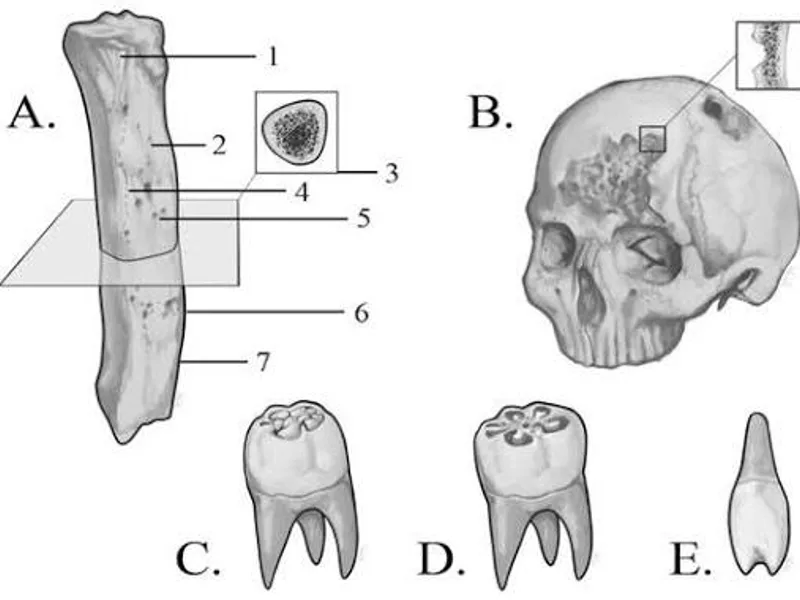
The international team examined 309 individuals from 16 archaeological sites across Vietnam, covering a period from 10,000 to 1,000 years before the present. Only three young children showed diagnostic signs of congenital treponematosis — distinctive dental abnormalities and skeletal lesions dating back at least 3,500 years.
Two of the three children came from a site called Man Bac in northern Vietnam. At Man Bac, dated to between 3,500 and 4,000 years ago, more than 10% of people buried showed evidence of treponemal disease written in their bones. That's a striking rate for any population.
The age distribution of infections at Man Bac was especially revealing. Most cases occurred among children and adolescents — a pattern more consistent with nonvenereal treponemal diseases that spread through skin contact rather than sexual activity.
So the population pattern said "yaws." But the children showed signs of mother-to-child transmission — something scientists had always associated with venereal syphilis. That contradiction is the crux of the discovery.
The Assumption Scientists Have Relied On for Decades
Lead researcher Dr. Melandri Vlok said that for decades, congenital infection in archaeological remains was often taken as strong evidence of venereal syphilis. Her team's research shows this assumption may not always hold true — other treponemal diseases may also have been transmitted from mother to child.
Think about what that means. Researchers around the world have been using this one diagnostic clue — mother-to-child transmission found in bones — to argue about whether syphilis predated Columbus, whether it existed in Europe before the 15th century, and where it originated. Now that clue is in question.
"Some cases previously labeled as congenital syphilis may represent entirely different diseases," Dr. Vlok explained.
This has obvious implications for how we understand the deep history of human illness. If you're interested in how diseases and conditions evolve over time, this discovery is one of the more significant finds of recent years.
The Bigger Debate: Where Did Syphilis Actually Come From?
The origin of syphilis has been argued over for centuries. One prominent theory holds that Christopher Columbus's sailors brought it back from the Americas to Europe in the 1490s, triggering a devastating epidemic that swept the continent. In spring 1495, the Italian campaign of Charles VIII of France was interrupted by an intense outbreak of an apparently unknown illness — a disease of high mortality that quickly engulfed the whole of Europe and left survivors with life-changing impairments.
The counter-theory says syphilis was already present in Europe before Columbus. Researchers on that side have pointed to pre-Columbian skeletal remains in Europe as evidence.
The new Vietnamese study complicates the Columbus debate further. Dr. Vlok argued that evidence of congenital cases is not reliable evidence of venereal syphilis over other types of treponema diseases, and that while new ancient DNA discoveries have found evidence of related bacteria in very old remains from the Americas as early as 5,500 years ago, these aren't actually syphilis — just close relatives in the same disease family.
Meanwhile, an ancient DNA analysis of a 5,500-year-old human skeleton from Colombia revealed that an ancestor of the bacterium that causes syphilis was present in the Americas thousands of years earlier than previously thought — diverging from today's lineages around 13,700 years ago.
The picture emerging is that this bacterial family is ancient, adaptable, and has been evolving alongside humans far longer than any textbook has suggested.
Why This Matters for Medicine Right Now
Here is where history stops being abstract. Syphilis cases have surged worldwide, leaving public health officials searching for ways to stop the spread. Understanding the full family of treponemal diseases — not just venereal syphilis — helps researchers develop better diagnostics, treatments, and potentially vaccines.
Yaws is a tropical disease that affects more than 150,000 people around the tropical world and can cause permanent disability. It is also re-emerging in some regions, partly linked to environmental changes. Dr. Vlok herself noted that yaws is resurfacing due to the climate crisis, which should concern anyone working in dermatology or infectious disease management.
If you or someone you know has skin lesions, joint pain, or symptoms that have gone undiagnosed, a general physician or dermatologist can help. These symptoms are general education only — a proper clinical examination is always necessary for diagnosis. Please consult a qualified doctor rather than self-diagnosing based on historical parallels.
The Ethical Side Researchers Are Grappling With
Co-lead author Minh Tran noted that in tropical environments, recovering ancient DNA is incredibly difficult, and destructive sampling raises important ethical questions. Future research must move in new directions, working in genuine partnership with communities connected to these remains, and considering preservation before any biomolecular work begins.
This is a conversation happening across bioarchaeology right now. The science is extraordinary — but the remains are people. Communities connected to those ancestors have a legitimate voice in how the research is conducted. That's not a small point, and it's good to see it named explicitly in the paper.
The Ancient DNA Problem in Tropical Climates
One frustrating constraint in this entire field: in tropical regions such as Southeast Asia, ancient DNA is often extremely poorly preserved, making it especially difficult to use genetic evidence to determine exactly which disease affected ancient populations.
This is why skeletal analysis — reading the bones themselves — remains so important. And it's also why misreading skeletal clues can send entire research streams in the wrong direction for decades.
What Happens Next in the Research
According to the researchers, the discovery demonstrates the remarkable adaptability of Treponema pallidum. Rather than concentrating only on determining where syphilis originated, future studies should examine how different treponemal diseases evolved alongside human populations, societies, and changing environments.
That's a mature and probably overdue shift in focus. The "Columbus debate" has dominated this field for so long that it may have crowded out equally important questions about how these diseases spread, who they affect most, and how climate and social change influence their reach. Whether you're a general physician thinking about infectious patterns, a pediatrician thinking about congenital infections, or a patient curious about skin conditions, the research pipeline feeding modern medicine starts in places like prehistoric Vietnam.
If you have questions about infectious diseases or STIs, don't hesitate to book a consultation with a verified specialist on Doctar. Early diagnosis matters — for syphilis in particular, the sooner it's identified and treated (with antibiotics, under a doctor's guidance), the better the outcomes. You can also search for hospitals with infectious disease units or explore diagnostic centres if testing is needed.