7 Intermittent Fasting Methods Compared: Which One Actually Fits Your Life?
"Intermittent fasting" isn't one single protocol — it's an umbrella term covering at least half a dozen distinct eating schedules, each with different fasting-to-eating ratios, difficulty levels, and evidence bases. Choosing the wrong one for your lifestyle is a leading reason people abandon fasting within the first few weeks.
This guide breaks down every major intermittent fasting method in detail, comparing their structure, pros and cons, who they suit best, and what the research says about each — so you can pick a schedule you can actually sustain, rather than one that just looks impressive online.
Table of Contents
16:8 Time-Restricted Eating
14:10 (The Beginner's Bridge)
5:2 Diet (The Fast Diet)
Alternate-Day Fasting (ADF)
Eat-Stop-Eat (24-Hour Fasts)
OMAD (One Meal a Day)
The Warrior Diet (20:4)
Crescendo Fasting
Side-by-Side Comparison Table
How to Choose the Right Method for Your Goals
Combining Methods and Progressing Over Time
Frequently Asked Questions
1. Why the Method You Choose Matters
All intermittent fasting approaches share the same underlying mechanism — extending the fasting window long enough to trigger metabolic switching, the shift from burning glucose to burning fat-derived ketones for energy. But how you get there matters enormously for real-world adherence. A protocol that produces dramatic results on paper is worthless if you abandon it after a week because it doesn't fit your job, family schedule, or social life.
Research and clinical experience consistently show that the "best" fasting method is the one a person can sustain consistently over months, not the most extreme one. With that in mind, here's a detailed breakdown of the major approaches, roughly ordered from easiest to most advanced.
2. 16:8 Time-Restricted Eating
Structure: Fast for 16 hours each day, eat all your meals within an 8-hour window (for example, noon to 8 p.m., or 9 a.m. to 5 p.m.).
This is by far the most popular and most researched intermittent fasting method, largely because much of the fasting window overlaps with sleep, making it far more manageable than it initially sounds. If you finish dinner at 8 p.m. and don't eat again until noon the next day, you've completed a 16-hour fast with minimal conscious effort during the overnight hours.
Pros:
Highly sustainable long-term; fits well into most daily routines
Substantial research base, including studies on metabolic and cardiovascular markers
Flexible eating window can be shifted earlier or later based on your schedule
Doesn't require extreme calorie restriction on any given day
Cons:
Best for: Beginners transitioning from a standard eating pattern; people wanting a sustainable, low-friction long-term approach.
3. 14:10 (The Beginner's Bridge)
Structure: Fast for 14 hours, eat within a 10-hour window.
This is essentially a gentler on-ramp to 16:8, and it's frequently recommended as the true starting point for anyone new to fasting, since it requires only modest adjustments to a typical eating schedule (skipping a late-night snack, for instance, is often enough).
Pros:
Very low barrier to entry
Minimal disruption to social eating patterns
Useful stepping stone toward more extended fasting windows
Cons:
Metabolic switching benefits may be less pronounced than longer fasting windows, since less time is spent in the fasted state
Weight-loss effects tend to be more modest compared to more restrictive protocols
Best for: Complete beginners, people with a history of disordered eating who want an extremely gentle entry point (under medical guidance), or anyone testing whether fasting suits their lifestyle before committing further.
4. 5:2 Diet (The Fast Diet)
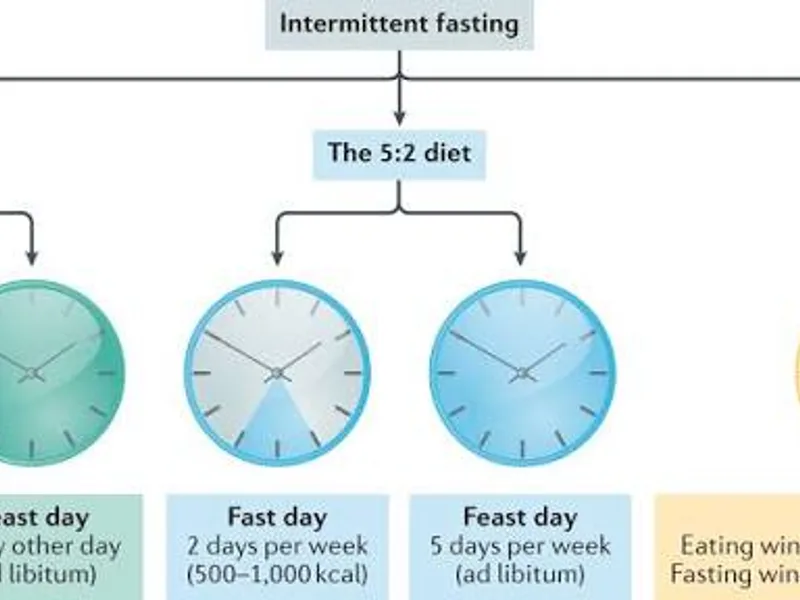
Structure: Eat normally five days a week; on two non-consecutive days, restrict intake to roughly 500–600 calories.
Unlike time-restricted eating methods, the 5:2 approach doesn't dictate daily eating windows — instead, it focuses on periodic, significant calorie reduction on select days while leaving the rest of the week largely unrestricted.
Pros:
Doesn't require daily fasting discipline — only two days per week
Can be easier to plan around work and social commitments since five days remain flexible
Reasonably well-studied for weight management outcomes
Cons:
The two low-calorie days can feel more intense than a daily time-restriction approach
Requires more deliberate meal planning for the restricted days
Some people find the "on-off" pattern harder to build into an automatic habit
Best for: People who prefer not to think about fasting daily and are comfortable with two more challenging days per week in exchange for five normal days.
5. Alternate-Day Fasting (ADF)
Structure: Alternate between a normal eating day and a fasting (or very low-calorie, typically around 500 calories) day, repeating every other day.
This is a considerably more intensive protocol than 16:8 or 5:2, since roughly half your days involve significant caloric restriction.
Pros:
Strong research base specifically for weight loss and some cardiometabolic markers
Clear, predictable structure (every other day) that some people find easier to follow than daily windows
Cons:
Physically and psychologically demanding, especially in the first few weeks
Higher risk of overeating on "feast" days if not managed carefully
Not recommended without medical supervision for anyone with underlying health conditions, including diabetes
Best for: People with fasting experience looking for a more aggressive approach to weight management, ideally under professional guidance.
6. Eat-Stop-Eat (24-Hour Fasts)
Structure: One or two full 24-hour fasts per week (for example, dinner to dinner the next day), with normal eating on all other days.
This method concentrates the "hard part" into a defined, complete day rather than spreading restriction across daily windows.
Pros:
Only requires planning around one or two days per week
Extended fasting duration may support more pronounced metabolic switching and, per some research, increased autophagy activity
Cons:
A full 24-hour fast is genuinely challenging, especially early on
Risk of overcompensating with excessive eating immediately after breaking the fast
Not appropriate for beginners without first building up fasting tolerance through shorter protocols
Best for: More experienced fasters comfortable with longer fasting windows, looking to add periodic deeper resets without daily restriction.
7. OMAD (One Meal a Day)
Structure: Consume all daily calories within roughly a 1-hour window, fasting for approximately 23 hours.
OMAD is one of the more extreme popular fasting protocols and essentially represents a very tight version of time-restricted eating.
Pros:
Simplifies meal planning to a single sitting
Some practitioners find one large, satisfying meal more psychologically manageable than multiple small restricted meals
Cons:
Difficult to consume adequate daily nutrients, protein, and calories in a single meal, particularly for active individuals
Higher risk of nutrient deficiencies if the single meal isn't carefully planned
Not recommended as a starting protocol; should be approached only after building tolerance with shorter fasting windows
Can strain digestion when consuming a large volume of food at once
Best for: Experienced intermittent fasters with a well-planned, nutrient-dense approach to their single meal — generally not recommended for beginners.
8. The Warrior Diet (20:4)
Structure: Fast (or eat very minimally — small amounts of raw fruits/vegetables) for 20 hours, then eat one large meal within a 4-hour evening window.
This method was one of the earlier popularized fasting approaches and draws loosely on the idea of eating patterns resembling ancient warrior cultures — eating lightly during active daytime hours and consuming the bulk of calories in the evening.
Pros:
Cons:
Eating a large meal close to bedtime doesn't suit everyone and can affect sleep quality for some people
More restrictive and harder to sustain long-term compared to 16:8
Limited amount of contemporary large-scale research specifically on this protocol compared to time-restricted eating generally
Best for: People who naturally have low daytime appetite and strong evening hunger, comfortable with a more restrictive structure.
9. Crescendo Fasting
Structure: Practice a fasting protocol (commonly 16:8) on only select days of the week — often 2 to 3 non-consecutive days — with normal eating on the remaining days.
This method was specifically developed with beginners and, in particular, women in mind, based on concerns that daily aggressive fasting can be more physiologically taxing for some individuals, particularly regarding hormonal balance.
Pros:
Gentler cumulative weekly restriction than daily 16:8
Allows the body more frequent recovery days
May be a good entry point for people concerned about fasting's effects on hormones or menstrual cycles
Cons:
Best for: Beginners, particularly those wanting a more conservative introduction, or people who've experienced fatigue or hormonal disruption with daily fasting.
10. Side-by-Side Comparison Table
Method | Fasting Window | Difficulty | Best For |
|---|
14:10 | 14 hrs | Easy | Complete beginners |
16:8 | 16 hrs | Easy–Moderate | Sustainable daily habit |
Crescendo Fasting | 16 hrs (2–3x/week) | Easy–Moderate | Beginners, hormone-sensitive individuals |
5:2 Diet | 2 low-cal days/week | Moderate | Flexible weekly structure |
Warrior Diet (20:4) | 20 hrs | Moderate–Hard | Evening-eaters |
Alternate-Day Fasting | Every other day | Hard | Experienced fasters, medically supervised |
Eat-Stop-Eat | 24 hrs, 1–2x/week | Hard | Experienced fasters |
OMAD | ~23 hrs | Hardest | Advanced, well-planned nutrition |
11. How to Choose the Right Method for Your Goals
If your main goal is sustainable, everyday fat management: 16:8 offers the best balance of evidence, flexibility, and manageability for most people.
If you dislike daily restriction: 5:2 lets you largely "forget about it" five days a week.
If you're extremely time-constrained and prefer simplicity: OMAD minimizes meal planning — but only pursue this after building fasting experience.
If you're new to fasting or concerned about hormonal effects: Start with 14:10 or crescendo fasting.
If you want to push metabolic switching further under guidance: Eat-Stop-Eat or alternate-day fasting, ideally with medical supervision, especially if you have any underlying health conditions.
12. Combining Methods and Progressing Over Time
Many experienced fasters don't stick rigidly to a single method — they progress through a gradual sequence. A common, sensible pathway looks like:
Weeks 1–2: 12:12, simply eliminating late-night snacking
Weeks 3–4: 14:10
Weeks 5–8: 16:8, the most common long-term maintenance approach
Beyond week 8 (optional): Occasional 24-hour fasts (Eat-Stop-Eat) once or twice a month for those wanting a more intensive periodic reset, always listening to how the body responds
This gradual approach reduces the shock to your system, minimizes the intense hunger and irritability that derail many people in their first week, and builds a habit that's realistic to maintain for months or years rather than days.
13. Frequently Asked Questions
Which intermittent fasting method is best for beginners? 14:10 or 16:8 are almost universally recommended starting points, since they require the least dramatic lifestyle disruption while still producing measurable metabolic effects.
Is OMAD better than 16:8 for weight loss? Not necessarily. While OMAD involves a longer fasting window, weight loss ultimately depends on total calorie balance and nutrient quality — 16:8 is often easier to sustain and, for many people, produces comparable long-term results with fewer risks of nutrient shortfalls.
Can I switch between fasting methods? Yes. Many people vary their approach — using 16:8 as a daily default and occasionally incorporating a 24-hour fast, for example. Flexibility, done thoughtfully, is generally fine.
Is alternate-day fasting safe long-term? It can be for some healthy adults, but it's more physically demanding than daily time-restricted eating and carries more risk for certain populations (people with diabetes, low body weight, or a history of disordered eating). Medical guidance is strongly recommended.
How do I know if a fasting method isn't right for me? Persistent dizziness, extreme fatigue, mood disturbances, disrupted sleep, or an unhealthy preoccupation with food are all signals to reassess your approach or method — and to consult a healthcare professional.
Do all fasting methods produce the same health benefits? Not exactly. Longer fasting windows are associated with more pronounced metabolic switching in current research, but the "best" method for actual health outcomes is strongly influenced by how consistently and sustainably a person can follow it.
Final Thoughts
There's no single "correct" way to practice intermittent fasting — only the method that fits your body, schedule, and goals well enough that you'll actually stick with it. Starting conservatively, listening to your body's signals, and progressing gradually will serve you far better than jumping straight into the most extreme protocol you've seen online. As always, check with a healthcare provider before beginning any new fasting regimen, especially if you have existing health conditions.
This article is for general informational purposes only and does not replace personalized medical advice.