A Report Built for Congress, But It Matters for Everyone
Every two years, the American Association for Cancer Research puts out a document meant to sit in front of lawmakers. The 2026 edition, released in June at a briefing on Capitol Hill, is the fourth in the series. It's dense, it's data-heavy, and honestly, most patients will never read it directly.
That's exactly why it's worth translating. The numbers in this report shape which cancer programs get funded, which communities get screening access, and which research questions get money next year. If you've ever wondered why cancer outcomes seem to vary so much depending on where someone lives or what community they're part of, this report is where a lot of that gets quantified.
The Genuinely Good News
Since 1991, the overall cancer death rate in the U.S. has fallen by 35%. That works out to more than 4.8 million fewer cancer deaths than would have happened if rates had stayed flat. More than 18.6 million people are now living as cancer survivors in the U.S.
Some of the disparity gaps have narrowed too, and by a meaningful amount. The difference in overall cancer mortality between Black and white populations shrank from 34% higher among Black individuals in 1991 to 9% higher in 2024. Lung cancer mortality tells an even more striking story: in 1991, Black individuals had a 23% higher lung cancer death rate than white individuals. By 2024, that had flipped, with the rate running about 4% lower.
Cervical cancer disparities between Hispanic and white women dropped from 70% higher in 2000 to 10% higher in 2024. Stomach cancer mortality gaps between Asian or Pacific Islander and white populations narrowed too, though they remain wide, from 150% higher in 2000 to 81% higher in 2024.
Where Progress Hasn't Reached
Here's where it gets harder to read. Black and American Indian or Alaska Native individuals still have the highest overall cancer death rates of any racial or ethnic group in the country. That's true even after decades of overall progress.
Geography matters more than most people assume. Rural county residents are 17% more likely to be diagnosed with colorectal cancer and 27% more likely to die from it compared with people in metropolitan areas. In clinical practice, this is often underestimated because rural patients frequently travel hours for a specialist visit or a colonoscopy, and that distance alone changes whether someone gets screened at all, not just whether they can afford it.
The report also flags a detail that doesn't get much media coverage: lesbian women face nearly double the incidence rates of thyroid cancer and non-Hodgkin lymphoma compared with heterosexual women. And cervical cancer death rates run 49% higher among women in persistent-poverty counties. These aren't small statistical blips. They're patterns that have held steady enough to make it into a national report meant for Congress.
Why These Gaps Exist in the First Place
The report doesn't pin this on one cause, and that's worth taking seriously rather than skipping past. Structural inequities, things like housing, income, education, and proximity to environmental hazards, shape who gets screened early and who doesn't. In 2023, breast, cervical, and colorectal cancer screening rates were all lower among people without a regular source of care or without a recent wellness visit.
Clinical trial access is part of the picture too. In 2022, more than 70% of U.S. counties had no active cancer clinical trials running at all. In nonmetropolitan counties specifically, that number climbed to 86%. If a new therapy is only tested in a narrow slice of the population, doctors genuinely don't know how well it'll work for everyone else, which is its own quiet driver of disparity down the road.
What's Actually Working
A few interventions in the report stand out because they have real numbers behind them, not just good intentions. A community-based physical activity program for underserved cancer survivors raised the share meeting activity recommendations from 29% to 60%. A multilingual patient navigation program at safety-net clinics raised treatment completion rates from 78% to 92%.
Medicaid expansion under the Affordable Care Act was linked to better access to surgery and improved survival for pancreatic cancer patients specifically. These aren't abstract policy wins. They're the kind of programs that determine whether a specific patient actually finishes their treatment.
A New Concern: Funding Cuts Are Already Showing Up in the Data
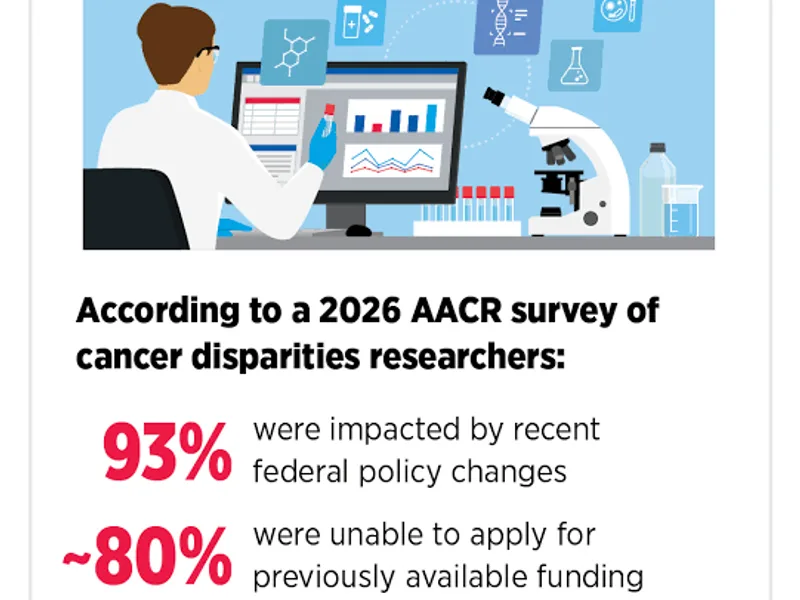
This is the part of the report that reads less like a progress update and more like a warning. In an AACR survey of cancer disparities researchers, 93% said recent federal policy changes had affected their work directly. More than half reported reduced or lost grant funding, and 56% said they've partially shifted away from disparities-focused research or are seriously considering it.
That matters because disparities research isn't a side project. It's the reason we know rural colorectal cancer death rates are 27% higher, or that lesbian women face elevated thyroid cancer risk. If that research pipeline slows down, the next progress report may have fewer answers, not more.