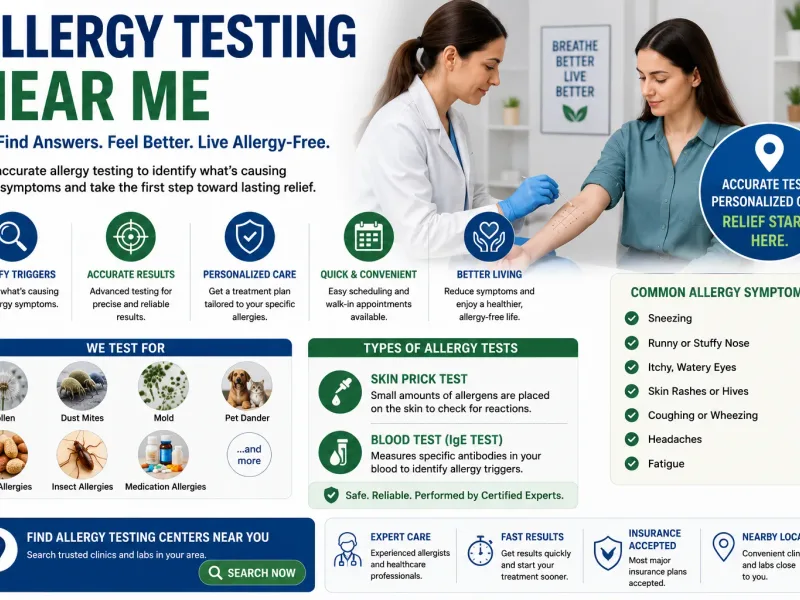
Why do people get allergy testing?
Allergy testing is generally used when a healthcare professional suspects that a person's symptoms may be caused by an allergic reaction. Common concerns include repeated sneezing, itchy or watery eyes, wheezing, hives, certain food reactions or symptoms that repeatedly appear after exposure to a particular substance.
Common allergens include pollen, house-dust mites, mould, animal dander and certain foods. Doctar's guide to [morning allergy symptoms] Why Allergy Symptoms Strike in the Morning explains how dust mites, pollen, mould and other exposures can produce recurring symptoms.
But not every runny nose or rash is an allergy. Viral infections, irritants, skin disorders and other medical conditions can produce similar symptoms. That is why the test result should be interpreted alongside the person's history.
What happens during an allergy test?
The two commonly discussed approaches are skin testing and blood testing.
A skin prick test places small amounts of selected allergens on the skin, usually the forearm or back. The skin is then gently pricked, and the clinician checks for a local reaction after a short period.
A specific IgE blood test measures antibodies associated with allergic sensitisation to particular allergens. It can be useful when skin testing is not suitable or when a doctor wants blood-based testing.
Neither test should be interpreted as a simple yes-or-no answer to every allergy question. A positive test may show sensitisation, meaning the immune system reacts to an allergen, but it does not automatically prove that the allergen causes a person's symptoms.
Doctar's article about the [diagnosis of food allergies] Food Allergy Diagnosis and Testing discusses medical history, skin prick testing, specific IgE blood testing and supervised food challenges.
Skin prick testing vs blood testing
Neither test is automatically “better.” The appropriate choice depends on the patient and the clinical question.
Skin testing can provide results relatively quickly and can assess several suspected allergens during one appointment. Blood testing can be useful when skin testing is difficult or when certain medicines or skin conditions interfere with the procedure.
A doctor may also choose different tests for different suspected allergies. For example, someone with seasonal sneezing may need assessment for airborne allergens, while someone with repeated symptoms after eating a particular food may require a different evaluation.
Doctar's [pollen-count guide] Understanding Pollen Count and Allergy Management explains why identifying environmental triggers can be useful when symptoms follow seasonal or outdoor exposure.
Don't order a huge allergy panel without medical advice
Large allergy panels can look attractive because they promise to test dozens or hundreds of possible triggers. More information, however, does not always mean a better diagnosis.
Testing allergens that have no connection with a person's symptoms can produce confusing results. A person may then unnecessarily avoid foods, change their lifestyle or become worried about an allergy that has never actually caused a reaction.
In clinical practice, this is often missed because patients understandably assume that the longest test report must be the most accurate one. The useful test is the one that helps answer the patient's actual clinical question.
When should you see an allergist?
An allergist or immunologist is trained to evaluate allergic and immune-system conditions. This can be particularly useful when symptoms are recurrent, severe, difficult to explain or affecting several parts of the body.
Doctar's [allergist and immunologist search] Find Allergists and Immunologists on Doctar can help users explore specialist care by location. Doctar's hospital directory also includes Allergist/Immunologist and Clinical Immunologist among its searchable specialties.
For children, specialist paediatric allergy care can be especially relevant. Doctar lists [Dr. Major K Nagaraju] Dr. Major K Nagaraju, Pediatrician and Allergist/Immunologist, whose profile identifies him as a paediatrician and allergist/immunologist and lists a Diploma in Allergy Asthma and Immunology.
Allergy testing for food reactions
Food allergy testing needs particular care because food reactions can be complicated. A person may report bloating, headache or stomach discomfort after eating a food, but those symptoms do not automatically prove a food allergy.
A true food allergy involves an immune response to a food protein. Depending on the history, an allergist may consider specific IgE testing, skin testing or, in selected circumstances, a medically supervised oral food challenge.
Doctar's [food-allergy and eczema guide] Eczema and Food Allergy: Understanding the Connection explains why eczema and food allergies can overlap in some patients, while also showing why the relationship needs careful assessment.
Do not perform a food challenge at home if a serious allergy is suspected. A severe reaction can develop quickly and requires medical supervision.
Allergy testing for skin problems
Repeated hives, itching, eczema or unexplained rashes may lead people to search for an allergy test. But skin symptoms have many possible causes.
A dermatologist may be involved when the main problem is a persistent rash, eczema or another skin condition. Doctar's [guide to rashes] Rashes: Causes, Symptoms, Diagnosis and Treatment explains that rashes can arise from allergies, infections, autoimmune conditions and other causes.
Doctar also discusses [dermatologist fees and allergy testing] Dermatologist Fee in Kolkata, noting that allergy testing can be an additional investigation when clinically indicated.
What about nasal allergies?
Allergic rhinitis can cause repeated sneezing, nasal itching, congestion, runny nose and watery eyes. Common triggers include pollen, dust mites, mould and pet dander.
If your symptoms appear at particular times of year or in certain environments, telling the doctor exactly when they occur can be surprisingly helpful. A symptom diary may reveal a pattern that a broad test panel would not.
Doctar's article on [hay fever nasal sprays] Hay Fever and Allergy Nasal Sprays explains common allergic-rhinitis symptoms and environmental triggers.
The platform also covers [allergic rhinitis and IBS] Allergic Rhinitis and IBS, including the role of medical history and allergy testing when appropriate.
When an ENT or pulmonologist may be involved
Not every allergy problem starts with an allergist. If the main complaint is persistent nasal blockage, sinus symptoms or throat problems, an ENT specialist may be appropriate.
Doctar lists [Dr. Vijay Sonawane in Pune] Dr. Vijay Sonawane, ENT Specialist in Pune, an ENT specialist with experience in ENT care.
For Bangalore patients, Doctar lists [Dr. Radhika Thappeta] Dr. Radhika Thappeta, ENT Specialist in Bangalore. Her profile includes ENT care and questions related to chronic sinusitis and nasal allergies.
Mumbai patients can explore [Dr. Pethe Neeraja Sanjeev] Dr. Pethe Neeraja Sanjeev, ENT Specialist in Mumbai or [Dr. Ritu Sheth] Dr. Ritu Sheth, ENT Specialist in Mumbai.
If allergies are linked with wheezing, asthma or other respiratory symptoms, a pulmonologist may also be involved. Doctar lists [Dr. Nagesh Dhadge in Pune] Dr. Nagesh Dhadge, Pulmonologist in Pune, whose profile specifically includes allergy testing alongside respiratory care.
How to find an allergy testing centre near you
A diagnostic centre may perform the laboratory part of an allergy evaluation, but the test should ideally be selected and interpreted in the context of medical care.
Doctar's [diagnostic centre search] Diagnostic Centres Near Me lets users search diagnostic facilities by location and test type. The platform says its directory includes filters such as accreditation, home sample collection and availability.
You can also browse [hospitals across India] Find Hospitals Across India when a hospital-based allergy or immunology service is more appropriate.
In some cities, Doctar's local healthcare directories can help narrow the search. For example, its [Jodhpur hospital directory] Hospitals in Jodhpur and [Nagpur healthcare directory] Healthcare Providers in Nagpur show the range of specialist categories available locally, including allergy/immunology services.
What should you take to the appointment?
Bring a clear description of what happens when symptoms appear. Mention the suspected food, medicine, insect sting, season, workplace, pet or other exposure if you have noticed a pattern.
Previous test reports can also help. If you have photographs of hives or swelling that disappeared before your appointment, keep them available for the doctor.
For children, parents should note when symptoms began, what the child had eaten or been exposed to, and whether the reaction has happened more than once.
When an allergic reaction is an emergency
Allergy testing is not appropriate during a severe acute reaction. Difficulty breathing, throat or tongue swelling, fainting, severe dizziness or symptoms affecting several body systems can indicate a serious allergic reaction.
Such symptoms require urgent medical care. Do not wait for an allergy appointment or laboratory test.
Doctar's article on [angioedema and anaphylaxis] Angioedema vs. Anaphylaxis explains why swelling involving the face, lips or throat, particularly with breathing difficulty, needs prompt medical attention.
What happens after the test?
A test result is only one part of the diagnosis. The next step may be avoiding a confirmed trigger, treating symptoms, considering allergy immunotherapy or investigating another cause if the results do not match the clinical history.
For selected allergic conditions, immunotherapy may be considered. Doctar's [immunotherapy guide for eczema] Understanding Immunotherapy for Eczema discusses allergy shots and why treatment decisions should be made by a healthcare professional.
For severe allergic conditions, Doctar also covers [biologic treatment for allergic rhinitis] Biologics for Allergic Rhinitis and [Xolair and allergic conditions] Xolair (Omalizumab) Guide. These are specialist treatments and are not appropriate for everyone.