What Is Yaws, and Why Does It Matter Now?
Most people have heard of syphilis. Very few have heard of yaws — and that gap in public awareness is part of the problem.
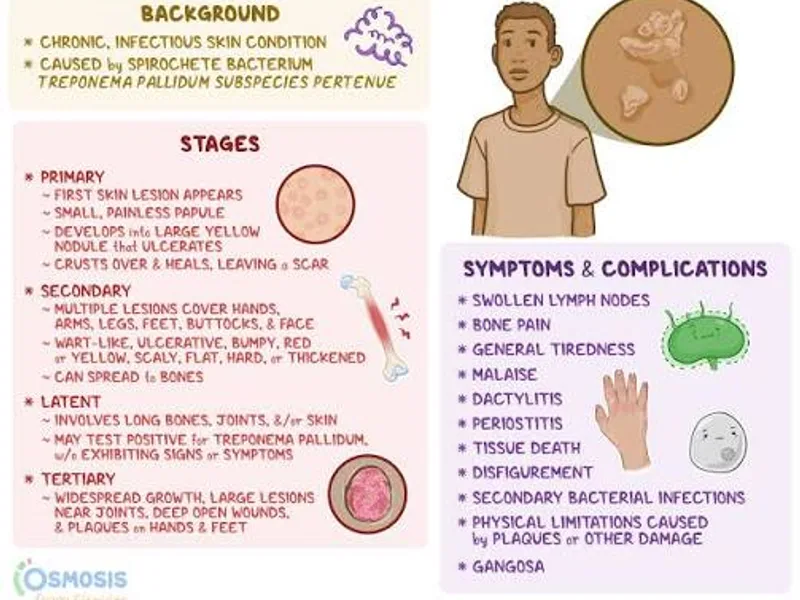
Yaws is an infectious disease caused by Treponema pallidum pertenue, a bacterium that closely resembles the one that causes syphilis. It spreads through direct skin-to-skin contact in humid tropical regions and causes disfiguring, sometimes painful lesions of the skin and bones. It is not sexually transmitted. Children are the primary victims, particularly those living in poor, remote communities.
Yaws primarily affects children under 15 years of age in poor and remote communities of tropical and subtropical regions — and it is making a comeback. The World Health Organization has reported a rise in cases of this neglected tropical disease.
In clinical practice, this is often missed because yaws is frequently confused with other skin conditions — fungal infections, eczema, or even insect bites — especially in regions where doctors may not encounter it regularly. If you or your child has persistent skin lesions that aren't responding to routine treatment, consulting a dermatologist or a general physician with experience in tropical diseases is the right step. This article is general education — please see a qualified doctor for any medical concern.
The Study: What the Bones Revealed
The study identified three children whose teeth and bones show clear signs of congenital treponematosis — a group of diseases that includes syphilis, yaws, and endemic syphilis. However, the broader pattern of disease in the population suggests the infection was not venereal syphilis.
The children's remains, taken from the Man Bac site in northern Vietnam and An Son in southern Vietnam, dated to around 4,100 to 3,300 years ago, had distinctive dental abnormalities and skeletal lesions, indicating the disease may have been congenital yaws, and not syphilis.
So what exactly are these "dental stigmata" the researchers found? When a developing baby is infected in the womb, it can cause abnormalities in the teeth that are visible even thousands of years later — notched or barrel-shaped incisors, abnormal molars. These, combined with characteristic lesions on the long bones of the limbs, are the diagnostic fingerprints that researchers look for. Finding them in three children from two different archaeological sites across Vietnam is significant.
The study looked at 309 individuals from 16 archaeological sites in Vietnam covering a period from 10,000 to 1,000 years ago. Only three children showed clear signs of congenital infection, including specific dental defects and bone damage dating back at least 3,500 years.
The Assumption That Just Got Challenged
Here is where the story becomes genuinely important for medical research, not just archaeology.
Researchers have for decades believed that of these treponemal diseases, only syphilis could be transmitted congenitally — meaning from mother to child — lending to the assumption that syphilis began with Christopher Columbus' voyages. That single assumption has anchored one of the longest-running debates in medical history.
The Columbus theory holds that his sailors brought syphilis back from the Americas to Europe in the 1490s, sparking a devastating continental epidemic. Critics of the theory have argued that syphilis must have existed in Europe before Columbus — but they relied on evidence of congenital infection in ancient European skeletons to make that case.
The new findings demonstrate that congenital infection in ancient remains does not exclusively indicate venereal syphilis, challenging previous assumptions in paleopathology. Paleopathology is the study of disease in ancient human remains — a field that just had its rulebook rewritten.
What Makes Yaws Different From Syphilis?
These two diseases come from the same bacterial family but behave very differently. Yaws is a non-venereal tropical infectious disease caused by Treponema pertenue, closely related to the syphilitic spirochete Treponema pallidum. It is most commonly seen among children in tropical regions and spreads by skin-to-skin contact.
Syphilis, by contrast, is sexually transmitted and can also cross the placenta to infect an unborn baby. That placental transmission — called congenital infection — was always considered yaws's one clear distinction from syphilis: it wasn't supposed to do that.
The Vietnamese bones suggest it might. That's the surprising part.
Yaws progresses through clinical stages. In the primary stage, patients develop a papilloma or ulcer, usually painless, often on the lower extremities, that is highly contagious. If untreated, this lesion heals on its own but may progress to secondary yaws, characterised by disseminated skin lesions, scaly papules, and painful changes to the skin. Untreated late-stage yaws can cause permanent damage to bones and joints — damage that, as this study shows, can still be read in a skeleton 3,500 years later.
Parents who notice unusual skin lesions or bone pain in their children should consult a dermatologist or general physician promptly. You can also search for verified children's health specialists on Doctar or access diagnostic services for testing if recommended by your doctor.
Yaws Was Almost Gone — Then It Came Back
This is where the story stops being purely historical and starts being an active public health concern.
In the 1950s, more than 50 million people worldwide were afflicted by yaws until WHO, in partnership with UNICEF, established a massive global control programme. The Global Yaws Control Programme, fully operational between 1952 and 1964, succeeded in treating 300 million people in 50 countries — reducing global levels of the disease by more than 95%. However, after the programme's enormous success, sustained surveillance diminished, which has given way to its resurgence in the 21st century.
As of 2023, 16 countries were considered endemic for yaws, and 82 countries, areas, and territories were considered previously endemic with current status unknown. India has historically been in the at-risk category, though eradication campaigns have made significant progress. The concern today is that weakened surveillance and climate-linked environmental changes are creating conditions for the disease to re-establish itself.
Dr. Vlok herself noted that understanding the complexity of treponemal diseases is essential, especially as diseases like yaws are re-emerging due to the climate crisis.
If you live in or have recently visited a tropical or subtropical region and develop unexplained skin lesions — particularly on the legs or feet — do not ignore them. A general physician can refer you for the right tests. Skin specialists and infectious disease-aware doctors are available across India through platforms like Doctar. For serious skin conditions requiring advanced care, checking available hospitals with relevant specialisations is a practical first step.
Treatment: The Good News
The good news is that yaws is treatable. A single oral dose of azithromycin is the recommended treatment for yaws, according to WHO guidelines, and health education alongside improved personal hygiene are the most important tactics for prevention.
Treatment specifics — dosage, duration, suitability for children or pregnant women — must be determined by a qualified doctor. Do not self-medicate. You can access a pharmacy through Doctar for prescribed medications and consult a general physician for a proper assessment first. If you need a home visit doctor for a child who cannot easily travel, that option is available too.
Why Ethical Research Matters Here
The researchers emphasised that future work must move in new directions, working in genuine partnership with communities connected to ancient remains, and considering preservation before any biomolecular work begins.
This matters beyond archaeology. When communities trust researchers — when the science is done with respect, not just on a population — the resulting knowledge is more durable, more credible, and more useful for public health. The same principle applies in modern medicine: transparent, patient-centred care builds better health outcomes. Doctar connects patients with verified doctors whose credentials and reviews are visible before you book — that same transparency at the point of care.