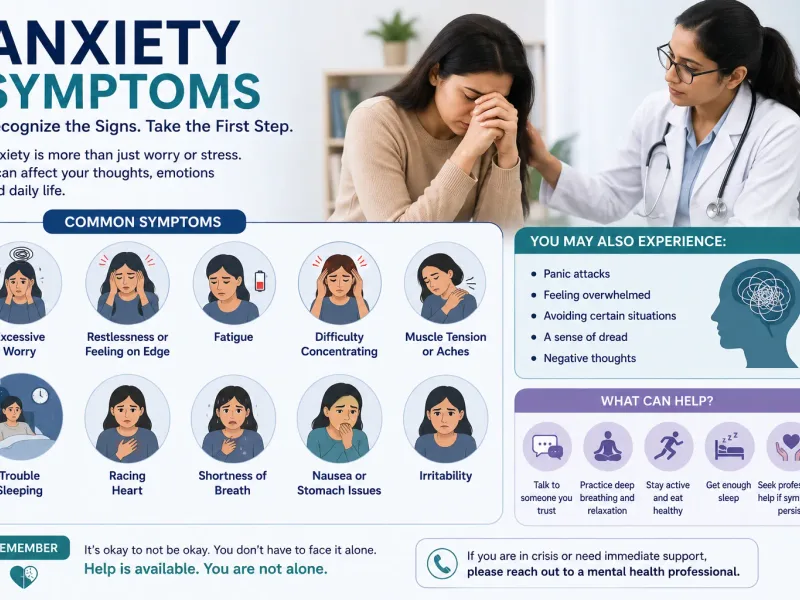
Anxiety symptoms are the mind and body's response to perceived threat or stress — but in anxiety disorders, they occur persistently, feel uncontrollable, and interfere significantly with daily life. The most common symptoms include excessive, hard-to-control worry, rapid heartbeat, muscle tension, sleep disturbance, and difficulty concentrating. When these symptoms are severe or long-lasting, they typically indicate an anxiety disorder — a group of conditions that are the most prevalent mental health disorders in the world, affecting more than 284 million people globally according to the World Health Organization.
Stress is a normal, time-limited response to an external pressure — a deadline, a difficult conversation, a health scare. Anxiety is different in two key ways: it often persists even when there is no clear trigger, and the worry tends to be disproportionate to the actual situation.
The American Psychological Association defines anxiety as "an emotion characterized by feelings of tension, worried thoughts, and physical changes like increased blood pressure." What distinguishes clinical anxiety from ordinary worry is persistence (lasting weeks or months), intensity (severe enough to feel unmanageable), and functional impairment (limiting work, relationships, or daily activities), according to the Diagnostic and Statistical Manual of Mental Disorders, 5th edition (DSM-5), published by the American Psychiatric Association.
Someone anxious about a real, upcoming event is experiencing normal anxiety. Someone who worries most days about many different things — health, money, family, safety — even when there is little objective reason to, and who cannot stop the worry despite trying, may have generalized anxiety disorder.
Anxiety's psychological symptoms are often the first to be noticed — though they can be easy to dismiss as ordinary stress or personal weakness. According to the Mayo Clinic and the National Institute of Mental Health (NIMH), mental symptoms of anxiety include:
Excessive, persistent worry about everyday events, often out of proportion to the actual risk
Difficulty controlling the worry — feeling unable to "switch off" anxious thoughts
Restlessness — a feeling of being keyed up, on edge, or unable to relax
Difficulty concentrating — the mind going blank or thoughts being easily interrupted by worry
Irritability — a lower threshold for frustration or anger, often linked to the exhausting nature of persistent anxiety
Feeling of impending doom or dread — a sense that something bad is about to happen, even without a specific threat
Avoidance behavior — deliberately steering clear of people, places, or situations that trigger anxiety
This pattern of worry is often described by people with anxiety as feeling like a radio that cannot be turned off. The content of the worry shifts — from work to relationships to health to finances — but the state of high alert persists.
Physical Symptoms of Anxiety
Anxiety is not purely a mental experience. The body's stress response — the "fight or flight" system — is powerfully activated by anxiety, producing a wide range of physical symptoms that can be just as disabling as the psychological ones.
The NIMH and Mayo Clinic both identify the following physical symptoms as common in anxiety disorders:
Rapid or pounding heartbeat (palpitations) — the heart responds to perceived danger by beating faster to pump more blood to muscles
Shortness of breath or feeling of chest tightness
Muscle tension, aching, or soreness — particularly in the neck, shoulders, jaw, and back
Sweating or trembling/shaking
Dizziness or lightheadedness
Gastrointestinal symptoms — nausea, stomach cramps, diarrhea, or irritable bowel symptoms
Frequent urination
Headaches
Fatigue — often severe, resulting from the physical toll of sustained high alertness
Sleep disturbance — difficulty falling asleep, staying asleep, or waking unrefreshed
Many people with anxiety first present to their primary care physician with physical complaints — heart palpitations, gastrointestinal problems, or chronic headaches — without immediately connecting them to anxiety. Anxiety-driven physical symptoms can closely resemble other medical conditions, which is one reason anxiety is frequently underdiagnosed or misdiagnosed.
[REVIEWER: add clinical insight here — e.g., from a psychiatrist or primary care physician's perspective, how physical anxiety symptoms are distinguished from cardiac, gastrointestinal, or thyroid conditions in the clinical encounter, and what work-up is typically performed to rule out medical causes before a primary anxiety diagnosis is made]
Types of Anxiety Disorders and Their Signature Symptoms
Anxiety is not a single condition. The DSM-5 recognizes several distinct anxiety disorders, each with its own characteristic symptom pattern.
Generalized Anxiety Disorder (GAD)
GAD is characterized by excessive, difficult-to-control worry about multiple areas of life — work, relationships, health, money, safety — on more days than not for at least six months. Physical symptoms including fatigue, muscle tension, and sleep disturbance are common accompaniments.
Panic Disorder
Panic disorder involves recurrent, unexpected panic attacks — sudden surges of intense fear that peak within minutes. During a panic attack, symptoms typically include racing heart, shortness of breath, chest pain, dizziness, tingling, and a terrifying sense of losing control or dying. Many people with panic disorder go to emergency rooms believing they are having a heart attack, according to the Mayo Clinic.
Social Anxiety Disorder
Social anxiety disorder (formerly called social phobia) involves intense fear of social or performance situations, driven by worry about humiliation, embarrassment, or judgment by others. The fear is disproportionate to the actual risk and leads to significant avoidance.
Specific Phobia
A specific phobia is an intense, irrational fear of a particular object or situation — heights, flying, needles, spiders, blood — that provokes immediate anxiety and is actively avoided, according to the DSM-5.
Separation Anxiety Disorder
Originally considered a childhood condition, separation anxiety disorder is now recognized in adults as well. It involves excessive fear or worry about separation from major attachment figures.
Agoraphobia
Agoraphobia is anxiety about situations in which escape might be difficult or help unavailable during a panic attack — such as being in crowds, on public transport, or outside the home alone. It frequently develops as a complication of panic disorder.
What Causes Anxiety?
Anxiety disorders do not have a single cause. Research consistently points to an interplay of biological, psychological, and environmental factors, according to the NIMH.
Biological factors include genetic predisposition — anxiety disorders run in families — and differences in brain chemistry, particularly in systems involving serotonin, norepinephrine, and gamma-aminobutyric acid (GABA), a neurotransmitter that helps regulate excitability in the nervous system.
Psychological factors include temperament and learned patterns of thinking. People who are naturally more sensitive to stress, who tend toward negative interpretation of uncertain situations, or who have experienced trauma are at elevated risk.
Environmental and life factors include chronic stress (financial difficulty, relationship problems, demanding work), childhood adversity, significant life changes, and medical illness. Certain medical conditions — including thyroid disorders, cardiovascular disease, and chronic pain — can either cause or worsen anxiety symptoms.
Substance use can also trigger or amplify anxiety. Caffeine, alcohol, cannabis, and a range of medications — including some used for asthma, decongestants, and certain weight-loss drugs — can produce or worsen anxiety symptoms, according to the Mayo Clinic.
When Anxiety Symptoms Require Medical Attention
Not every episode of worry or nervousness needs clinical intervention. But certain patterns should prompt a conversation with a healthcare provider, according to the NIMH and the Anxiety and Depression Association of America (ADAA):
Worry or fear that is present most days and feels impossible to control
Physical symptoms — particularly rapid heart rate, chest tightness, or breathing difficulty — that are new, severe, or unexplained
Avoidance of work, social situations, or activities that were previously manageable
Symptoms that have persisted for six weeks or more
Use of alcohol or other substances to manage anxiety
Thoughts of self-harm
Anxiety disorders respond well to treatment. Evidence-based approaches include cognitive behavioral therapy (CBT) — consistently shown in randomized trials to be one of the most effective treatments — and medications including SSRIs, SNRIs, and in specific circumstances benzodiazepines, according to clinical practice guidelines from the American Psychological Association and NIMH. Many people benefit from a combination of therapy and medication, particularly for moderate to severe anxiety.
[REVIEWER: add clinical insight here — e.g., from a clinician's perspective, how the initial assessment of a patient presenting with anxiety symptoms proceeds — what questions are most diagnostically useful, how quickly patients typically respond to first-line treatments, and what factors predict a more complicated course]
FAQ
What are the most common symptoms of anxiety? The most common anxiety symptoms are excessive, hard-to-control worry, restlessness, difficulty concentrating, irritability, muscle tension, sleep problems, and fatigue. Physical symptoms are also frequent and include rapid heartbeat, shortness of breath, sweating, gastrointestinal upset, and dizziness. These symptoms must be persistent and significantly interfere with daily life to meet the criteria for an anxiety disorder, according to the DSM-5.
How do you know if your anxiety is a disorder? Anxiety becomes a disorder when worry feels uncontrollable, is out of proportion to the actual situation, occurs most days, lasts for weeks or months, and meaningfully interferes with work, relationships, or daily activities. The DSM-5 criteria for generalized anxiety disorder, for example, require at least six months of excessive worry across multiple areas, accompanied by at least three associated symptoms such as fatigue, muscle tension, or sleep disturbance.
Can anxiety cause physical symptoms? Yes. Anxiety activates the body's stress response, producing very real physical symptoms including rapid heartbeat, chest tightness, shortness of breath, muscle tension, gastrointestinal symptoms, headaches, dizziness, and fatigue. These physical symptoms are not imagined — they reflect genuine physiological changes. Many people with anxiety first seek medical attention for physical complaints rather than for worry itself.
What triggers anxiety symptoms? Common triggers include stressful life events (job loss, relationship problems, health concerns), certain medical conditions (thyroid disorders, heart conditions), caffeine and alcohol, sleep deprivation, and traumatic or adverse experiences. For people with anxiety disorders, however, symptoms may occur without a clear external trigger or in response to situations that others would find only mildly stressful. Identifying personal triggers is often an important part of anxiety treatment.
What is the difference between a panic attack and an anxiety attack? Panic attacks are a defined clinical event: sudden, intense surges of fear with characteristic physical symptoms (rapid heart rate, chest pain, shortness of breath, dizziness) that peak within minutes and then subside. "Anxiety attacks" is a colloquial term — not a formal DSM diagnosis — typically used to describe a build-up of anxiety rather than the sudden onset of a panic attack. Panic attacks can occur in panic disorder, other anxiety disorders, and sometimes without any underlying disorder.