

Emergency & Help
24/7 Emergency & General Advisory
🚨 24/7 Medical Emergency
Non-Emergency Advisory
10:00 AM – 6:00 PM, Mon–Sat
For appointments & general queries.
24/7 Emergency & General Advisory
🚨 24/7 Medical Emergency
Non-Emergency Advisory
10:00 AM – 6:00 PM, Mon–Sat
For appointments & general queries.
When U.S. Representative Alexandria Ocasio-Cortez publicly shared that she was beginning the egg-freezing process at 36, millions of women started asking the same questions. What does it actually involve? How much does it cost? And does it work?
When Rep. Alexandria Ocasio-Cortez posted an Instagram video of herself injecting fertility hormones into her stomach before a live national television interview, it stopped a lot of people mid-scroll. "Women can do anything," she said, pulling back her shirt and self-administering the shot in a green room before appearing on ABC's This Week. Just like that, a medical procedure most people have only heard of in passing became a dinner table conversation.
The 36-year-old congresswoman said she made the decision to undergo the fertility procedure to "feel more in control of my life." Whether you agree with her politics or not, her candour opened a door that many women have been quietly standing outside of for years.
So here is what the procedure actually involves, what it costs, and what the science genuinely says about whether it works.
Egg freezing, known medically as oocyte cryopreservation (think: preserving your eggs by freezing them), is a process where a woman's eggs are extracted from her ovaries, frozen, and stored for potential future use. Since the first successful pregnancy using previously cryopreserved oocytes in 1986, the procedure has become increasingly utilised both for medical reasons (such as preserving fertility before cancer treatment) and electively, to delay age-related fertility decline.
The reason more women are turning to it now is straightforward: eggs age along with the rest of the body. A woman's egg quality and quantity decline with time, and that decline becomes significantly faster after the mid-thirties. Freezing eggs earlier preserves a biological snapshot of that moment.
If you've ever spoken to a about your fertility options, you may have heard about this process already. If not, it's worth knowing what you're actually signing up for before making any decisions.
The process isn't a single appointment. It takes weeks and involves daily hormone injections, regular monitoring, and a minor surgical procedure.
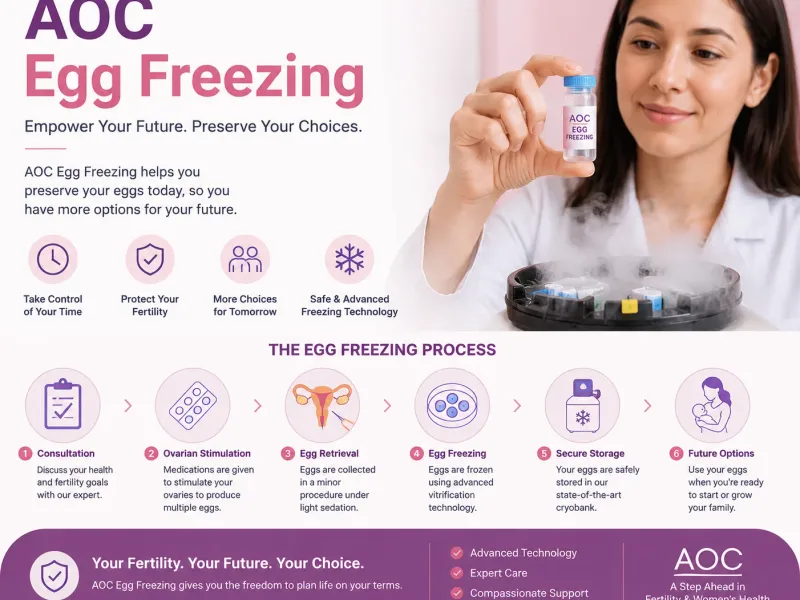
A typical treatment cycle takes about 10 to 14 days for most patients, although the full process — beginning with the initial consultation — can take considerably longer. The first phase involves injectable hormonal medications called gonadotropins, which stimulate the ovaries to produce multiple eggs in a single cycle rather than the usual one. During this period, a woman visits the clinic frequently — often every other day — for ultrasound monitoring and blood tests to track how the ovaries are responding.
Once the eggs are mature, a trigger injection is given, and roughly 36 hours later, the egg retrieval takes place. The eggs are collected during a procedure known as vaginal oocyte aspiration, performed under sedation. It's brief — usually 20 to 30 minutes — but it is a clinical procedure, not a simple blood draw. The retrieved eggs are then rapidly frozen using a technique called vitrification (ultra-fast freezing that prevents ice crystal damage) and stored.
In clinical practice, what often surprises patients is how physically and emotionally demanding the hormone phase can be. Bloating, mood swings, and fatigue are common, and the monitoring schedule can be genuinely disruptive to work and daily life. It's rarely talked about in the brochures.
You can search for fertility specialists and gynaecologists through Doctar to discuss your individual situation before beginning any treatment.
This is the question that doesn't get a satisfying answer, because the honest answer is: it depends.
As a rough guide based on scientific studies, fertility specialists may discuss banking approximately 15 to 20 mature eggs for patients younger than 35. But there is no "magic number" that fits everyone. Age at freezing has a major influence, because a lower proportion of eggs are expected to be chromosomally normal as age increases — meaning not every retrieved egg will ultimately lead to a viable embryo or pregnancy.
Not all frozen eggs survive the thaw either. Typically 80 to 90 percent of mature eggs survive the cryopreservation and thawing process, but not all will go on to fertilise or develop into viable embryos. A successful pregnancy is never guaranteed, and this is a point fertility clinics don't always emphasise clearly enough.
AOC is 36, which puts her at an age where the decline in egg quality and quantity becomes significantly more rapid after 37, according to fertility specialists. She hasn't disclosed how many cycles she plans to complete, or her specific medical situation — nor should she have to.
For personalised guidance, speak to a who can run tests like an AMH (anti-Müllerian hormone) level — a blood marker that gives an indication of your ovarian reserve.
Money is usually where the conversation stalls, because the costs are significant and highly variable.
The most recent peer-reviewed US figure is "around $12,000" per cycle in 2023 dollars. One estimate placed the full chain — retrieval cycle, annual storage, thaw, fertilisation, and transfer — at well over $18,000 in older prices. Storage fees add up over years, and annual storage runs roughly $500 to $1,000.
Medications are usually billed separately and can add thousands more, depending on how your body responds to stimulation. How much you spend on medication depends on your stimulation protocol and how your body responds — some patients require significantly more than others.
Insurance coverage in most countries remains patchy. The US federal government requires coverage for egg and sperm freezing for employees facing infertility caused by medical treatment, and for 2026 added a year of storage — but elective egg freezing for healthy women remains largely out-of-pocket for most. In India, the cost is considerably lower than in the US, though it varies by city and clinic. If you're exploring options, search for fertility-related specialists on Doctar to find qualified providers in your area.
This question deserves an honest answer rather than a marketing one.
Studies find only about 10 to 15 percent of women actually return to use their frozen eggs, so it's important to understand both the benefits and the trade-offs before committing. Whether that's because circumstances changed, pregnancies happened naturally, or people simply moved on, the data is a useful reality check.
Women's fertility peaks in the 20s, with roughly a 20 to 25 percent chance of conception per month during that period. Outcomes from frozen eggs are best when the eggs were collected at a younger age. Some economic models show that freezing at 33 and using those eggs later can cut total family-building costs roughly in half compared with waiting and doing IVF at older ages.
Available data are still insufficient to predict live birth rates or the number of oocytes needed to result in a live birth with certainty. However, outcomes are best among patients under 37.5 years old or with strong AMH levels at the time of retrieval.
To put that plainly: egg freezing is a genuine option, not a guarantee. It buys time, not certainty. Anyone making this decision deserves to walk into it with clear eyes.
AOC said part of the reason she chose to speak publicly was the current political climate. "In this political environment where this administration is denying reproductive care to women across the country, I think it's important for us as leaders to have these conversations and share these processes, especially for working women, and normalise them," she told ABC News.
That framing aside, the simple act of showing a needle, a belly, and a moment of nervousness on camera does something that a thousand informational pamphlets don't. It makes a medically intimidating process feel human.
She added in her Instagram video: "Normally, I keep my private life quite private. But there isn't a ton out there, and it can feel very daunting." That's probably the most useful thing she said.
Visit Hospital
Near You