

Emergency & Help
24/7 Emergency & General Advisory
🚨 24/7 Medical Emergency
Non-Emergency Advisory
10:00 AM – 6:00 PM, Mon–Sat
For appointments & general queries.
24/7 Emergency & General Advisory
🚨 24/7 Medical Emergency
Non-Emergency Advisory
10:00 AM – 6:00 PM, Mon–Sat
For appointments & general queries.
New atrial fibrillation research this year has focused less on flashy new drugs and more on a quieter problem: catching AFib before it causes a stroke. A major 2026 smartwatch trial and fresh questions about "silent" AFib detected by wearables are reshaping how doctors think about screening.
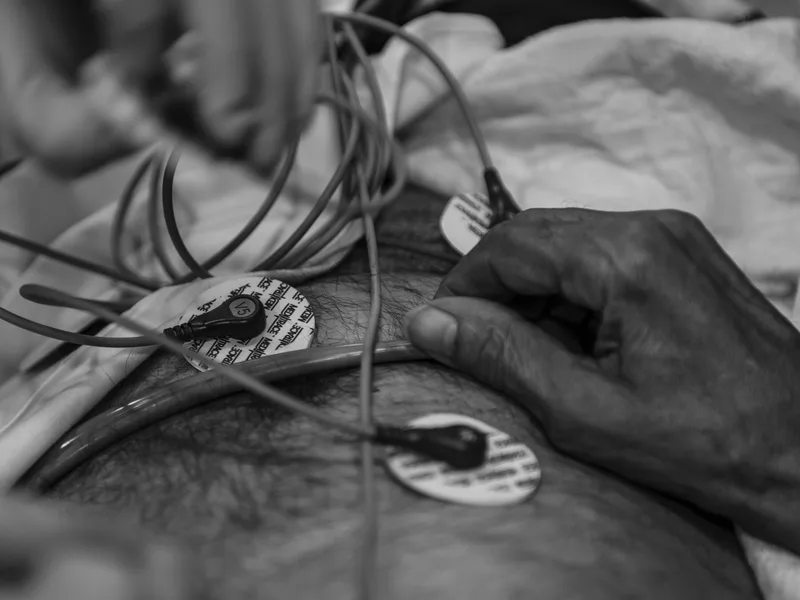
Atrial fibrillation, often shortened to AFib, is the most common irregular heart rhythm doctors see. The heart's upper chambers quiver instead of beating in a coordinated way, which lets blood pool and clot more easily than it should.
Here's the part that makes AFib genuinely tricky: a lot of people have no idea they have it. Episodes can come and go without symptoms, which is exactly why it so often gets diagnosed only after a stroke has already happened. That's not a rare edge case, it's a well-documented pattern in cardiology, and it's the reason so much 2026 research has focused on catching AFib earlier rather than just treating it once found.
The most talked-about study this year is the EQUAL trial, published in JACC in January 2026. Researchers in the Netherlands took adults over 65 with an elevated stroke risk score and randomly split them into two groups: one wore a smartwatch with heart-rhythm sensors for six months, the other received standard care without that monitoring.
The smartwatch group had a meaningfully higher rate of new AFib detection than the standard care group. That's not a shocking result on its face, of course a device checking your heart rhythm constantly will catch more than occasional doctor visits will. But the trial matters because it's one of the more rigorous, randomized looks at whether consumer wearables actually improve detection in a real clinical pathway, not just in theory.
In clinical practice, this is the part that tends to get skipped in the news coverage: detecting more AFib isn't automatically the same as improving outcomes. Finding a rhythm abnormality is only useful if it changes what a doctor does next, and that's turned out to be more complicated than it sounds.
This is genuinely one of the more interesting tensions in cardiology research right now. As wearables get better at catching brief, asymptomatic episodes of AFib, sometimes called subclinical AFib, doctors have run into a real dilemma. Should short, silent episodes be treated the same way as the AFib that shows up with symptoms and lasts for hours?
A widely cited 2024 trial found that apixaban, a blood-thinning medication commonly used for AFib, didn't clearly reduce stroke risk in patients with subclinical AFib the way it does in patients with more established, longer-lasting AFib, while it did increase bleeding risk. That finding has quietly reshaped how cardiologists think about wearable-detected AFib in 2026. More detection doesn't automatically mean more treatment is the right call, and blood thinners carry real risks of their own.
I'll be honest, this is the kind of nuance that gets lost when a headline says "wearables catch hidden heart problem." The tool works. What to actually do with what it finds is still very much a live question among specialists, and it's a genuinely reasonable one to be uncertain about.
On the treatment front, 2026 also brought further data from large trials comparing pulsed field ablation, a newer catheter-based technique using electrical pulses instead of heat or cold, against standard drug therapy as a first-line option for persistent AFib. Early results across several of these studies have generally favored the newer ablation approach for reducing AFib recurrence compared to medication alone, though results vary by patient and trial design.
This matters mainly for patients whose AFib hasn't responded well to medication, or who are weighing ablation against staying on drugs long-term. It's a decision that depends heavily on individual heart structure and AFib pattern, which is exactly the kind of judgment call that needs a cardiologist's input rather than a general online comparison.
Should you panic if your smartwatch shows an "irregular rhythm" notification? No, not immediately, these alerts have real false positive rates and aren't a diagnosis on their own. Should you ignore it either? Also no.
The right move is a proper follow-up, usually starting with an ECG done in a clinical setting, not just repeating the watch reading at home. A cardiologist can confirm whether what was detected is actually AFib, assess your personal stroke risk factors, and decide whether monitoring, medication, or a referral for ablation makes sense.
Visit Hospital
Near You