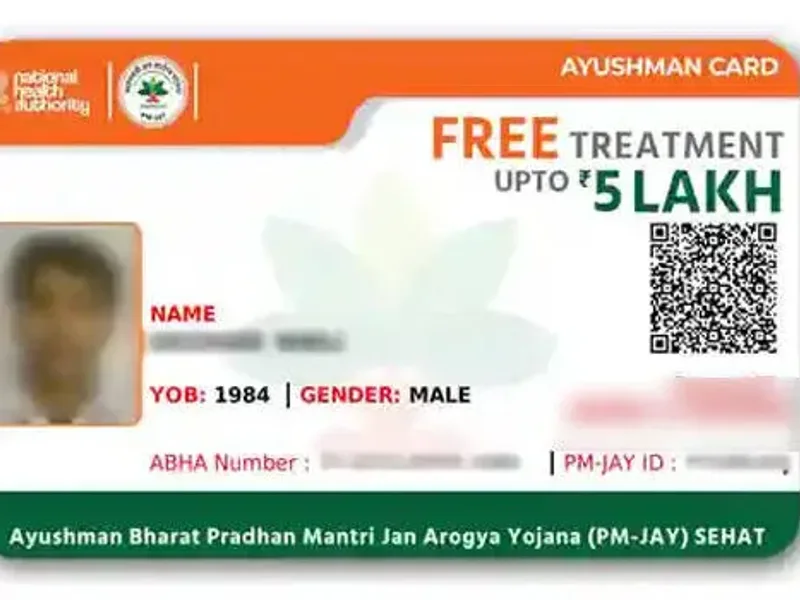
The headline number is simple enough: every eligible family gets up to ₹5 lakh a year in cashless hospital cover under Ayushman Bharat – Pradhan Mantri Jan Arogya Yojana (PM-JAY). What trips people up is assuming that number works like a personal bank balance you can spend on anything medical. It doesn't.
It's a family floater, which means the ₹5 lakh is shared across everyone on the card, not allocated per person. If one family member uses ₹3 lakh for a surgery, the remaining ₹2 lakh stays available to the rest of the family for that year, and the whole amount resets the following year. There's no cap on family size and no individual sub-limit, so a household of two or a household of eight draws from the same pool.
How the package rate system works, and why it matters more than the ₹5 lakh figure
Here's the part that actually determines whether a family pays anything out of pocket: PM-JAY doesn't reimburse whatever a hospital decides to charge. It pays a fixed, pre-set rate for each procedure, drawn from a government list called the Health Benefit Package, which currently covers somewhere around 1,900 procedures across 27 medical specialties.
If a hospital's private rate for a knee replacement is ₹1.8 lakh but the scheme's package rate for that procedure is ₹90,000, the empanelled hospital is contractually bound to accept the package rate as full payment for a PM-JAY patient. That's the whole point of empanelment. The patient isn't billed the difference, and the hospital can't ask for it as a "top-up," at least not for anything that falls inside the package.
Having sat in on a few hospital billing conversations involving government schemes, the confusion almost always starts the same way: a family gets a private cost estimate first, then finds out the scheme number looks completely different, and assumes something's being taken away from them. Nothing is. The package rate is what the hospital actually gets paid, and the patient's responsibility for a covered procedure is, correctly, zero.
Where it does get complicated is with anything that falls outside the defined package, an implant brand that isn't the standard one covered, for instance, or an add-on procedure the hospital suggests during treatment. That's worth asking about explicitly before signing any consent form, not after.
What's actually covered, and what isn't
The scheme covers secondary and tertiary hospitalisation, meaning conditions serious enough to need admission, not routine outpatient visits. Coverage extends to three days of pre-hospitalisation costs and fifteen days of post-hospitalisation costs for the same condition, including relevant diagnostics and medicines during that window.
Pre-existing conditions are covered from day one. That's genuinely unusual. Most private health insurance in India makes you wait two to four years before a pre-existing condition like diabetes or a heart condition is covered, and PM-JAY skips that entirely.
What isn't covered is worth knowing before you need it, not during a crisis. Outpatient consultations that don't lead to admission, cosmetic procedures, fertility treatment, routine dental work like fillings or root canals unless they're tied to a hospitalisation, and non-emergency vaccinations outside government immunisation drives all fall outside the scheme. If a family member needs ongoing outpatient management for something like diabetes or thyroid issues, that's a separate cost to plan for, even with an active Ayushman card.
There's also a rule worth knowing if more than one procedure is needed during a single hospital stay. The scheme pays the full package rate for the first, most significant surgery, 50% of the package rate for a second procedure done in the same admission, and 25% for a third. It's not obvious, and it matters if a patient needs, say, a cardiac procedure alongside a related secondary surgery.
The admission process, step by step
Walking into a hospital with an Ayushman card doesn't work quite like walking in with a normal insurance card. There's a specific sequence, and knowing it in advance saves time when it matters.
Go to the hospital's Ayushman Mitra desk, a help counter most empanelled hospitals maintain specifically for this scheme, and show the Ayushman card along with a photo ID.
The desk verifies identity against the beneficiary database.
For planned (non-emergency) treatment, the hospital submits a pre-authorisation request to the PM-JAY system before admission, essentially getting sign-off that the specific package applies.
Once approved, treatment proceeds cashless, no deposit, no advance payment, no upfront charge for anything covered under the package.
At discharge, the hospital files its claim directly with the government or the state's implementing agency. The patient is never involved in that claims process.
Emergency admissions work slightly differently, since pre-authorisation can happen after admission in genuinely urgent cases, but the cashless principle stays the same either way.
Common misconceptions worth clearing up
A few assumptions come up often enough that they're worth addressing directly. Ayushman Bharat is not "government hospitals only," most states have a substantial private hospital network empanelled too, sometimes a majority of the total. It's also not a scheme you pay for upfront and get reimbursed later, that describes ordinary insurance, not this. And it's not an individual policy, it covers the whole family unit under one floater limit, not one member at a time.
If any empanelled hospital asks a covered patient for a cash advance or deposit before a package-covered procedure, that's a direct violation of the scheme's terms, not a grey area. Worth raising it immediately with the hospital's Ayushman Mitra desk, and escalating to the national helpline, 14555, if it isn't resolved on the spot.
What to actually do with this information
If you or a family member holds an Ayushman card, it's worth finding out in advance which local hospitals are empanelled for the kind of care you're most likely to need, rather than discovering it during an admission. A nearby hospital search, or one specific to Kolkata, is a reasonable starting point, followed by a direct call to confirm current empanelment and package coverage for your situation.
For planned procedures, get an opinion from the relevant specialist before you're at the admission desk. A cardiologist can tell you in advance which package a cardiac condition is likely to fall under, and whether angioplasty or bypass surgery is the likely route based on the diagnosis. An orthopedist can do the same for a knee replacement or spinal fusion, and an ophthalmology consult ahead of cataract surgery can flag whether a particular lens choice falls inside the standard package or counts as an upgrade you'd pay for separately.
Since outpatient care and ongoing chronic conditions sit outside the ₹5 lakh cover, it's worth budgeting for those separately. A general physician for routine check-ups, an endocrinologist for diabetes or thyroid management, and regular diagnostics all fall into that outpatient category the scheme doesn't touch. The same goes for a pharmacy for ongoing medication that isn't tied to a hospital stay.
For families managing an elderly relative's care, a home visit doctor or a home-care nurse can help sort documents and confirm scheme status before a hospital trip becomes necessary, and a physiotherapist is worth arranging in advance for recovery after any joint or cardiac procedure, since post-discharge rehabilitation generally isn't part of the hospitalisation package itself. Women anticipating maternity-related hospitalisation should confirm package details with a gynecologist beforehand, and families with young children should do the same with a pediatrician for any planned paediatric procedure.
In an actual emergency, none of this planning matters as much as getting to care quickly, call an ambulance or head straight to the nearest emergency service, and work through the Ayushman Mitra desk once the patient is stabilised.