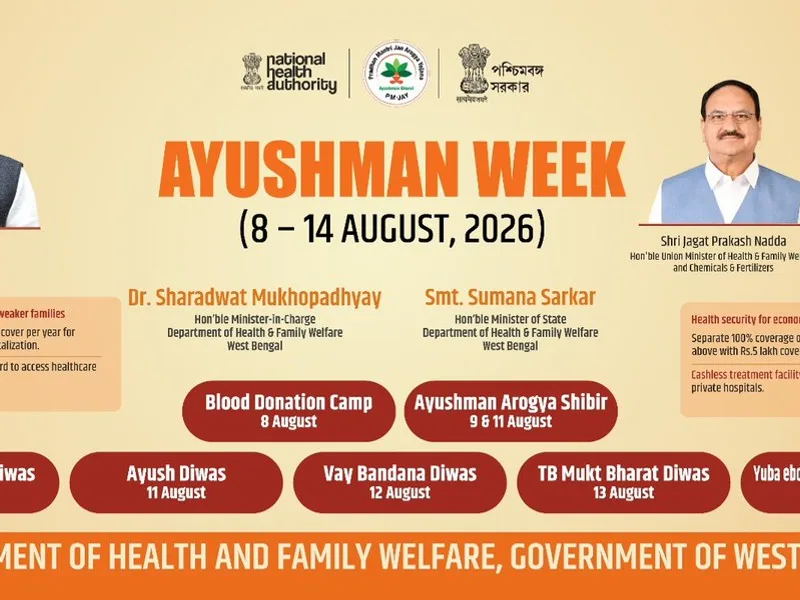
Most awareness weeks come and go without much changing on the ground. Ayushman Week 2026 might be an exception, and that's mostly down to timing rather than the campaign itself.
When It Happened and Why West Bengal's Involvement Matters
Ayushman Week 2026 was observed across West Bengal from August 8 to 14, 2026, framed by the state's Department of Health and Family Welfare as a step toward building a healthier, more empowered West Bengal. On its own, that's a fairly standard state health department message — spread awareness, strengthen access, the usual language of a government campaign.
What makes it worth writing about is what came right after. The Ayushman Bharat PM-JAY scheme was formally launched in West Bengal on August 16, 2026, providing up to ₹5 lakh in annual cashless health coverage per family, and specifically including senior citizens aged 70 and above as beneficiaries. For readers outside West Bengal, this might not register as news. For anyone who's followed Indian health policy over the last few years, it's a genuinely notable shift — West Bengal had, for a long time, run its own separate state health scheme instead of formally rolling out PM-JAY. So an awareness week landing right before a formal launch reads less like routine calendar messaging and more like groundwork laid deliberately.
What Ayushman Bharat PM-JAY Actually Covers
For readers unfamiliar with the scheme, here's the plain-language version. Ayushman Bharat Pradhan Mantri Jan Arogya Yojana, or PM-JAY, is a government health insurance scheme that pays for hospital treatment, both secondary care (things like a planned surgery) and tertiary care (more specialized, complex treatment), at empanelled hospitals — meaning hospitals officially registered under the scheme.
The scheme provides ₹5 lakh per family per year for these hospitalization costs, and targets economically weaker sections identified through socio-economic caste census data, covering close to 50 crore people nationally. It's cashless at the point of care, at least in theory, which matters enormously for families who otherwise delay treatment because they simply don't have money sitting ready for a hospital admission.
The senior citizen provision is worth pausing on. Coverage for those 70 and above has become a specific national focus point in recent scheme updates, and it addresses a real gap — older patients often face the highest hospitalization costs relative to income, and they're the group most likely to skip or delay treatment over cost concerns. In clinical settings, this is a pattern that's hard to miss: an elderly patient with a treatable condition who waits months, sometimes past the point where treatment is straightforward, purely because nobody in the family wants to raise the money question first.
What an Awareness Week Is Actually Supposed to Do
It's fair to ask why a scheme needs a whole week of promotion instead of just... existing. The honest answer is that scheme awareness in India has consistently lagged behind scheme availability. A significant portion of the population remains unaware of what AB-PMJAY actually provides, even in states where it's been running for years, which is exactly why awareness days and weeks keep getting scheduled as a deliberate catalyst for mass information campaigns.
That's not a small problem. A scheme covering 50 crore people is only useful to the person who knows they're eligible, knows which hospitals accept it, and knows what paperwork to carry. Ayushman Week-style campaigns typically lean on community outreach, health camps, and now increasingly digital tools to close that gap. One recent addition nationally is an AI-based WhatsApp assistant that provides instant information on hospital empanelment, eligibility checks, and scheme benefits.
What Families in West Bengal Should Actually Check
If you're in West Bengal and trying to figure out whether this applies to you, don't take a social media post as confirmation of eligibility. Scheme rollouts, especially newly launched ones, tend to have staggered empanelment — meaning not every hospital signs on immediately, and district-level implementation can lag behind the state-level announcement by weeks or months.
The practical step is to check your family's eligibility and card status directly through official government channels rather than assuming coverage based on the launch announcement alone. If your family already holds a state health scheme card, ask specifically how it interacts with the new PM-JAY rollout — the two aren't always automatically merged, and getting that wrong at the hospital counter during an actual emergency is the worst time to find out.