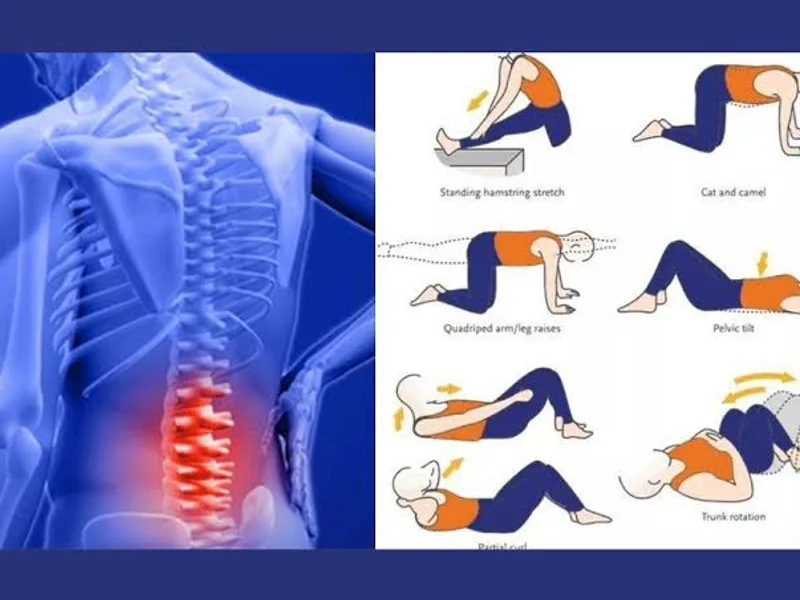
Why exercise can help lower back pain
Exercise works on more than the back itself. Strengthening the abdominal, hip and back muscles can improve movement control, while gentle mobility exercises may reduce stiffness and make everyday activities easier.
Walking is also useful because it keeps the body moving without requiring complicated equipment. Clinical guidance from NICE recommends encouraging people with low back pain or sciatica to continue normal activities and consider exercise programmes suited to their needs and abilities.
For a broader look at mobility and flexibility, see DOCTAR's guide to Improving flexibility and mobility.
1. Pelvic tilts
Pelvic tilts are a gentle starting point for people who find larger movements uncomfortable. Lie on your back with your knees bent and feet supported. Slowly tighten your abdominal muscles and gently flatten your lower back toward the floor, then relax.
The movement should be controlled rather than forced. If it causes sharp pain or makes your symptoms noticeably worse, stop.
People who want to understand the relationship between the pelvis and lower back can also read DOCTAR's guide to Pelvic and lower back pain.
2. Bird-dog exercise
The bird-dog exercise trains the muscles around your abdomen, hips and spine to work together. Start on your hands and knees. Slowly extend one arm and the opposite leg while keeping your trunk steady, then return to the starting position and switch sides.
The goal is stability, not height. Avoid arching or twisting your back to make the movement bigger.
This type of core-focused approach also relates to DOCTAR's information on Strengthening the posterior chain.
3. Glute bridges
Weak or poorly conditioned hip muscles can make everyday movement harder. Glute bridges strengthen the buttock and hip muscles while requiring the lower back to remain relatively stable.
Lie on your back with your knees bent. Press through your feet and gently lift your hips, keeping your ribs and pelvis controlled. Lower yourself slowly.
If you are returning to exercise after an injury, a physiotherapist can help determine whether bridges are appropriate and how to modify them.
For more information about home-based rehabilitation, see. At-home physical therapy.
4. Gentle knee-to-chest movement
A gentle knee-to-chest movement may feel comfortable for some people with stiffness. Lie on your back and slowly bring one knee toward your chest while keeping the other leg comfortable.
Do not force the stretch. Back pain is not something you should try to “stretch away” aggressively.
DOCTAR also covers , including gentle movements and stretches. Spinal decompression exercises
5. Hip mobility exercises
Sometimes the hips, rather than the lower back itself, need more attention. Tight or poorly mobile hips can affect how the pelvis and spine move during everyday activities.
The 90/90 stretch is one option for working on hip mobility, although it is not suitable for every person or every painful condition. Learn more about the. 90/90 stretch for hip and back health.
Gentle yoga may also be useful for some people. DOCTAR's guide to provides examples and modifications. Yoga poses for hip and lower back pain.
6. Walking
Walking is one of the simplest exercises to consider when back pain makes gym-based exercise unattractive. Start at a comfortable pace and choose a distance that does not significantly increase your symptoms.
You do not need to turn every walk into a workout. The goal is regular movement and gradually rebuilding confidence.
People who cycle should also pay attention to bike position and training load.Cycling and lower back pain.
7. Pilates and controlled core exercise
Pilates can combine controlled movement, core training and body awareness. It may be useful for some people with persistent or recurrent back pain, particularly when taught by someone who understands musculoskeletal conditions.
However, Pilates is not a guaranteed cure. The American College of Physicians lists exercise, including motor-control exercise, yoga and other non-drug approaches among options for chronic low back pain.
Read more about on DOCTAR. Pilates for chronic back pain
For additional core work, DOCTAR also covers. Oblique exercises for a stronger core
Should you stretch when your back hurts?
Sometimes. Gentle stretching can help when stiffness or muscle tightness is part of the problem, but stretching is not automatically appropriate for every cause of back pain.
For example, some people may feel better with flexion-based movements, while others may find them irritating. That is why copying an exercise routine from the internet can be a poor substitute for assessment when symptoms are persistent or unusual.
DOCTAR's article on also discusses mobility and soft-tissue techniques. Foam rolling for back pain.
What about squats and strength training?
Strength training does not automatically damage the lower back. Problems can arise when technique, load, recovery or exercise selection do not match a person's current ability.
If squats cause pain, reduce the load and consider having your technique assessed rather than repeatedly pushing through symptoms. DOCTAR explains common reasons for Lower back pain when squatting.
Exercises such as reverse crunches may also require modification when someone already has significant back symptoms. See DOCTAR's guide to the Reverse crunch exercise guide.
In clinical practice, this is often missed because people focus on finding one “bad” muscle or one perfect stretch. Lower back pain is more complicated than that. A gradual return to useful movement is often more practical than chasing a single corrective exercise.
When exercise may not be the right first step
Not every episode of back pain should be managed with home exercises. Pain following a major injury, severe or rapidly worsening symptoms, unexplained weight loss, fever, significant weakness or symptoms involving bladder or bowel control require medical assessment.
Pain travelling down the leg with numbness, tingling or weakness may indicate nerve involvement, sometimes called sciatica. Conditions such as [spinal stenosis] can also produce back and leg symptoms that need a more specific assessment. Spinal stenosis symptoms and treatment
Persistent morning stiffness or back pain that behaves differently from ordinary mechanical pain may also warrant evaluation for inflammatory conditions such as Axial spondyloarthritis.
People with known inflammatory spinal disease should follow an exercise plan designed around their condition. DOCTAR also explains . Spondyloarthritis management.
Other factors that can affect back pain
Exercise is only one part of back health. Long periods of sitting, poor workstation setup, low activity levels and changes in body weight can all influence how the back feels and functions.
DOCTAR's guide to discusses sitting, standing and movement habits. Improving posture and body alignment.
Weight is another factor, although it should never be used to blame someone for their pain. Read about for more context. Obesity and back pain.
If you are considering specialist rehabilitation, DOCTAR's guide to may also be useful for readers seeking local care. Physiotherapy clinics in Kolkata.
Other DOCTAR resources that may be useful include information on Thoracic mobility exercises. Back braces and posture support . Reverse hyper exercises . Inversion therapy for back pain and . TENS and lower back pain.
For readers with upper-back symptoms, DOCTAR also provides information about . Rhomboid muscle pain