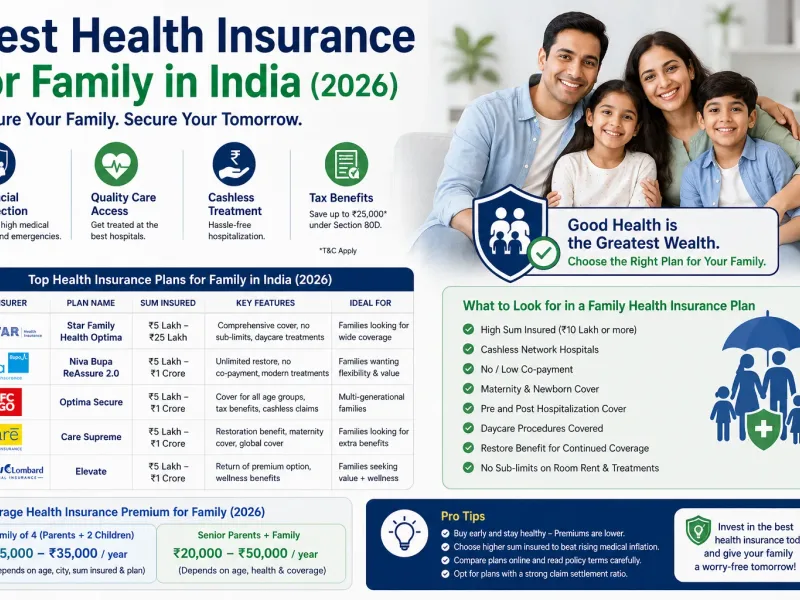
Buying health insurance for your family is one of those decisions most people put off until someone lands in a hospital. Then the panic sets in — and the bills.
The Indian health insurance market has grown significantly in the last few years, with hundreds of plan variants available from dozens of insurers. That's not helpful when you're sitting at a kitchen table trying to figure out what your family actually needs.
Here's what actually matters — based on how families use healthcare in India, not just what the brochure says.
What Is a Family Floater Plan?
A family floater plan is a single health insurance policy that covers your entire family under one sum insured. If your plan has a ₹10 lakh cover, any family member can use that amount in a given year — but the total across all claims can't exceed ₹10 lakh.
This works well for younger families where the probability of multiple large claims in the same year is low. But for families with elderly parents or members with chronic conditions, individual policies sometimes make more sense. Worth thinking through before you sign anything.
When a family member does fall ill, getting the right general physician early can prevent a minor issue from becoming a hospitalisation claim altogether.
Key Things to Check Before Buying a Family Health Insurance Plan
1. Sum Insured — Don't Go Too Low
A ₹3–5 lakh family floater used to be considered adequate. It isn't anymore. A single orthopedic surgery or a week in a private hospital ICU can easily cross ₹4–6 lakh in a metro city. For families in cities like Kolkata, Mumbai or Bangalore, a minimum of ₹10–15 lakh is more realistic.
If you ever need knee replacement surgery or bypass surgery, the costs can run well above ₹1.5–2.5 lakh — and that's on the conservative side.
2. Room Rent Limit — The Hidden Trap
This one catches families by surprise more often than anything else. Many policies cap room rent at 1% of the sum insured per day. On a ₹5 lakh policy, that's ₹5,000/day. If you stay in a room costing ₹8,000/day, the insurer doesn't just deny the extra ₹3,000 — they proportionately reduce your entire claim. Doctors' fees, surgery charges, everything.
Always look for policies with no room rent sub-limit, or at minimum, choose one that allows a private room without restriction.
3. Pre-Existing Disease Waiting Period
Most plans have a 2–4 year waiting period for pre-existing diseases — conditions like diabetes, hypertension, or thyroid disorders that you already have when you buy the policy. If your family has members managing diabetic issues or irregular blood pressure, this waiting period is critical to understand upfront.
Some insurers offer plans with reduced waiting periods at a higher premium. That trade-off may well be worth it.
4. Network Hospitals — Cashless Matters
Cashless treatment means the insurer pays the hospital directly. You don't have to arrange funds during a crisis. Check whether the hospitals near you — particularly the ones you'd actually go to — are in the insurer's network.
You can check which hospitals are available near you on Doctar. For families in Kolkata, leading facilities like Manipal Hospitals AMRI and Apollo Gleneagles Cancer Hospital are examples of the kind of hospitals you want in-network.
5. Maternity and Newborn Cover
If you're planning a family, check whether maternity is covered — and what the waiting period is for that specific benefit. Many plans exclude maternity for the first 2–4 years. Newborn cover from day one is a separate clause; don't assume it's automatic.
Which Family Members Should You Include?
The instinct is to include everyone: spouse, children, parents. But parents — especially if they're above 60 or have pre-existing conditions — can significantly raise your premium and reduce the available cover for the rest of the family through their claims.
A practical approach many families use: buy a separate senior citizen plan for parents and keep the floater for the nuclear family. This is particularly relevant for senior citizen health needs that are different in nature and frequency.
If a parent needs regular orthopedic care, physiotherapy, or has cardiac concerns, a dedicated policy gives them better coverage without compromising yours.
What About Children's Coverage?
Children are generally covered from 91 days of age in most family floater plans. Pediatric illnesses, vaccinations, and minor procedures are usually covered if hospitalisation is required. But outpatient doctor visits — the kind where your child has a cough and fever — are typically not covered unless you have an OPD rider.
For routine child health issues, having a trusted pediatrician near you matters as much as having a policy. In clinical practice, I've seen families delay consulting a doctor because they assumed their insurance would cover it and they'd need to go to a network hospital. That delay can make things worse. Most insurers do cover home visit doctors now, but only for specific conditions.
Add-On Covers Worth Considering
Critical Illness Rider: Pays a lump sum on diagnosis of specific diseases — cancer, stroke, kidney failure, and others. If your family history includes heart conditions requiring angioplasty or similar serious interventions, this rider adds meaningful protection.
OPD Cover: Covers outpatient consultations and diagnostic tests without hospitalisation. Increasingly useful, though it raises your premium.
No Claim Bonus: Many plans increase your sum insured by 10–50% for each claim-free year. If your family stays healthy, this quietly builds your coverage over time.
Government vs. Private Health Insurance
India has several government schemes — Ayushman Bharat (PM-JAY) covers secondary and tertiary care for eligible families up to ₹5 lakh per year. State-level schemes vary significantly.
But Ayushman Bharat's income eligibility means it doesn't apply to most salaried urban families. If you're in that gap — earning too much for government schemes but still stretched by private premiums — a mid-range private floater plan in the ₹10,000–20,000 annual premium range for a family of four is often the most practical option.
Some employers also offer group health insurance. It's worth using, but don't depend on it entirely. Job changes leave gaps. A personal floater policy that runs alongside your employer's plan is a sensible backup.
Ayurveda and Alternative Treatment Coverage
A less-known point: many modern health insurance policies now cover Ayurvedic treatments and AYUSH-based hospitalisation. If your family relies on traditional medicine for chronic conditions, check whether your preferred policy includes this.
Using Health Services Wisely With Insurance
Insurance pays best when you use the healthcare system well. That means: not delaying care, understanding what's covered before you need it, and having doctors you actually trust.
Having a primary care doctor who knows your family's history is one of the most underused tools in managing healthcare costs. A GP who catches something early saves far more than a specialist who treats it late. Platforms like Doctar let you find, compare, and book verified doctors near you — including female doctors if that's a preference, dentists, gynecologists, and other specialists.
For families with specific needs, home visit doctors and home diagnostics can reduce hospital visits — and unnecessary claims — significantly.
In a genuine emergency, knowing where to go and which hospitals are network-covered can save both time and money.