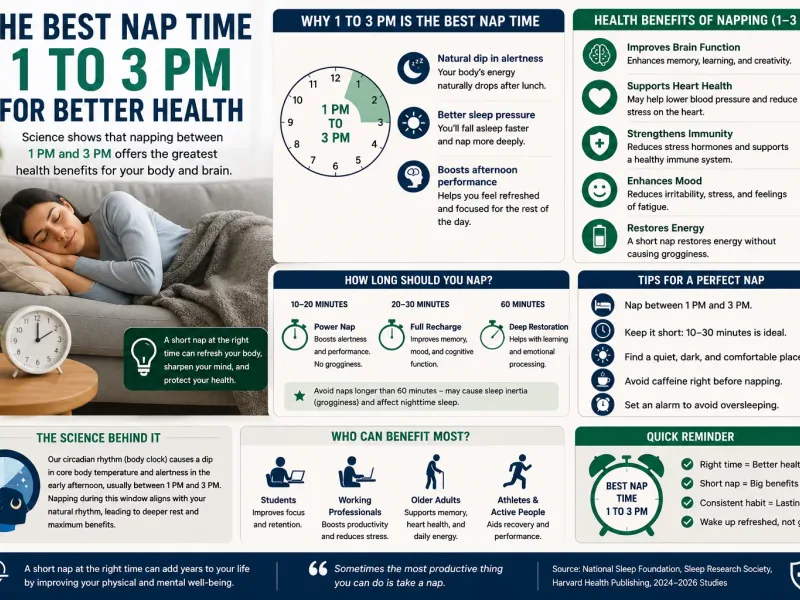
For people with a fairly typical wake-and-sleep schedule, the early afternoon is generally the best time to nap, according to the Sleep Foundation. <cite index="22-1">Napping between 1 p.m. and 3 p.m. is likely optimal for people who maintain a traditional sleep-wake schedule</cite>, a window that lines up with what's often called the post-lunch dip or afternoon slump.
The timing isn't really about lunch itself — it's about the body's internal clock. The Sleep Foundation explains that <cite index="23-1">the post-lunch dip is linked to circadian rhythm, the body's internal clock that follows a 24-hour cycle, which includes two peak periods for sleepiness: the greatest at night, and a second one in the early afternoon</cite>.
That means the dip shows up even in people who skip lunch entirely — it's a built-in feature of human physiology, not just a post-meal food coma. A 2026 narrative review on daytime napping summarized this pattern plainly, noting that <cite index="28-1">circadian rhythms favor naps between roughly 1 and 5 p.m. for peak benefit</cite>.
Body temperature plays a role too. Core body temperature drops slightly during this window, which makes it physically easier to fall asleep — the same mechanism that makes nighttime sleep easier once body temperature drops in the evening.
[REVIEWER: add clinical insight here — e.g., how you counsel patients who report feeling an afternoon energy crash about whether napping, adjusting sleep habits, or ruling out an underlying condition is the more appropriate first step]
Timing matters on both ends of the window. Mayo Clinic is direct about the risk of napping too late in the day: <cite index="25-1">napping after 3 p.m. can make it harder to sleep soundly at night</cite>. The concern is straightforward — a late nap reduces the natural buildup of "sleep pressure," the biological drive to fall asleep that accumulates the longer someone has been awake, making it harder to fall asleep at the usual bedtime.
This is also why nap timing isn't purely about hitting an exact window on the clock. Federal guidance on shift-work fatigue from the CDC's National Institute for Occupational Safety and Health (NIOSH) describes the pattern in more detail: <cite index="27-1">circadian rhythms promote sleep during the night for people on a regular daytime schedule, with the strongest drive for sleep between 2 and 5 a.m., and a secondary pressure point in the afternoon around 2 to 4 p.m.</cite>, while the late morning and the few hours before a person's usual bedtime tend to be the hardest times to fall or stay asleep.
Your Personal Wake Time Shifts the Window
The 1-to-3-p.m. rule of thumb is built around a standard schedule — generally a wake time somewhere around 6 to 7 a.m. People who wake up notably earlier or later than that may find their own circadian dip falls outside the commonly cited window entirely.
The underlying pattern, more precisely, tracks a set number of hours after waking rather than a fixed clock time. For someone who wakes up several hours earlier or later than average, the natural afternoon dip shifts earlier or later along with it. The practical takeaway isn't to abandon the 1-to-3-p.m. guidance — it's a reasonable default for most people on a conventional schedule — but to notice your own natural slump and nap close to when it actually happens, rather than forcing a nap at 1 p.m. if your body isn't there yet.
[REVIEWER: add clinical insight here — e.g., how nap timing recommendations should be adjusted for shift workers, new parents, or older adults with different natural sleep-wake patterns]
How Long Should a Nap Actually Last?
Duration changes what a nap actually does for you, and there's a fairly consistent range cited across sleep research:
Short naps (10–20 minutes) are best for a quick boost in alertness without grogginess afterward. This length keeps the sleeper in lighter sleep stages, so waking up doesn't come with the disoriented, foggy feeling known as sleep inertia.
Naps in the 30–90 minute range support deeper physical and cognitive recovery. Mayo Clinic notes that napping offers real benefits for healthy adults, including <cite index="25-1">less tiredness, more alertness, better mood, and improved performance, including quicker reaction time and better memory</cite> — benefits generally tied to naps in this longer range, though even a longer nap runs some risk of grogginess on waking.
A full 90–120 minute nap allows time to complete an entire sleep cycle, moving from the lightest stage of sleep through deep sleep and back again, which some university sleep health programs point to as ideal when there's enough time in the schedule.
The tradeoff is simple: shorter naps are lower-risk and easier to fit into a workday, while longer naps offer more restorative benefit but carry a higher chance of sleep inertia and a bigger risk of interfering with nighttime sleep if timed too late.
Who Should Adjust This Advice
The 1-to-3-p.m. guidance is aimed at people on a fairly conventional schedule. Mayo Clinic notes that <cite index="25-1">factors such as a person's need for sleep, sleeping schedule, age, and medication use can all play a role in figuring out the best time of day to nap</cite>, meaning the ideal window isn't identical for everyone.
People with irregular schedules — including parents of newborns, night-shift workers, and people with substantially earlier or later chronotypes than average — may need a different nap window entirely, timed around their own actual dip in alertness rather than the clock-based default. Older adults may also nap more frequently due to age-related changes in sleep architecture and daily activity patterns, according to recent research on napping across the lifespan.
Regular, unavoidable daytime sleepiness that disrupts a person's ability to function isn't something napping alone should have to solve. If daytime sleepiness is a persistent, significant problem despite reasonable sleep habits, it's worth talking to a health care provider rather than relying on naps to compensate indefinitely.
FAQ
Why is 1 to 3 PM considered the best time to nap? This window generally lines up with the body's natural circadian dip — a biologically built-in period of reduced alertness in the early afternoon that happens independent of meal timing. For people on a typical daytime schedule, napping during this window tends to feel easier and cause less grogginess afterward.
Is it bad to nap after 3 PM? Napping later in the day can reduce the natural buildup of sleep pressure needed to fall asleep at night, according to Mayo Clinic. For most people, keeping naps within the early afternoon helps avoid interfering with nighttime sleep.
How long should a nap be for the best benefits? It depends on the goal. A 10–20 minute nap boosts alertness with minimal grogginess. Naps of 30–90 minutes support mood and cognitive recovery but carry more risk of sleep inertia. A full 90–120 minute nap completes a sleep cycle but requires enough time in the schedule to avoid disrupting nighttime sleep.
Does the best nap time change based on when I wake up? Yes. The 1-to-3-p.m. window assumes a fairly standard wake time of roughly 6 to 7 a.m. People who wake up notably earlier or later may find their own natural afternoon dip shifts earlier or later along with their schedule.
Can napping make it harder to sleep at night? It can, particularly if a nap is too long or too late in the day. Keeping naps earlier in the afternoon and generally under about 30–90 minutes reduces the risk of interfering with nighttime sleep for most people.