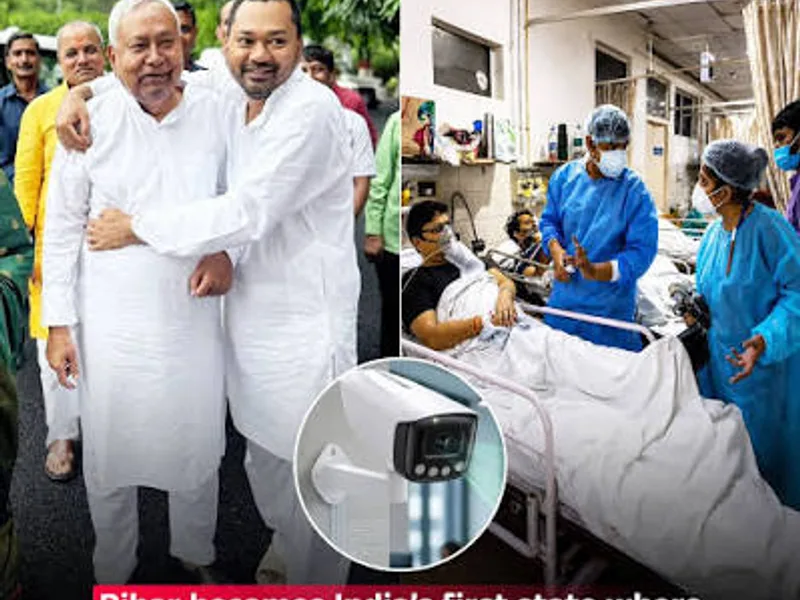
Numbers on a government press release rarely tell you what actually happens when your father needs a hernia operation and the nearest Sadar Hospital is twenty minutes away instead of Patna, three hours away. But this time, the numbers are worth a closer look, because they point to a real change in what district-level government hospitals in Bihar are now doing.
Bihar's district hospitals performed 5,651 surgeries in July 2026 alone, according to state health department figures shared during a review meeting led by Health Secretary Kumar Ravi. Araria's Sadar Hospital topped the list with 423 surgeries that month. Nalanda followed with 327, Bhojpur with 301, Vaishali with 292, and Madhubani with 287.
Two single-day figures stand out more than the monthly totals. Sadar Hospital Sasaram performed 20 surgeries in 24 hours on August 11, while Sadar Hospital Munger managed 12 surgeries in a 10-hour stretch. Whether you call that a "record" depends on what you're comparing it against, since Bihar hasn't historically published detailed hospital-wise surgical data for public comparison. What's clear is that these are unusually high numbers for hospitals that, until recently, mostly handled deliveries and basic emergency cases.
What's Behind the Jump
This isn't happening by accident. The state health department has directed district hospitals to expand toward what it calls 70 types of surgeries, moving well beyond Caesarean deliveries into procedures like cataract surgery, hernia repair, appendix removal, orthopaedic fixes, and fissure and fistula surgery. Separate operation theatres for gynaecology, general surgery and orthopaedics have also been recommended, with pre-fabricated structures suggested where hospitals don't have space to build permanent new blocks.
Ayushman Bharat claims are now being used as one measure of hospital performance too, which changes the incentive on the ground. Government doctors have been told to treat eligible patients at government facilities rather than routing them to private hospitals, a practice that quietly drained patients (and public trust) away from Sadar Hospitals for years. In clinical practice, this referral pattern was often driven less by medical necessity and more by which facility had a working operation theatre that week, so tying performance to actual surgical output is a sensible way to close that gap.
The Referral System Is Being Tightened Too
Alongside the surgery push, the department has made it mandatory for referrals to go through something called the Bhavya Portal, backed by basic diagnostic tests before a patient is sent elsewhere. The goal is to stop unnecessary referrals from primary and community health centres straight to bigger hospitals, and instead treat PHCs, CHCs, sub-divisional hospitals and district hospitals as one connected network.
Round-the-clock emergency care and a proper triage system, sorting patients by how urgently they need attention rather than by who arrived first, have also been ordered across district hospitals, along with functional ventilator-equipped ICUs. On paper, that's the backbone of a real referral chain. Whether every district hospital has the staff to run it 24x7 is a fair question, and one worth asking your local hospital directly rather than assuming.
What This Means If You're Deciding Where to Get Treated
Here's the honest caveat. A hospital reporting a high surgical count in a given month doesn't automatically mean it can handle every procedure, or that it has a surgeon available on the day you walk in. Duty rosters matter, and the Health Secretary specifically warned against unauthorised absence or private practice during duty hours, which tells you this has been a real problem, not a hypothetical one.
Before assuming your nearest Sadar Hospital can do a specific surgery, call ahead or check with a general physician who can guide you on whether it's the right facility for your case. For anything beyond the newly expanded list, cataract, hernia, appendix, basic orthopaedic and gynaecological procedures, you may still need a referral to a bigger centre, and it helps to research that hospital in advance rather than during a crisis.
Where Patients Should Focus Their Own Planning
If you're managing a family member's care in a district covered by this expansion, start by confirming what your Sadar Hospital actually offers right now, not what the state plan eventually promises. For eye conditions and cataract evaluation, a local ophthalmology consult or specialist review before surgery is still worth doing. For hernia, appendix or general surgical concerns, a general surgeon consult can help you understand whether your case is straightforward or needs a higher-level facility.
Orthopaedic cases, common with agricultural and construction-related injuries in rural Bihar, are worth discussing with an orthopedist before assuming a district hospital can manage complex fractures. Pregnant women and new mothers should still confirm delivery and gynaecological surgery capacity with a gynecologist ahead of the due date rather than in labour. Post-surgical recovery for a child should involve a pediatrician familiar with the case, and any cardiac-related concern before surgery deserves a cardiologist opinion, since cardiac surgery isn't part of this district-level expansion.
Pre-surgical diagnostics, blood work, imaging, ECGs, are worth confirming are actually available on-site through a diagnostic centre check before you commit to a date, since the referral tightening now requires basic tests before any transfer. If your case involves ongoing conditions like diabetes, a pre-surgery review with an endocrinologist reduces surgical risk considerably, and a dietitian consult afterward helps recovery. Skin-related surgical concerns should go through a dermatologist first, and any respiratory risk factor before anaesthesia is worth flagging to a pulmonologist.
Post-operative care at home matters just as much as the surgery itself. Arrange home nursing support if the patient is elderly or immobile, a compounder for follow-up injections, and physiotherapy where mobility recovery is part of the plan. Keep a reliable pharmacy lined up for post-surgical medication, and know how to reach an ambulance quickly if complications arise in the days after discharge.
For elective or non-emergency reviews, a home visit doctor can save an elderly or recovering patient an unnecessary trip. If a procedure genuinely needs a bigger centre, compare options through a broader surgery search or check doctors across India for a second opinion before committing to travel. You can read more general explainers on the Doctar blog, learn how the platform verifies listings on the About Doctar page, or reach out through Contact Doctar if you're struggling to find the right facility nearby. A general doctor search near you is also a reasonable starting point if you're unsure which specialist your case actually needs.