Every blood pressure measurement produces two numbers, written as one over the other — for example, 122/78 mmHg.
Systolic pressure (top number): The pressure in your arteries when your heart contracts and pumps blood. This is the higher of the two numbers and the one most associated with cardiovascular risk in older adults.
Diastolic pressure (bottom number): The pressure in your arteries when your heart rests between beats. Both numbers matter — isolated elevations in either can indicate cardiovascular risk.
mmHg stands for millimetres of mercury, the unit in which pressure is measured. You do not need to understand the physics; you need to know where your numbers fall.
Blood Pressure Chart: Categories Explained
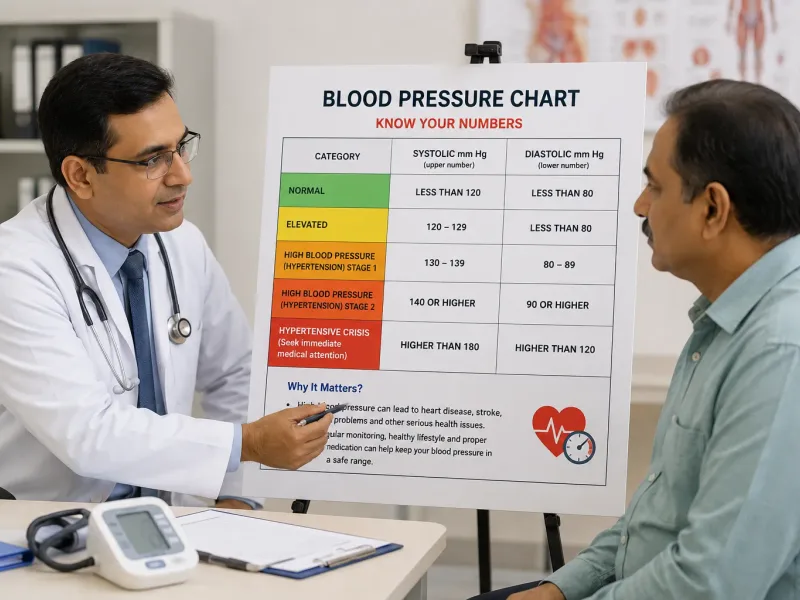
The following categories are based on guidelines from the American College of Cardiology (ACC) and American Heart Association (AHA), adopted in 2017 and consistent with guidance from the European Society of Hypertension (ESH) and broadly referenced in Indian clinical practice:
Category | Systolic (mmHg) | | Diastolic (mmHg) |
|---|
Normal | Less than 120 | and | Less than 80 |
Elevated | 120–129 | and | Less than 80 |
High Blood Pressure Stage 1 | 130–139 | or | 80–89 |
High Blood Pressure Stage 2 | 140 or higher | or | 90 or higher |
Hypertensive Crisis | Higher than 180 | and/or | Higher than 120 |
Low Blood Pressure (Hypotension) | Less than 90 | or | Less than 60 |
A single elevated reading does not confirm hypertension. Blood pressure fluctuates throughout the day — with activity, stress, caffeine, and posture. A diagnosis of hypertension is typically based on two or more elevated readings taken on separate occasions, under resting conditions, according to the WHO diagnostic criteria.
Hypertension is a sustained elevation of blood pressure above the threshold at which the risk of cardiovascular events begins to rise significantly. It is not a disease with a clear on/off switch — risk increases progressively with rising pressure, which is why the "elevated" category (120–129/less than 80) exists as an early warning zone.
The heart of a person with uncontrolled hypertension works harder than it should for every beat of every day. Over time, this strains the heart muscle, damages the inner lining of blood vessels, and accelerates the buildup of arterial plaques — all of which increase the risk of heart attack and stroke. The kidneys, which are highly sensitive to blood pressure, sustain damage that can progress silently to chronic kidney disease.
The WHO's Global Status Report on Noncommunicable Diseases identifies hypertension as the single largest modifiable risk factor for cardiovascular disease worldwide.
This is the most important thing to understand about hypertension: it almost never causes symptoms until it has already caused damage or reached a crisis level.
Headaches, dizziness, and nosebleeds are frequently associated with high blood pressure in popular understanding — but the evidence for these as reliable hypertension symptoms is weak. A landmark review in the Journal of Hypertension found no consistent relationship between blood pressure level and headache in the absence of hypertensive crisis. Most people with Stage 1 or Stage 2 hypertension feel completely normal.
The only way to know your blood pressure is to measure it.
[REVIEWER: add clinical insight here — e.g., how you communicate the significance of asymptomatic hypertension to patients who feel well and are reluctant to start treatment, and what motivates behavioural change in your experience]
Risk Factors for High Blood Pressure in India
Several factors increase the likelihood of developing hypertension. Some are modifiable — meaning lifestyle changes can reduce them. Others are not.
Non-modifiable risk factors:
Age — blood pressure tends to rise with age as arteries stiffen; risk increases sharply after 40
Family history of hypertension
South Asian ethnicity — Indians are at elevated cardiovascular risk at lower blood pressure thresholds and younger ages compared to Western populations, a pattern documented extensively in the literature
Modifiable risk factors:
High salt (sodium) intake — India's average dietary sodium intake significantly exceeds the WHO's recommended maximum of 5 grams of salt per day
Physical inactivity
Overweight and obesity, particularly central adiposity (abdominal fat)
Tobacco use — smoking and smokeless tobacco both raise blood pressure acutely and damage blood vessels chronically
Excessive alcohol consumption
Chronic stress
Uncontrolled diabetes — hypertension and type 2 diabetes frequently coexist, each worsening the other's cardiovascular impact
The ICMR's INDIAB study highlights that urban populations in India show higher hypertension prevalence than rural populations, linked partly to sedentary occupations, processed food consumption, and psychosocial stress.
What Is a Hypertensive Crisis?
A hypertensive crisis occurs when blood pressure rises above 180/120 mmHg. It is a medical emergency.
Two subtypes exist:
Hypertensive urgency: Severely elevated blood pressure without evidence of organ damage. Requires prompt medical treatment — but not necessarily emergency hospitalisation in every case, depending on clinical assessment.
Hypertensive emergency: Severely elevated blood pressure with evidence of acute organ damage — stroke, heart attack, aortic dissection (tearing of the main artery from the heart), acute kidney injury, or pulmonary oedema (fluid in the lungs). This requires immediate hospitalisation and intravenous treatment.
Symptoms that accompany a hypertensive crisis and signal emergency: severe headache, chest pain, shortness of breath, back pain, numbness or weakness, vision changes, or difficulty speaking. Do not wait. Go to the nearest emergency department immediately.
What Is Low Blood Pressure (Hypotension)?
Low blood pressure — generally defined as below 90/60 mmHg — is not always a problem. Some people have naturally low blood pressure and feel perfectly well.
Symptomatic hypotension produces dizziness, lightheadedness, fainting, blurred vision, or nausea — typically when standing up suddenly (orthostatic hypotension) or after prolonged standing. It can result from dehydration, medication side effects, heart conditions, or prolonged bed rest.
Severe or sudden hypotension can be dangerous — a sign of internal bleeding, severe infection (sepsis), or anaphylaxis. In these contexts, it is a medical emergency regardless of the specific number.
How Blood Pressure Is Measured — and What Affects Accuracy
Accurate measurement requires attention to conditions. The AHA recommends:
Sitting quietly for five minutes before measurement
Feet flat on the floor, back supported
Arm at heart level, resting on a flat surface
No caffeine, exercise, or smoking in the 30 minutes before measurement
Cuff placed on bare skin, not over clothing
Common sources of inaccurately high readings: rushing to the appointment, a full bladder, talking during measurement, and the "white coat effect" — blood pressure that is elevated in a clinical setting due to anxiety but normal at home. Home blood pressure monitoring using a validated digital device is increasingly recommended by guidelines as a complement to clinic measurements, particularly for diagnosis and long-term management.
[REVIEWER: add clinical insight here — e.g., how you approach the white coat effect in your practice, when you recommend home monitoring, and how you counsel patients who are newly diagnosed with Stage 1 hypertension and uncertain whether they need medication]
Managing High Blood Pressure: The Evidence Base
For Stage 1 hypertension (130–139/80–89 mmHg) without other cardiovascular risk factors, lifestyle modification is the first-line recommendation — before medication, according to both AHA/ACC and ESH guidelines.
Evidence-supported lifestyle measures include:
Dietary sodium reduction — the DASH (Dietary Approaches to Stop Hypertension) diet, studied extensively by the NIH, reduces systolic blood pressure by 8–14 mmHg in people with hypertension
Regular aerobic exercise — 150 minutes per week of moderate-intensity activity reduces systolic blood pressure by 4–9 mmHg on average, per AHA data
Weight reduction — losing 1 kg of body weight reduces systolic blood pressure by approximately 1 mmHg
Limiting alcohol — the WHO recommends no safe level of alcohol consumption, and reducing intake lowers blood pressure measurably
Smoking cessation — each cigarette raises blood pressure acutely; cessation reduces long-term cardiovascular risk substantially
For Stage 2 hypertension, or Stage 1 with high cardiovascular risk, medication is typically recommended alongside lifestyle changes. Multiple effective drug classes exist — the right choice depends on individual clinical factors and must be determined by a doctor.
FAQ
Q: What is normal blood pressure by age in adults? The standard target for adults of all ages is below 120/80 mmHg for optimal cardiovascular health. For older adults (above 65), some guidelines accept targets up to 130/80 mmHg, balancing cardiovascular benefit against the risk of falls from overly lowered blood pressure. Blood pressure naturally tends to rise with age, but this trend is not inevitable with healthy lifestyle habits.
Q: What blood pressure reading requires immediate medical attention? Any reading above 180/120 mmHg is a hypertensive crisis. Seek emergency care immediately — especially if accompanied by chest pain, severe headache, shortness of breath, vision changes, numbness, or difficulty speaking. Even without symptoms, a reading this high requires same-day medical evaluation. Do not wait to see if it comes down on its own.
Q: Can stress cause high blood pressure? Acute stress temporarily raises blood pressure. Whether chronic psychological stress directly causes sustained hypertension is more complex — the evidence suggests it contributes indirectly through behaviours such as poor sleep, overeating, physical inactivity, and increased alcohol or tobacco use. Regardless, stress management is a recognised component of comprehensive hypertension care.
Q: Is it possible to lower blood pressure without medication? Yes — for many people with Stage 1 hypertension and no other high-risk features. Sodium reduction, weight loss, regular aerobic exercise, and the DASH diet each produce measurable blood pressure reductions supported by clinical trial evidence. Whether lifestyle change alone is sufficient depends on the degree of elevation and individual risk profile, which a doctor must assess. Medication is not avoidable for everyone.
Q: How often should I check my blood pressure? Adults with normal blood pressure should have it checked at least every two years. Adults with elevated readings (120–129 mmHg systolic) should be rechecked within three to six months. Anyone diagnosed with hypertension should monitor as directed by their doctor — typically more frequently during treatment initiation or adjustment. Home monitoring with a validated device is useful between clinic visits.