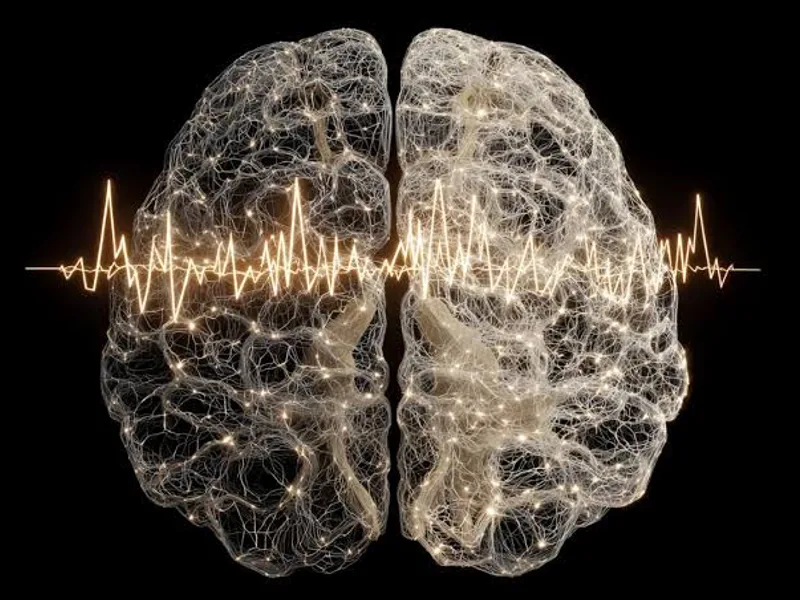
What Are Brain Electrical Rhythms, Exactly?
Neurons communicate by sending tiny electrical signals to each other. When large groups of neurons fire together in a repeating pattern, that collective activity creates a measurable electrical wave. These waves are grouped by their frequency — how many times they cycle per second — and each frequency band has a different name and a different role.
The main ones you'll encounter in medical literature:
Delta waves (0.5–4 Hz) dominate during deep, dreamless sleep. They're the slowest of the major rhythms and are essential for physical recovery and memory consolidation — the brain literally replaying and filing away the day's events.
Theta waves (4–8 Hz) appear during light sleep, meditation, and certain creative states. They're also strongly linked to memory encoding in the hippocampus, the brain region most damaged early in Alzheimer's disease. If you've ever had a sudden insight while dozing off, theta activity is likely what opened that mental door.
Alpha waves (8–12 Hz) are what you produce when you close your eyes and consciously relax. They represent a kind of "idling" mode — the brain standing by, not actively processing input. Loss of alpha rhythm in certain regions is sometimes an early, subtle marker of cognitive change, though this alone is not diagnostic.
Beta waves (12–30 Hz) are the rhythm of active, focused thinking. Conversations, problem-solving, decision-making — all of these generate beta activity. Interestingly, excessive high-frequency beta is also associated with anxiety and a hypervigilant nervous system.
Gamma waves (30–100 Hz) are the fastest commonly studied rhythm. They appear during intense concentration, sensory processing, and may play a role in binding separate pieces of information into a coherent perception — how your brain "assembles" what you see and feel into one unified experience.
How the Brain Keeps These Rhythms in Sync
The rhythms don't just run in isolation. Networks of brain regions communicate in real time, and they use these rhythms to coordinate. Think of it as timing signals — Region A sends a theta pulse, and Region B knows to "listen" during that window. This cross-region synchrony is what allows complex tasks like reading, navigating a city, or having a conversation to happen fluidly.
In clinical practice, this synchrony is often missed in standard assessments because a routine brain scan (MRI) shows structure, not function. It takes an electroencephalogram (EEG) — a recording of the brain's electrical activity through electrodes placed on the scalp — to actually see these rhythms. Many people with early-stage functional brain changes look completely normal on MRI. The rhythm is where the story starts.
A neurologist can order an EEG if there's clinical suspicion of rhythm disruption. This is a non-invasive, painless test — and one that's underused in early workups for cognitive complaints and sleep disorders.
When Rhythms Go Wrong: What the Research Points To
Disrupted brain electrical rhythms are now implicated in a surprisingly wide range of conditions. This doesn't mean rhythm disruption causes every condition listed — the relationship is often bidirectional, and much research is still ongoing. But the patterns are hard to ignore.
Epilepsy
This is the most well-known application of EEG. Epileptic seizures are, at their core, abnormal electrical discharges — rhythms gone haywire, with large groups of neurons firing uncontrollably and simultaneously. Neurologists have used EEG to diagnose and classify epilepsy for nearly a century. Identifying which rhythm is disrupted and where in the brain it originates guides both medication choices and, in some cases, surgical decisions.
Sleep Disorders
Deep, restorative sleep requires properly timed slow-wave (delta) activity. People with insomnia, obstructive sleep apnea, and restless legs syndrome all show characteristic rhythm disruptions during sleep studies. If you're constantly tired despite sleeping enough hours, the quantity of sleep isn't the issue — the quality of your brain's electrical cycling during sleep may be. A general physician can refer you for a sleep study if disrupted sleep rhythms are suspected.
Anxiety and Mood Disorders
High-amplitude beta waves in the frontal lobes are consistently found in people with generalized anxiety disorder. Some research has also connected disrupted alpha rhythms with depression, particularly in the left prefrontal cortex — though this is an active area of investigation, not settled science. These findings are one reason psychiatrists and neuroscientists are increasingly interested in EEG-based approaches to tracking treatment response.
Cognitive Decline and Dementia
This is perhaps where rhythm research has become most urgent. Patients in early Alzheimer's disease show measurable reductions in alpha and gamma power long before symptoms become obvious on a standard cognitive test. Theta rhythms in the hippocampus — the structure that codes new memories — appear impaired even in mild cognitive impairment. Researchers are actively studying whether restoring gamma rhythms through non-invasive methods (light flicker, sound pulses) can slow disease progression, though this work is still in clinical trial phases.
If you or a family member is concerned about memory, booking a consultation with a neurologist is a sensible first step rather than waiting for symptoms to worsen.
Attention-Deficit/Hyperactivity Disorder (ADHD)
Children and adults with ADHD show elevated theta waves during tasks requiring sustained attention — the brain slipping toward a drowsy, unfocused state when it should be alert and engaged. Some clinical settings now use quantitative EEG (qEEG) as one tool in ADHD evaluation, though it's used alongside — not instead of — clinical assessment by a pediatrician or psychiatrist.
The Brain's Rhythms and Your Body: A Two-Way Street
Here's something most people don't expect: your body rhythms influence your brain rhythms too. Slow, deep breathing lowers heart rate and strengthens alpha and theta waves. Chronic pain amplifies beta and disrupts sleep-stage transitions. Poor gut health — through the gut-brain axis — can alter neurochemistry in ways that affect oscillatory patterns. Even posture has been shown in small studies to influence frontal lobe alpha activity.
This is not an argument for pseudoscience. It's the opposite — it underscores how deeply interconnected your systems are, and why general physicians who manage the whole patient often catch what specialists working in isolation miss.
Can You Improve Your Brain Rhythms?
Honestly, this is where the science is exciting but still evolving. A few things are well-supported:
Sleep quality. There is no supplement or device that substitutes for consistent, quality sleep. Delta wave production depends on proper sleep cycling. A sleep disrupted by apnea or anxiety produces less of it. Treating the underlying cause matters more than chasing a number.
Aerobic exercise. Multiple well-designed studies have found that regular aerobic exercise increases alpha and theta power during rest and improves gamma coherence during cognitive tasks. This is one reason physiotherapists and cardiologists increasingly discuss cognitive health as a secondary benefit of exercise.
Mindfulness meditation. Years of sustained practice are associated with increased alpha and theta amplitudes, and notably, higher-than-average gamma synchrony in experienced meditators — though it's worth being sceptical of overblown claims here. Short-term practice shows modest effects.
Neurofeedback. Some clinical settings use EEG-based biofeedback, where patients learn to self-regulate their own brainwaves by receiving real-time feedback. Evidence is mixed, but it's an active area of research, particularly for ADHD and anxiety.
What won't help — despite persistent marketing claims — are most commercial "brainwave entrainment" apps and devices. Some may produce transient subjective effects, but there is no strong evidence they produce lasting, clinically meaningful changes in rhythm. If you're interested in any brain-based intervention, run it past a qualified clinician first, not a wellness influencer.
When to See a Doctor
Rhythm disruption rarely announces itself dramatically. The signs are often subtle — persistent fatigue despite adequate sleep, unexplained mood shifts, memory lapses that seem out of proportion to stress, episodes of confusion, or sudden unusual sensations. These can have many causes. But if they're present, an evaluation that includes a neurologist — and potentially an EEG — is reasonable.
You can search for a neurologist near you, book a home visit doctor for an initial assessment, or find a diagnostic centre for brain-related testing through Doctar.