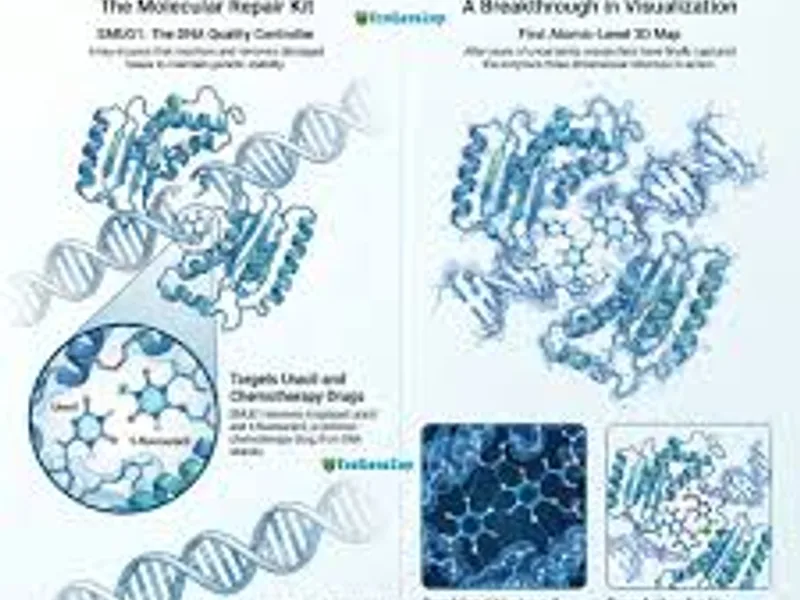
Cancer DNA Repair Breakthrough: What Scientists Found
Every cell in your body breaks its own DNA constantly, just from normal wear and tear. Healthy cells fix these breaks using a set of repair tools. Cancer cells use the same tools, sometimes even more aggressively, to survive treatments designed to kill them.
That's the quiet backstory behind a wave of recent research into what scientists call the DNA damage response, or DDR. Understanding how cancer repairs itself has become one of the more active areas in oncology research right now, and a few 2026 findings are worth unpacking carefully.
The Basic Idea, Without the Jargon
Chemotherapy and radiation work largely by damaging a tumor's DNA badly enough that the cancer cell dies. The problem is that cancer cells are often unusually good at patching that damage back up. When repair succeeds often enough, the tumor keeps growing even after treatment, and sometimes it becomes resistant to the same drug going forward.
Researchers have spent the last two decades mapping out exactly which proteins cancer cells lean on to do this repair work. Names like BRCA1, BRCA2, RAD51, and CHK1 come up constantly in this research, largely because they're central to a repair process called homologous recombination, which is one of the more accurate ways cells fix broken DNA strands.
What's New in 2026
A team at the Institute for Basic Science in South Korea reported this year that they'd found a way to destabilize the machinery cancer cells use to restore their repair function after treatment with PARP inhibitors, a drug class that already works by blocking one repair pathway. The idea isn't to invent a new mechanism from scratch, but to close the backdoor cancer cells use to regain repair ability once they've adapted to existing drugs.
Separately, researchers at Duke University described in March how a form of DNA that floats outside the main chromosomes, called ecDNA, helps some of the most aggressive cancers survive by relying on specific repair partners. This ecDNA shows up in roughly one in three cancer patients according to their reporting, and it's especially common in cancers like glioblastoma. That's a notable detail because ecDNA has been harder to target with standard drugs, so identifying its repair dependencies opens a door that wasn't really there before.
A third study out of Hebrew University, published in August, suggested something almost counterintuitive: cancer cells may be damaging their own DNA as a side effect of running certain growth genes at extremely high activity. The repeated repair that follows, sometimes done imperfectly, may actually help the tumor evolve and adapt. If that holds up in further research, it reframes DNA damage not just as a treatment tool but as something tumors do to themselves as part of how they progress.
None of these are approved treatments yet. They're published research, most still in early or preclinical stages, and it's worth being honest about that instead of implying a cure is imminent.
Why This Connects to BRCA and Family History
In clinical practice, this is often missed because patients hear "DNA repair" and assume it only applies to lab research, not to anything relevant to their own risk. But this is exactly the biology behind BRCA1 and BRCA2 testing, which many oncologists already use to guide treatment and screening decisions.
People who inherit a faulty copy of BRCA1 or BRCA2 have cells that are worse at this same homologous recombination repair from birth, which is part of why their lifetime risk of breast and ovarian cancer is elevated. It's also why PARP inhibitors work particularly well in BRCA-mutated tumors specifically. The repair pathway is already compromised, and blocking the backup pathway pushes the cancer cell past what it can survive.
This is where family history conversations become genuinely useful, not just a box to check at a doctor's visit. If several relatives across generations have had breast, ovarian, pancreatic, or prostate cancer, that pattern is worth raising directly with a doctor. It's the kind of detail covered well in Doctar's piece comparing prostate cancer and colon cancer, which touches on how hereditary risk factors overlap across different cancer types more than people expect.
Where This Might Show Up in Actual Treatment
Some DDR-targeting drugs are already in use, PARP inhibitors being the clearest example. The newer research is mostly about extending how long those drugs stay effective, and about finding DDR vulnerabilities in cancers that don't currently respond well to any DNA-repair-targeted therapy.
Colorectal cancer is one area where this research overlaps with more familiar screening advice. A portion of colorectal cancers are linked to inherited DNA repair problems, most notably Lynch syndrome, which affects a different repair system called mismatch repair. Doctar's guide on understanding types of colon cancer is a decent starting point if this is new territory, and their piece on colon cancer complications explains why catching these cases early through genetic counseling matters as much as catching them through routine screening.
People managing chronic inflammatory conditions of the colon, like those covered in Doctar's account of living with ulcerative colitis, also carry elevated long-term cancer risk tied partly to how repeated cell damage and repair cycles play out over years. That's a slower, chronic version of the same biology researchers are studying in tumors directly.
A Fair Word on Timeline
It's tempting to read "breakthrough" and assume something is close to changing treatment next year. Some of this research probably will, eventually, but drug development from a lab finding to an approved therapy typically takes the better part of a decade, sometimes longer. Even PARP inhibitors, now a standard option, took roughly fifteen years from early lab work to first approval.
That's not a reason to dismiss the research. It's a reason to hold two things at once: this is genuinely important science, and it's not yet something that changes what happens at your next oncology appointment.