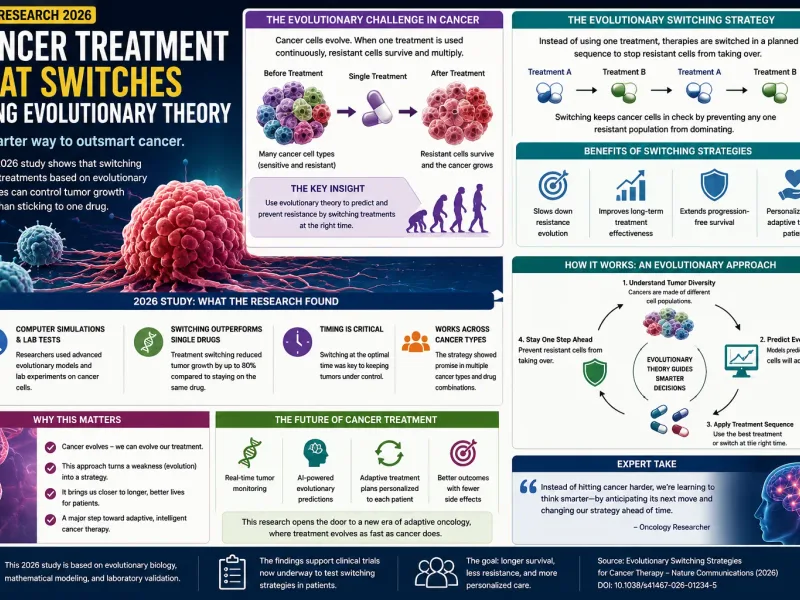
A new approach to cancer treatment — applying evolutionary biology to determine when to switch between therapies — shows promise for extending the time that treatments remain effective and potentially improving cure rates. Research published in the journal Genetics in July 2026 found that mathematically timed switching between therapies before a tumor begins to regrow could outperform the standard clinical approach of treating at the maximum tolerated dose until resistance emerges. Clinical data from a completed Phase 2 trial at Moffitt Cancer Center in prostate cancer have already shown that this strategy more than doubled median time to disease progression compared with standard of care.
Drug resistance is the central challenge in cancer medicine. Most cancer drugs work by targeting a vulnerability in cancer cells — a mutation, a protein, a signaling pathway. Initially, they can be highly effective. But tumors are not uniform: they contain many genetically distinct subpopulations of cells, and some of those subpopulations happen to already carry mutations that make them less sensitive to the drug. Under the constant pressure of treatment, those resistant cells survive and multiply while sensitive ones are killed.
<cite index="79-1">Drug resistance transforms initially effective cancer treatments into temporary reprieves.</cite> The standard approach in oncology has been to administer the maximum tolerated dose — as much drug as the patient can bear — continuously until the tumor stops responding. The evolutionary problem with this strategy is that it applies relentless selective pressure, which reliably, predictably selects for resistant cell populations.
<cite index="81-1">Cancer progression is a dynamic process of continuous evolution, in which genetic diversity and heterogeneity are generated by clonal and subclonal amplification based on random mutations. Traditional cancer treatment strategies often lead to treatment failure due to drug resistance.</cite>
The theoretical foundation of evolutionary cancer therapy rests on a critical biological observation: drug-resistant cancer cells are not free. Maintaining the biochemical machinery that protects a cell from a specific drug requires cellular resources. In the absence of the drug, drug-sensitive cells — which have no such overhead — typically grow faster and outcompete resistant cells for space and nutrients.
<cite index="77-1">The insight driving this research is ecological: drug-resistant cancer cells are not free. They pay a metabolic cost to maintain the biochemical machinery that protects them from the drug. In the absence of the drug, sensitive cells grow faster and outcompete resistant ones for resources. The standard maximum-dose approach never provides that selective pressure relief, ensuring resistant cells always have an advantage.</cite>
Evolutionary cancer therapy exploits this. Rather than eliminating sensitive cells as quickly as possible, the strategy deliberately preserves a population of drug-sensitive cells that can act as competitors to resistant cells — keeping them in check. Treatment is adjusted, cycled, or switched not on a fixed schedule, but in response to how the tumor is actually evolving.
The July 2026 Study: Two-Strike Therapy
The most recent major contribution to this field comes from Dr. Robert Noble and colleagues at City St George's, University of London, published in the journal Genetics on July 22, 2026. The paper, titled "Preventing evolutionary rescue in cancer using two-strike therapy," uses mathematical and computational models to investigate the optimal timing of switching between two cancer therapies.
<cite index="77-1">The research applies evolutionary theory to oncology treatment timing, finding that switching between multiple therapies before a tumor begins regrowth could generally perform better than the current standard of treating at maximum tolerated dose until resistance emerges. "Smarter timing may be one of the keys to making cancer treatment more effective," the research team stated. "A new study suggests that doctors could improve cure rates by changing therapies before a tumor has a chance to recover."</cite>
The core concept — "two-strike therapy" — refers to administering a second treatment while the tumor is still partially suppressed by the first, rather than waiting for documented disease progression. The mathematical models predict that delivering the second strike when resistant cells have not yet had time to multiply into a dominant population gives the second drug its best chance of killing them.
<cite index="79-1">Multi-strike therapy is being investigated in three small clinical trials: a Phase 2 trial using conventional chemotherapy drugs in metastatic rhabdomyosarcoma (NCT04388839); a Phase 1 trial in metastatic prostate cancer (NCT05189457); and a Phase 2 trial using targeted therapies in metastatic breast cancer (NCT06409390). Further trials are in development.</cite>
Clinical Evidence: The Moffitt Prostate Cancer Trial
The strongest existing clinical evidence for evolutionary therapy comes from a landmark pilot study at Moffitt Cancer Center in Tampa, Florida, led by Dr. Jingsong Zhang.
The trial (NCT02415621) enrolled men with metastatic castration-resistant prostate cancer — advanced prostate cancer that has stopped responding to hormone therapy — who were starting abiraterone acetate, a drug that blocks testosterone production in cancer cells. Rather than taking abiraterone continuously, patients cycled on and off the drug, guided by their PSA (prostate-specific antigen) level, which serves as a marker of cancer activity.
<cite index="89-1">This strategy significantly improved median radiographic progression-free survival to 30.4 months in the adaptive therapy group, compared with 14.3 months median radiographic progression-free survival in the standard-of-care group. Median overall survival was 58.5 months in the adaptive therapy group compared with 31.3 months in the standard-of-care group.</cite>
More than doubling median survival in a disease as difficult as metastatic castration-resistant prostate cancer is a striking result. The trial also found reduced drug usage — meaning patients were taking abiraterone for less total time while achieving better outcomes, which has both quality-of-life and cost implications.
[REVIEWER: add clinical insight here — e.g., from an oncologist's perspective, how this adaptive therapy protocol would be implemented in practice — what PSA threshold triggers a treatment pause versus restart, how frequently monitoring is required, and whether patients experience difficulty tolerating the on-off cycle emotionally or physically]
Evolutionary Game Theory: A Mathematical Framework
A key tool enabling evolutionary cancer therapy is mathematical modeling, specifically evolutionary game theory — the application of game theory to populations of competing organisms, in this case cancer cell subpopulations.
<cite index="80-1">Cancer development is a dynamic and continuously evolving process, with the emergence of drug-resistant cancer cells being one of the primary reasons for the failure of traditional treatments. Adaptive therapy, as an emerging cancer treatment strategy, is increasingly being applied in oncology.</cite>
<cite index="76-1">By incorporating pharmacokinetics into a cancer evolutionary game theory model, researchers can propose an optimal control problem constrained by maximum drug concentration and maximum tumor burden. This allows for the design of personalized treatment plans for different patient groups.</cite>
In practice, this means mathematicians and oncologists are working together to build models that can predict — for an individual patient — when their tumor is likely to become resistant, what competing cell populations are present, and when to switch treatment to stay ahead of resistance. PSA in prostate cancer is one such measurable marker; similar "evolutionary biomarkers" are being identified for other cancer types.
Circulating tumor DNA (ctDNA) — fragments of cancer DNA that float in the bloodstream and can be detected through blood tests — is emerging as a key tool here. <cite index="78-1">A 2026 review in Evolution, Medicine, and Public Health highlights circulating tumor DNA technology as an opportunity for clinical implementation of adaptive therapy, enabling real-time monitoring of tumor evolution without invasive biopsies.</cite>
What Conditions Is This Approach Being Tested In?
Beyond prostate cancer, evolutionary therapy frameworks are being applied across multiple cancer types:
Metastatic rhabdomyosarcoma: A Phase 2 trial (NCT04388839) using evolutionary timing of conventional chemotherapy drugs started recruiting in 2020 and is expected to conclude in 2026.
Metastatic breast cancer: A Phase 2 trial (NCT06409390) using targeted therapies with evolutionary dosing guidance began in 2024.
Colorectal cancer: Computational models linking DNA methylation patterns to tumor evolutionary history — developed by Noble's group at City St George's — may enable more precise evolutionary treatment planning for colorectal tumors, according to a 2026 preprint from the same team.
The prostate cancer evidence remains the most mature, but the conceptual framework is disease-agnostic: any cancer in which drug resistance drives treatment failure, and in which measurable markers of tumor burden can be tracked over time, is a potential candidate for evolutionary therapy.
Challenges and Open Questions
Evolutionary therapy is compelling in theory and encouraging in early clinical data. But significant challenges remain before it can become standard of care.
<cite index="78-1">Adaptive therapy offers an evolution-informed approach to delay resistance and improve outcomes in metastatic and recurrent disease. However, key challenges in clinical implementation include: the need for frequent biomarker monitoring to guide real-time treatment decisions; the mathematical expertise required to translate models into practical clinical protocols; and the difficulty of conducting randomized clinical trials that adequately test evolutionary timing strategies against standard care.</cite>
Blinding is nearly impossible — patients and oncologists know when treatment is paused — which complicates clinical trial design. Regulatory agencies require rigorous evidence, and Phase 3 randomized trials with sufficient patient numbers will be needed before evolutionary therapy can enter standard treatment guidelines. The mathematical models, however sophisticated, are also simplifications: real tumors have more complex dynamics than any model can fully capture.
<cite index="79-1">Critical questions regarding the timing of subsequent treatment strikes, the time until extinction, the effect of environmental and demographic factors, and most importantly, the conditions under which multi-strike therapy is a feasible alternative to other therapies remain unanswered.</cite>
[REVIEWER: add clinical insight here — e.g., how a medical oncologist would advise a patient with metastatic prostate cancer or another solid tumor who asks whether evolutionary therapy is available to them, what clinical trial options exist in their region, and what questions to ask their oncology team about their tumor's evolutionary biology]
FAQ
What is evolutionary cancer therapy? Evolutionary cancer therapy — also called adaptive therapy — treats tumors as evolving populations of cells rather than fixed targets. Instead of maximizing drug doses until resistance develops, it times treatment switches to exploit the metabolic cost that drug-resistant cells carry. The goal is to keep sensitive cells alive as competitors that suppress resistant cells, extending the time treatments remain effective.
Has evolutionary treatment switching been tested in humans? Yes. The most advanced clinical evidence comes from a Moffitt Cancer Center pilot trial in metastatic castration-resistant prostate cancer, which found that adaptive on-off abiraterone therapy guided by PSA levels more than doubled median progression-free survival (30.4 months versus 14.3 months) and median overall survival (58.5 months versus 31.3 months) compared with standard continuous therapy.
What is two-strike therapy in cancer treatment? Two-strike therapy is a specific evolutionary approach in which a second cancer treatment is introduced while a tumor is still partially suppressed by the first — before resistant cells have had time to multiply into a dominant population. A 2026 study published in Genetics by Dr. Robert Noble and colleagues at City St George's, University of London, used mathematical models to show this timing strategy could generally outperform maximum-dose continuous therapy.
How does evolutionary game theory apply to cancer treatment? Evolutionary game theory models the competition between drug-sensitive and drug-resistant cancer cell populations the way ecologists model species competing for resources. These mathematical models can predict when resistant cells are likely to gain a growth advantage and when switching treatments would deliver the best results. Clinical implementations use biomarkers — such as PSA in prostate cancer or circulating tumor DNA — to track tumor evolution in real time.
What cancers are being treated with adaptive evolutionary therapy? Active clinical trials are underway in metastatic castration-resistant prostate cancer, metastatic rhabdomyosarcoma, and metastatic breast cancer. The approach is being explored computationally in colorectal cancer and other solid tumor types. The conceptual framework applies most readily to metastatic cancers in which drug resistance is a major driver of treatment failure and where measurable real-time biomarkers of tumor burden exist.
Practical Takeaway
Evolutionary cancer therapy does not mean abandoning existing drugs — it means using them differently, guided by the biology of how tumors evolve resistance. The clinical data from prostate cancer are the most compelling: more than doubling median survival with the same drug, used more strategically. For patients with advanced cancers in which drug resistance is a concern, it is worth asking your oncology team whether adaptive therapy trials are open for your cancer type and whether biomarker-guided treatment timing is something your care plan can incorporate. The Moffitt Cancer Center and the Noble lab at City St George's are among the institutions currently running or analyzing trials in this space.
This article must be reviewed and attributed to a named, qualified medical reviewer — such as a board-certified medical oncologist with experience in precision or personalized cancer medicine — before publishing. It is intended for general education only and does not constitute medical advice. Clinical trial availability varies by institution and cancer type; consult your oncology team for guidance specific to your diagnosis.
Sources
Patil S, Ahmed A, Viossat Y, Noble R. Preventing evolutionary rescue in cancer using two-strike therapy. Genetics. 2026;232(2). DOI: 10.1093/genetics/iyaf255.
Medical Daily. Treating Cancer Like an Evolving Ecosystem Could Beat Drug Resistance, New Mathematical Models Suggest. July 22, 2026
Wu J, Strobl MA, Scott JG. Adaptive therapy and its challenges. Evolution, Medicine, and Public Health. 2026;14(1):1–3. DOI: 10.1093/emph/eoag010.
Moffitt Cancer Center. Is Adaptive Therapy in Prostate Cancer Patients a Promising Treatment? Reporting on NCT02415621.
Zhang J, et al. Adaptive abiraterone therapy for metastatic castration-resistant prostate cancer — pilot clinical trial results.
PMC. A Phase 1b Adaptive Androgen Deprivation Therapy Trial in Metastatic Castration Sensitive Prostate Cancer.(includes NCT02415621 data cut-off analysis)
Li Z, Tan X, Yu Y. Optimal adaptive cancer therapy based on evolutionary game theory. PLOS ONE. 2025;20(4):e0320677. DOI: 10.1371/journal.pone.0320677.
Brady-Nicholls R, et al. Bringing evolutionary cancer therapy to the clinic: a systems approach. npj Systems Biology and Applications. 2025.
Image Suggestion
An editorial graphic showing two branching populations of cancer cells — one labeled "drug-sensitive" and one labeled "drug-resistant" — with arrows illustrating competitive dynamics under different treatment strategies. The visual should resemble a peer-reviewed figure from evolutionary ecology or cancer biology literature, emphasizing the concept of competition between cell populations rather than a conventional "cancer cell under a microscope" stock image. A schematic of the on-off treatment cycle alongside PSA curves would also convey the practical clinical application clearly.
Schema Suggestion
MedicalWebPage + FAQPage MedicalWebPage signals E-E-A-T credibility for a YMYL oncology topic grounded in named peer-reviewed sources from Genetics, Evolution, Medicine, and Public Health, PLOS ONE, and active ClinicalTrials.gov registrations; FAQPage enables rich result display for all five FAQ entries in Google Search and AI Overviews, including the high-intent "has evolutionary cancer therapy been tested in humans" query from patients researching treatment options.