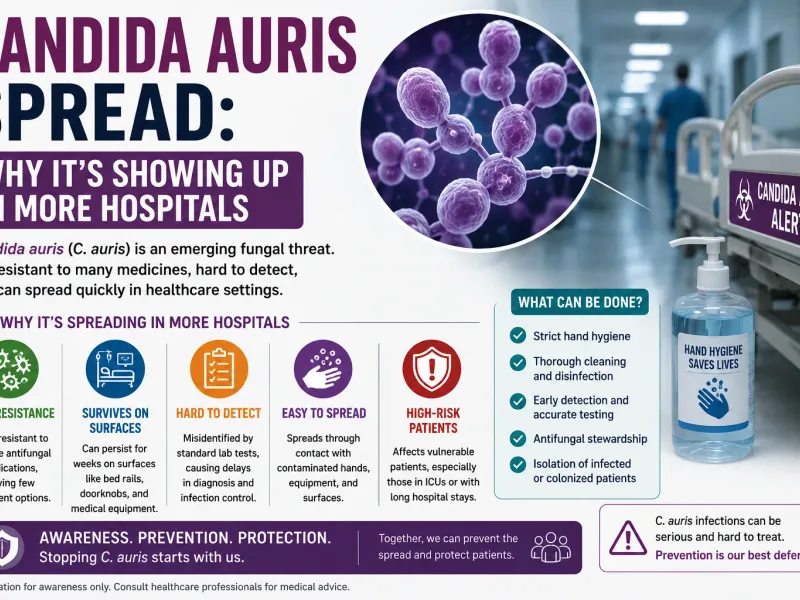
Candida auris is a type of yeast — a fungus, not a bacteria or virus — that was first identified in Japan in 2009 and has since spread to healthcare facilities in dozens of countries. In the US, it showed up on the CDC's radar around 2016, and the case count has grown almost every year since.
What makes it worth talking about isn't that it's especially common. It's that some strains resist nearly every antifungal drug doctors have. When it does cause a serious infection, treatment options can run out fast.
How Far Has It Spread in 2026?
As of the week ending July 25, 2026, the CDC's surveillance data shows Candida auris cases reported in 26 states, with more than 3,400 cases logged so far this year. Texas has reported the most by a wide margin, over 700 cases, followed by Michigan and Illinois, both in the several-hundreds range.
That geographic spread is the real story here. A decade ago this fungus barely registered outside a couple of clusters in New York and New Jersey. Now it's turning up in the Midwest, the South, and pockets of the Mountain West — basically wherever there are hospitals and nursing homes with medically fragile patients.
[REVIEWER: add clinical insight here — for example, how you or your facility approach screening for C. auris in high-risk admissions, and what a positive screen actually changes about patient care day to day.]
Here's the thing about Candida auris that trips people up: it's not really an "everyone should worry" kind of germ. It thrives in a very specific environment — sick, vulnerable people connected to catheters, breathing tubes, or IV lines, often in facilities where the fungus can survive on surfaces for long stretches and pass between patients.
Healthy people who don't work in or aren't hospitalized in these settings are at very low risk. The people who need to actually watch for it are patients who:
Most fungal infections respond to a fairly small handful of antifungal drug classes. Candida auris is the exception — some strains show resistance to all three major classes typically used, leaving doctors with limited or no effective options in the worst cases.
It's also notoriously hard to identify with standard lab equipment, which is part of why it can spread quietly in a facility before anyone catches it. Specialized testing is usually needed to confirm it's C. auris rather than a more common, treatable Candida species.
There's no single, obvious symptom that screams "Candida auris" — that's part of what makes it tricky. Signs can include fever, chills, and low blood pressure that don't improve with standard antibiotic treatment, which is often the clue that pushes doctors toward fungal testing in the first place.
Infections can range from fairly minor, like a wound or ear infection, to serious and invasive, where the fungus enters the bloodstream and can affect the heart or brain. It's the bloodstream infections that carry the highest risk.
[REVIEWER: add clinical insight here — for example, what typically prompts your team to test specifically for C. auris rather than treating empirically for a more common infection.]
How Facilities Are Trying to Stop the Spread
Because C. auris survives well on surfaces, containment in healthcare settings leans heavily on infection control basics, just done more rigorously:
Screening high-risk patients on admission, especially those transferring from another facility with known cases
Isolating colonized or infected patients where possible
Using hospital-grade disinfectants effective against C. auris, since some standard cleaners don't fully kill it
Frequent hand hygiene, particularly alcohol-based sanitizer use between patient contacts
Tracking and reporting cases to public health departments so spread between facilities can be caught early
None of this is exotic. It's the same infection-control playbook used for other resistant organisms, just applied with extra attention because this one is unusually persistent on surfaces and unusually hard to treat once it takes hold.
Should the General Public Be Worried?
Probably not in the way outbreak headlines might suggest. If you're not currently hospitalized, in a nursing home, or working in one of those settings, your personal risk is low. This isn't a fungus spreading through community contact the way a cold or flu virus does.
That said, if you have a family member in a hospital or long-term care facility, it's fair to ask the staff about their infection control practices, particularly if your loved one has a catheter, feeding tube, or breathing tube — those are the entry points C. auris tends to exploit.