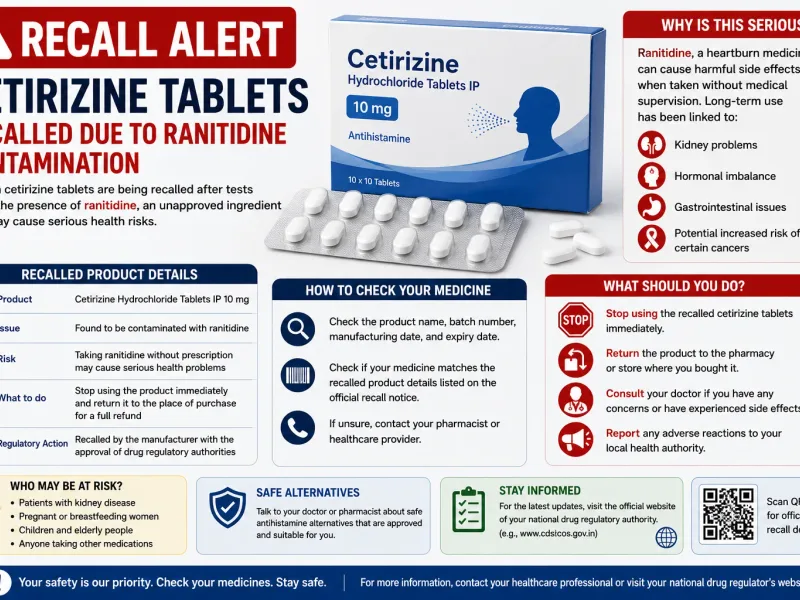
Four lots of Cetirizine Hydrochloride Tablets USP 5 mg were voluntarily recalled on July 18, 2026, by Unique Pharmaceutical Laboratories due to potential cross-contamination with ranitidine, a stomach acid-reducing drug. The recall was initiated after a pharmacy technician noticed red dots and discoloration on the tablets while counting them. For people with a hypersensitivity (allergic sensitivity) to ranitidine, taking contaminated cetirizine could trigger a life-threatening allergic reaction, including anaphylaxis. No adverse events have been reported in connection with this recall, according to the FDA.
The recall covers a specific product sold exclusively through one distributor in 100-count bottles. Here are the exact details from the FDA recall notice:
Product name: Cetirizine Hydrochloride Tablets USP 5 mg
Manufacturer: Unique Pharmaceutical Laboratories (a division of J.B. Chemicals & Pharmaceuticals Ltd., Panoli, Gujarat, India)
Distributor: Rising Pharma Holdings Inc., East Brunswick, New Jersey
NDC: 16571-401-10
Package size: 100-count HDPE bottle
Expiration date: October 2028
Affected lot numbers: GY825029, GY825030, GY825031, GY825032
Shipped: April 2026 through June 2026
Distribution: Nationwide, to wholesalers and retailers
To determine whether your cetirizine is part of this recall, check the lot number on your bottle. The lot number is printed on the label. If the number matches any of the four above and the NDC matches 16571-401-10, do not take the medication.
Important: Cetirizine is the active ingredient in brand-name Zyrtec, but Zyrtec-branded products are not included in this recall, according to AARP's reporting on the FDA notice. This recall affects only the Rising Pharma generic distribution of Unique Pharmaceutical Laboratories' product.
The recall traces back to a single alert from a pharmacy technician — a detail that is both reassuring (the system worked) and worth understanding.
A technician noticed something unusual: red dots on some tablets and visible discoloration on others while counting cetirizine tablets at the time of dispensing. The appearance of ranitidine tablets mixed in with white cetirizine tablets was physically visible, which led to the product complaint that triggered the manufacturer's investigation.
Laboratory testing confirmed the cross-contamination. The California Board of Pharmacy's recall documentation reveals that two of the four lots — GY825030 and GY825031 — specifically failed related substances testing by HPLC (high-performance liquid chromatography), a standard analytical method for detecting impurities. Follow-up mass spectrometry analysis identified ranitidine as the contaminant. Out of an abundance of caution, all four lots were recalled, including the two that had not individually failed.
The cause of the mix-up appears to have been a manufacturing cross-contamination event — likely from shared equipment or production lines not adequately cleaned between runs of different drugs — rather than intentional adulteration.
What Is Ranitidine and Why Does Its Presence Matter?
Ranitidine is a medication that reduces the amount of acid the stomach produces. It was once widely sold under the brand name Zantac and was a common treatment for heartburn, ulcers, and gastroesophageal reflux disease (GERD). In 2020, the FDA asked all manufacturers to withdraw ranitidine products from the US market after testing found that they contained unacceptable levels of N-nitrosodimethylamine (NDMA), a probable human carcinogen, according to the FDA's ranitidine NDMA update page. A reformulated version was subsequently approved in 2025.
The risk from the current cetirizine recall is different from the NDMA issue. Here, the concern is allergic sensitivity. Some people have a documented hypersensitivity to ranitidine — meaning their immune system reacts to it as a foreign threat. For a person with that sensitivity who unknowingly takes cetirizine tablets contaminated with ranitidine, the immune reaction could escalate rapidly into anaphylaxis.
Anaphylaxis is a severe, whole-body allergic reaction that can develop within minutes and is a medical emergency.
[REVIEWER: add clinical insight here — e.g., how ranitidine hypersensitivity differs from common ranitidine side effects, how common it is relative to the broader population, and what distinguishes a mild allergic response to ranitidine from one that is likely to progress to anaphylaxis]
What Are the Risk Symptoms?
The FDA's recall notice specifies that for those with ranitidine hypersensitivity, ingesting contaminated cetirizine tablets may cause the following life-threatening symptoms:
Hypotension (sudden drop in blood pressure)
Dyspnea (difficulty breathing or shortness of breath)
Difficulty swallowing
Throat and facial edema (swelling of the throat or face)
Generalized pruritus (widespread itching)
Urticaria (hives — raised, itchy welts on the skin)
Loss of consciousness
These symptoms can appear quickly after exposure and can escalate rapidly. If you or someone you know develops any of these symptoms — particularly throat swelling, difficulty breathing, or a sudden drop in blood pressure — call 911 immediately. Do not wait to see if it improves on its own.
For people with no known sensitivity to ranitidine, the FDA has not indicated a specific health risk from taking the contaminated tablets. However, the appropriate step is still to stop taking the recalled product and contact your pharmacist or prescriber.
Who Is Most at Risk?
Not everyone who took these tablets faces equal risk. The severe reactions described in the FDA notice are specifically tied to individuals with hypersensitivity to ranitidine or its components.
People more likely to fall into this category include those who have previously had an allergic reaction after taking ranitidine (Zantac or a generic equivalent), including skin rash, hives, itching, swelling, or breathing difficulty. Anyone with a known drug allergy documented in their medical records should be particularly careful to check whether they have the recalled lot.
People with a history of anaphylaxis to any medication face elevated risk from unexpected exposure to allergens through cross-contaminated products. If you are uncertain about your sensitivity history, contact your pharmacist, who can access your prescription records.
What to Do If You Have the Recalled Tablets
Step 1: Check your bottle. Look at the lot number and NDC printed on the label. If it reads NDC 16571-401-10 and the lot number is GY825029, GY825030, GY825031, or GY825032, the product is recalled.
Step 2: Stop taking the medication immediately. Do not finish the bottle. Set it aside until you speak with your pharmacist.
Step 3: Contact your pharmacist. Rising Pharma Holdings Inc. is the distributor managing the recall. You can also contact them directly at 844-874-7464 or by email at pv@risingpharma.com or qa@risingpharma.com, according to the FDA recall notice. Your pharmacist can also advise on returning the medication and arranging a replacement.
Step 4: Do not simply throw the tablets away without checking. If you need your allergy medication and are running low, speak with your pharmacist before discarding so they can arrange an alternative prescription or over-the-counter replacement.
Step 5: Report adverse reactions. If you have already taken tablets from a recalled lot and experienced any unusual symptoms, report them to the FDA's MedWatch Adverse Event Reporting Program at 1-800-FDA-1088 or at fda.gov/medwatch.
[REVIEWER: add clinical insight here — e.g., guidance for pharmacists and prescribers receiving questions from patients who took recalled cetirizine, including how to assess whether a patient's previous ranitidine exposures suggest elevated risk, and what monitoring is appropriate for symptomatic patients]
What This Recall Is Not
Two important clarifications:
This is not a Zyrtec recall. The brand-name Zyrtec product is manufactured by a different company and is not part of this recall, according to AARP's reporting on the FDA notice. If your cetirizine bottle says Zyrtec or is from a different manufacturer, it is not covered by this recall.
This is not the NDMA-ranitidine cancer risk. The 2020 ranitidine recalls involved long-term exposure to a probable carcinogen. The risk in this recall is entirely different: it is an acute allergic reaction risk specific to people who are hypersensitive to ranitidine. People without known ranitidine sensitivity are not facing the same type of cancer-related concern from this contamination.
FAQ
What lot numbers of cetirizine are recalled? The four recalled lot numbers are GY825029, GY825030, GY825031, and GY825032. All are Cetirizine Hydrochloride Tablets USP 5 mg in 100-count HDPE bottles with NDC 16571-401-10, expiration date October 2028, manufactured by Unique Pharmaceutical Laboratories and distributed by Rising Pharma Holdings Inc.
Is Zyrtec part of this cetirizine recall? No. Brand-name Zyrtec is manufactured by a different company and is not included in this recall. The recall affects only the Rising Pharma generic distributed under NDC 16571-401-10, in 100-count bottles from lot numbers GY825029 through GY825032.
What should I do if I already took tablets from the recalled lots? If you have no known sensitivity to ranitidine and have no unusual symptoms, contact your pharmacist to return the medication and obtain a replacement. If you have a known ranitidine allergy or experience any unusual symptoms — especially difficulty breathing, swelling of the throat or face, hives, or dizziness — seek emergency medical care immediately.
Why was ranitidine in the cetirizine tablets? The contamination appears to have been a manufacturing cross-contamination — ranitidine tablets from a different product run physically mixed into the cetirizine tablets, likely due to inadequate equipment cleaning between production runs. A pharmacy technician spotted the discrepancy after noticing red dots and discoloration in the white cetirizine tablets.
Who should be most concerned about this recall? People with a documented hypersensitivity or prior allergic reaction to ranitidine (Zantac or its generic equivalents) face the greatest risk. For everyone else, the appropriate step is to check the lot number, stop taking the product if it is recalled, and contact their pharmacist for a replacement.
Practical Takeaway
Go to your medicine cabinet now. If you have a 100-count bottle of cetirizine 5 mg from Rising Pharma — NDC 16571-401-10 — check the lot number on the label. If it reads GY825029, GY825030, GY825031, or GY825032, do not take it. Call your pharmacist to return it and get a replacement. If you have a known allergy to ranitidine and you have already taken tablets from one of these lots, contact your doctor or go to an emergency department immediately. No adverse events have been reported yet — but the window for a serious reaction in a sensitive individual is real.
This article must be reviewed and attributed to a named, qualified medical reviewer — such as a board-certified pharmacist, allergist, or clinical pharmacologist — before publishing. It is intended for general education only and does not constitute medical advice. For the most current recall details, consult the official FDA recall notice.
Sources
US Food and Drug Administration (FDA). Unique Pharmaceutical Laboratories Issues Voluntary Nationwide Recall of Cetirizine Hydrochloride Tablets USP 5 mg Due to Potential Cross Contamination with Ranitidine, July 18, 2026.
AARP. Cetirizine Allergy Drug Recalled Over Contamination, July 2026.
Asthma and Allergy Foundation of America (AAFA). Recall Alert: Prescription Cetirizine Due to Cross Contamination, July 2026.
California Board of Pharmacy. Rising Pharma Holdings Inc. Recall Notice — Cetirizine Hydrochloride Tablets USP 5 mg, July 2026.
ABC News. Allergy Medication Recalled for Potential Cross-Contamination with Ranitidine, July 2026.
CBS News. Antihistamine Recall Triggered by Heartburn Drug Contamination Risk, FDA Says, July 2026.
Fox Business. Allergy Medication Recalled for Possible Drug Mix-Up That Could Trigger Life-Threatening Reactions, July 2026.
FDA. FDA Updates and Press Announcements on NDMA in Zantac (Ranitidine).
Category
Drug Safety / Consumer Health / Pharmacy
Image Suggestion
An editorial photograph of a 100-count HDPE prescription bottle of white tablets on a pharmacy counter, with a printed FDA recall notice placed beside it. The label on the bottle should be partially visible, emphasizing the lot number area — the key identifying detail consumers need. Avoid alarming red-warning stock imagery; the practical "check your bottle" angle is the message.
Schema Suggestion
MedicalWebPage + FAQPage MedicalWebPage signals E-E-A-T credibility appropriate for a YMYL drug-safety article sourced directly from FDA recall notices and pharmacy board documentation; FAQPage enables rich result display for the five FAQ entries in Google Search and AI Overviews, including the high-urgency "what lot numbers are recalled" query that consumers need answered immediately.