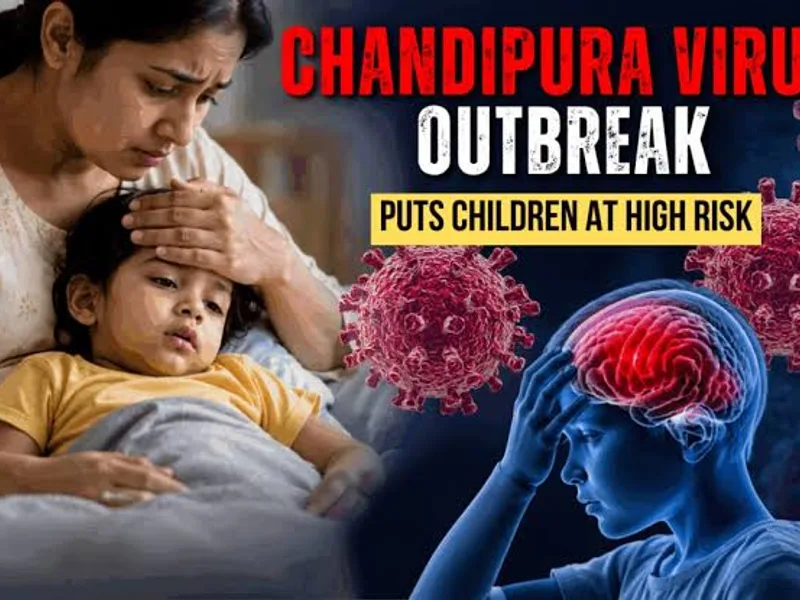
Gujarat's health department has spent the first week of August fielding a question no parent wants to ask: why is my child's fever not going away? As of early August 2026, the state has confirmed positive cases of Chandipura virus out of 184 suspected cases in children under and of those children have died. Cases have also been reported in bordering districts of Rajasthan.
The Union Health Ministry has sent in its National Joint Outbreak Response Team, and investigators are working under a "One Health" framework — meaning they're looking at humans, animals, and the environment together, not just the virus in isolation. That's a sensible approach for a disease whose exact triggers still aren't fully pinned down.
If this sounds familiar, that's because it should. Chandipura virus isn't a new pathogen that appeared out of nowhere. It's a recurring visitor to western and central India, and this is far from its worst outing.
What Chandipura Virus Actually Is
Chandipura virus (CHPV) belongs to the Rhabdoviridae family — the same viral family as rabies, though the two diseases behave very differently and one does not turn into the other. It was first picked up in 1965 in a village called Chandipura in Maharashtra, which is where the name comes from.
In clinical practice, this is often the part that gets missed early on: CHPV doesn't look dangerous at first. A child comes in with a high fever, maybe some vomiting, and looks like any other case of a monsoon viral illness. The trouble is how fast it can turn.The illness can progress from what looks like a routine fever to fatal brain inflammation within 24 to 48 hours, which is a brutally short window for a family to recognise something is seriously wrong and get to a hospital.
How the Virus Spreads
The main carrier in India is the female phlebotomine sandfly, a tiny insect much smaller than a mosquito and easy to miss. These sandflies breed in cracks in mud-brick walls, damp cattle sheds, and piles of organic debris — conditions that are common in rural and semi-urban homes during and after the rains.
Some researchers have also flagged Aedes mosquitoes and ticks as possible secondary carriers, though sandflies remain the dominant route of transmission in outbreak settings. One reassuring fact worth repeating clearly: there's no confirmed evidence of the virus spreading directly from person to person. This is an insect-borne disease, not a contagious one in the way flu or measles is.
Symptoms Parents Shouldn't Wait Out
The early signs are frustratingly ordinary — sudden high fever, sometimes with chills. But watch closely for what comes next, because this is where CHPV separates itself from an everyday viral fever:
Repeated vomiting
Altered consciousness, confusion, or unusual drowsiness
Seizures or convulsions
Signs of a change in behaviour or responsiveness in a young child
If a child's fever is paired with any drop in alertness or a seizure, that is not a "wait and see how the night goes" situation. Head to a hospital or an emergency department immediately. Early referral to a facility equipped to manage acute encephalitis syndrome has consistently been linked to better outcomes in past outbreaks.
Why Children Bear the Brunt
Almost every confirmed case in this outbreak, and in previous ones, involves children under 15. Nobody has a fully settled explanation for why the disease hits this age group so hard, though a developing nervous system and different patterns of outdoor and evening exposure near sandfly breeding sites are both thought to play a role.
Is that a fully satisfying answer? Not really. And that gap in understanding is part of why researchers keep pushing to study this virus more seriously, rather than treating it as a problem that quietly resolves once the monsoon ends.
Diagnosis and Treatment: Where Things Stand
There is still no antiviral drug built specifically for CHPV, and no vaccine. Management in hospital is what doctors call "supportive care" — controlling fever, managing seizures, protecting the airway, and treating complications as they arise, rather than attacking the virus directly.
This is general medical information, not a treatment plan. If a child in an affected area develops encephalitis-type symptoms, the right move is a pediatrician or an emergency physician, not home remedies or a wait-and-watch approach. A pediatrician near you or the nearest emergency care service should be your first call, not your last resort.
What Families Can Actually Do
Vector control is the backbone of prevention here, since there's no vaccine to fall back on:
Keep children away from cattle sheds and areas with cracked mud walls, especially at dusk and after dark, when sandflies are most active
Use insect repellents on exposed skin for children playing outdoors in the evening
Plaster and seal cracks in walls where sandflies breed
Use bed nets, ideally insecticide-treated ones, particularly for young children
Clear organic debris and damp waste near the home where possible
None of this guarantees safety, and it shouldn't be sold that way. But it meaningfully reduces exposure, which is the only lever families currently have.
A Pattern That Keeps Repeating
This isn't the first time. Outbreaks have shown up periodically since the early 2000s — Gujarat in 2005, smaller clusters in Maharashtra in 2009, more cases in 2010, scattered reports through 2016 and 2019, and then a larger national outbreak in 2024 that the <cite index="5-1">WHO recorded as 245 AES cases with 82 deaths across multiple states</cite>, the largest CHPV event in two decades at the time. Now, 2026 has produced another serious monsoon season.
That repetition matters. It suggests this isn't a freak event but a disease that returns whenever conditions line up, which makes the case for sustained research funding and stronger rural health infrastructure a lot harder to ignore.