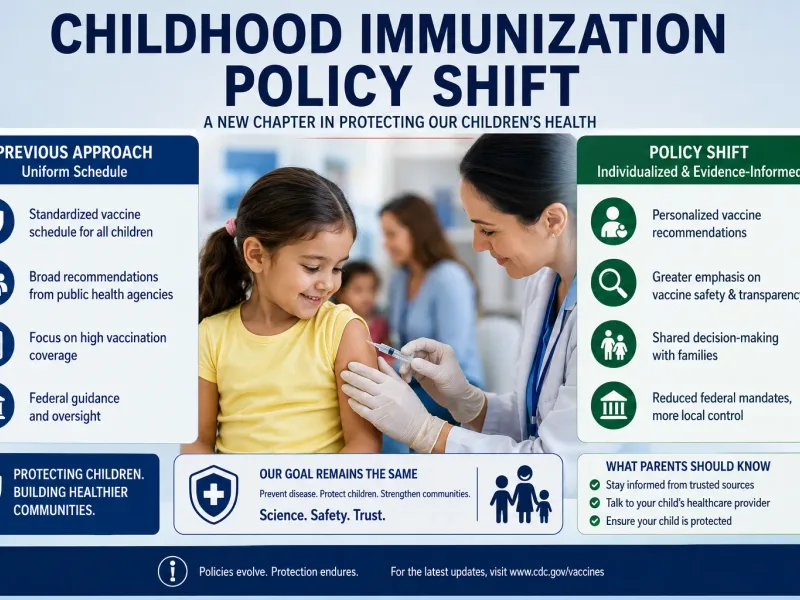
What the childhood immunization policy shift means
A childhood immunization policy shift is not simply a change in which vaccines children receive. It can affect when vaccines are recommended, who is considered eligible, how catch-up vaccination is handled, and how doctors explain benefits and risks to families.
The issue became particularly visible in the United States after major changes to the federal vaccine advisory system and childhood schedule. In June 2025, the U.S. Department of Health and Human Services reconstituted the Advisory Committee on Immunization Practices, or ACIP, the expert group that advises federal health officials on vaccines.
Later in 2025, ACIP recommendations moved some childhood vaccinations toward individual or shared decision-making. These included COVID-19 vaccination and, in certain circumstances, hepatitis B vaccination for newborns whose mothers tested negative for hepatitis B.
But the story did not end there.
Why the U.S. vaccine schedule became controversial
The federal government issued a revised childhood immunization schedule in January 2026. A federal court subsequently stayed implementation of that schedule and stayed the appointments of several ACIP members and votes taken by that committee. The CDC now states that the July 2, 2025 schedule is the current federal child and adolescent schedule while the legal proceedings continue.
That distinction matters. Parents reading that a "new vaccine schedule" has been announced may assume it automatically replaces the schedule their child's doctor is using. In this case, the legal order means the situation is more complicated.
The American Academy of Pediatrics has also published its own 2026 childhood and adolescent immunization schedule. Its policy page says the schedule is revised annually to reflect current vaccine recommendations.
For families, this creates an uncomfortable question: Which schedule should I follow?
The safest answer is not to choose a schedule from a social-media post. A pediatrician should review the child's age, previous vaccinations, health conditions, travel plans and exposure risks before advising on any individual vaccination decision.
Parents looking for a pediatrician in Kolkata can use a qualified local clinician to discuss these questions. Doctar also lists Dr. Rama Manna, Dr. Kajari Sarkar Biswas, and Dr. Sabyasachi Bhattacharya among pediatricians in Kolkata.
What has actually changed?
The recent policy debate has involved several different questions rather than one blanket vaccine change.
COVID-19 vaccination
In September 2025, ACIP recommended an individual decision-making approach for COVID-19 vaccination for people aged six months and older. The recommendation placed greater emphasis on the child's or person's individual risk of severe COVID-19 and discussion with a healthcare professional.
That does not mean parents should independently stop or start vaccination. It means the policy framework shifted toward a more individualized discussion.
Hepatitis B vaccination
Hepatitis B was another major point of debate. In December 2025, ACIP voted to move the decision about the birth dose toward individual decision-making for babies born to mothers who tested negative for hepatitis B.
The subsequent court order stayed that change. The CDC's current posted schedule therefore remains an essential reference when describing the federal position.
Chickenpox vaccination
ACIP also recommended standalone varicella, or chickenpox, vaccination for toddlers rather than using the combined measles, mumps, rubella and varicella vaccine in that age group. The rationale included evidence that MMRV was associated with a higher risk of fever-related seizures in some 12–23-month-old children compared with separate MMR and varicella vaccination.
This is a good example of why vaccine policy cannot be reduced to "more vaccines" versus "fewer vaccines." Sometimes the question is which formulation should be used and when.
What about India?
India has its own public immunization programme, so a U.S. policy dispute does not automatically change what Indian children should receive.
The Ministry of Health and Family Welfare's National Immunization Schedule includes vaccines such as BCG, oral polio vaccine, hepatitis B, DPT-containing vaccines, measles-rubella, rotavirus and pneumococcal vaccination, with schedules varying by age and programme eligibility.
Parents in India should therefore check the National Immunization Schedule and their pediatrician's advice, rather than importing another country's vaccine schedule.
For local care, Doctar lists Dr. Shampa Mitra Pahari, Dr. Hinglaj Saha, Dr. Sushmita Banerjee, Dr. Ritajyoti Sengupta, and Dr. Subhasis Saha.
In clinical practice, this is often missed because parents focus on the name of a vaccine rather than the child's complete vaccination record. A doctor usually needs to see the previous doses and their dates before deciding whether a child is up to date or needs catch-up vaccination.
Why catch-up vaccination matters
A missed vaccine does not necessarily mean a child must start an entire vaccine series again. CDC catch-up guidance specifically provides age-based intervals for children and adolescents whose vaccinations are delayed, and the correct approach depends on the vaccine and the child's age.
Families can also consider a home-visit pediatrician service in Kolkata or explore home-visit pediatricians across India when travel to a clinic is difficult.
For children who need broader medical assessment, Doctar also has listings for Dr. Debasish Mitra, Dr. Soumik Dhar, Dr. Paromita Roy, Dr. Saptarshi Das, Dr. A J Chitkara in Delhi, and Dr. Shubhra Doctor in Delhi.
Where vaccination services may be available
Parents may also encounter vaccination services through hospitals and public health facilities. Doctar listings currently identify vaccination facilities at places such as Bhagirathi Neotia Woman & Child Care Centre, CGHS Wellness Centre, Barrackpore, Bidhannagar Sub-Divisional Hospital, and James Long Clinic.
Other Doctar-listed facilities include Renaissance Hospital, Teghoria, PG Hospital - IPGMER and SSKM Hospital, Chittaranjan Seva Sadan Hospital, and V.I.P. Apex Medical Centre. Availability and services can change, so families should confirm directly before visiting.
The bigger issue is trust
The most consequential part of a childhood immunization policy shift may be the uncertainty it creates.
Vaccination recommendations work best when parents can clearly understand who made the recommendation, what evidence supports it, and whether the recommendation is currently in force. Rapid policy changes, legal challenges and competing schedules can make that harder.
The practical response is simple: keep your child's vaccination record, use the immunization schedule that applies in your country, and ask a qualified pediatrician to clarify any conflicting information before making a decision.