Cholesterol Guideline Update 2026: What Changed and Why
Guidelines rarely make headlines. This one did. In March 2026, <cite index="67-1">the American College of Cardiology, the American Heart Association, and nine other medical associations issued an updated guideline for managing dyslipidemia, the medical term for abnormal cholesterol and other blood fat levels. It replaced guidance that had been in place since 2018, and the changes aren't cosmetic.
Why This Update Matters More Than It Sounds
Cholesterol guidelines shape a lot of quiet decisions. They influence what your doctor flags as normal on a lab report, when a statin gets suggested, and how aggressively your numbers get tracked over time. When those thresholds shift, so does the experience of a huge number of routine checkups.
Roughly one in four US adults has high LDL cholesterol, the type most strongly linked to heart attack and stroke risk. That was already true under the old guideline. What's new is how the update reframes who counts as "high risk" and how early doctors are now encouraged to step in.
The Big Change: LDL Targets Are Back
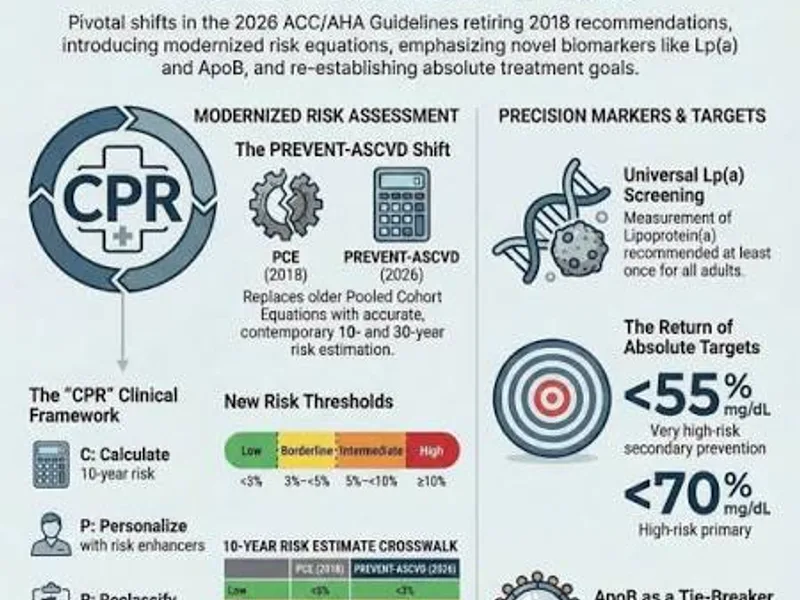
The new guideline restores specific treatment goals for LDL cholesterol based on a person's individual risk level, something the 2018 version had moved away from in favor of broader risk categories. This is the change cardiologists seem most vocal about.
For people who've already had a cardiovascular event like a heart attack, the numbers are notably strict. The guideline sets an LDL target under 55 mg/dL for people at very high risk, and under 70 mg/dL for others with established cardiovascular disease who aren't considered very high risk.More broadly, the guideline reintroduces a general LDL goal under 100 across the board, tightening to under 70 for people with certain risk factors or prior cardiac events.
If you've read your own lab results before and weren't sure what number you were supposed to be aiming for, that confusion was somewhat by design under the older approach. This update brings back a clearer target, which our guide on understanding high cholesterol breaks down in plainer terms if you want the fundamentals first.
A New Test Most People Haven't Heard Of: Lp(a)
This is arguably the more practical change for everyday patients. <cite index="62-1">The guideline now recommends universal screening of adults for elevated lipoprotein(a), known as Lp(a), a lipoprotein recognized as an independent cause of atherosclerotic cardiovascular disease, separate from LDL cholesterol.
In plain terms, Lp(a) is a cholesterol-carrying particle in your blood that's largely determined by genetics rather than diet or exercise. Two people with identical LDL numbers can have very different heart disease risk if one has high Lp(a) and the other doesn't. That's exactly the kind of thing standard cholesterol panels have historically missed.
In clinical practice, this is often the piece patients are surprised by. Someone can eat well, exercise regularly, and still carry meaningfully elevated cardiovascular risk because of an inherited lipoprotein pattern nobody thought to test for. The new guideline recommends this Lp(a) measurement be included as part of cardiovascular risk assessment for essentially all adults, not just those with a known family history.
Screening Now Starts in Childhood
This part surprises a lot of parents. The guideline recommends that cholesterol screening begin as early as ages 9 to 11, with follow-up testing recommended again around age 19.Universal lipid screening for children in that age range is meant to catch inherited cholesterol disorders, like familial hypercholesterolemia, far earlier than they'd otherwise be found.</cite>
One of the guideline's core themes is treating LDL earlier across the entire life course, noting that elevated cholesterol matters even in young adults, not just people over 40 or 50.Committee members have been direct about this, noting that high cholesterol begins affecting heart disease risk as early as adolescence.
Whether that changes how often your own children get screened is a conversation worth having with their pediatrician, not something to act on unilaterally based on a blog post. But it's a meaningful shift from how cholesterol testing has traditionally been treated as a middle-age concern.
A New Risk Calculator and Additional Markers
The 2026 guideline incorporates the newer American Heart Association PREVENT-ASCVD equations for calculating cardiovascular risk, along with expanded use of biomarkers like apolipoprotein B, or apoB, alongside Lp(a). is another marker some cardiologists consider more precise than standard LDL numbers, since it reflects the total count of potentially harmful particles rather than just their cholesterol content.
The guideline also reviews practical treatment algorithms for people with diabetes, established cardiovascular disease, or statin intolerance, along with guidance specific to certain populations.If statins haven't agreed with you in the past, this update gives doctors a clearer framework for what to try next instead of simply lowering the dose and hoping for the best.
New Medication Options Get a Mention Too
The guideline also incorporates five newer FDA-approved lipid-lowering therapies that weren't available when the 2018 version was written. Statins remain the backbone of treatment for most people, and our explainer on statin interactions with grapefruit is still worth a read if you're newly prescribed one. But it's worth knowing that non-statin options have expanded meaningfully since the last update, particularly for people who can't tolerate statins or need additional LDL lowering beyond what a statin alone achieves.
Does This Mean You Need New Tests Right Away?
Not necessarily, and definitely not without talking to your doctor first. If you've had a cholesterol panel recently and your doctor didn't flag anything, there's no need to panic or demand a full re-workup tomorrow. But at your next routine visit, it's reasonable to ask whether Lp(a) testing applies to you, especially if you have a family history of early heart disease or a personal history that doesn't fully explain your cholesterol numbers.
Cholesterol doesn't just affect the heart either. It's worth remembering that lipid levels also play a role in brain health, which is a good reminder that these guideline updates aren't just about a single number on a lab slip.
Talking to Your Doctor About the Update
If you're unsure whether any of this changes your own care, that's a completely normal reaction, and it's a fair thing to bring up directly. Ask your doctor whether your current LDL target has shifted under the new guideline, whether Lp(a) testing makes sense for you, and whether your risk calculation should be redone using the newer PREVENT-ASCVD approach. You can search for a cardiologist or specialist near you or find a general doctor to start the conversation if you don't already have one.
People managing related conditions, like AFib, should also ask how the update touches their care, since diet and lifestyle factors for AFib overlap heavily with cholesterol management. The same goes for anyone recovering from a cardiac event; our guide on safe exercise after heart disease treatment covers how physical activity fits into the bigger risk-reduction picture alongside medication.