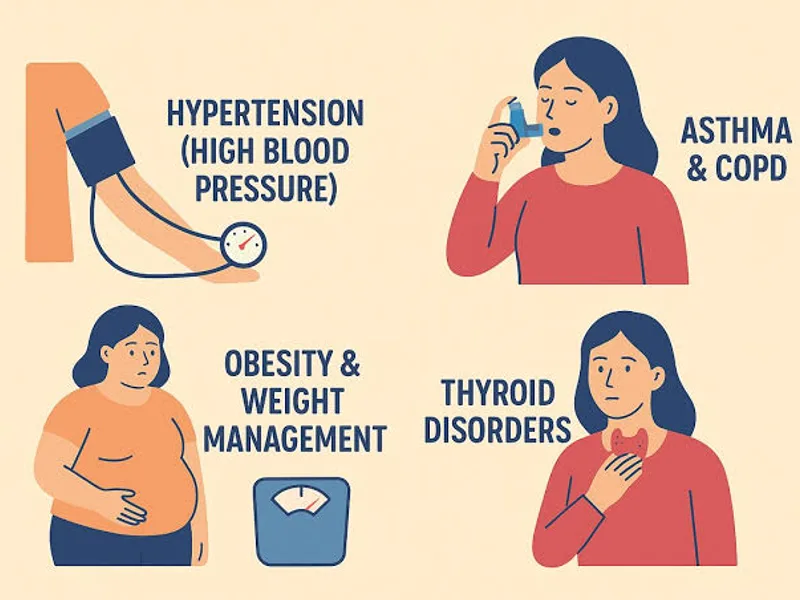
What "chronic condition management" actually means
Chronic condition management is the ongoing process of controlling a long-term health condition through a combination of medication, lifestyle habits, monitoring, and regular medical follow-up — as opposed to treating a single acute episode and moving on. For conditions like heart disease and asthma, the goal isn't a cure; it's keeping the condition controlled enough that it doesn't limit daily life or lead to a medical emergency.
Both conditions share a common thread in how experts frame management. The 2023 AHA/ACC guideline for chronic coronary disease describes effective management as combining lifestyle changes — increased physical activity, a balanced diet, and addressing tobacco use — with medication and, when needed, procedures that address the underlying disease mechanism. The CDC frames asthma similarly: most of the serious outcomes associated with the condition, including hospitalizations and deaths, are theoretically preventable when the condition is managed according to established guidelines.
Chronic coronary disease management starts with an honest risk assessment — a clinician reviewing your specific combination of risk factors, from blood pressure and cholesterol to smoking status and family history, to understand where you sit on the risk spectrum. This isn't a one-time step; it's revisited periodically as your health and treatment response change.
From there, day-to-day management typically combines several elements working together. Lifestyle changes — regular physical activity, a heart-healthy diet, and tobacco cessation where relevant — are described in the current AHA/ACC guideline as critical to improving outcomes, not as optional add-ons to medication. Medications targeting blood pressure, cholesterol, and clot prevention are prescribed based on individual risk factors, and taken consistently rather than only during symptomatic periods. For some patients, revascularization procedures may also be part of the treatment plan when medication and lifestyle changes alone aren't enough to manage the underlying blockage.
The current guideline notably emphasizes a more patient-centered approach that accounts for social determinants of health — recognizing that factors like access to healthy food, safe places to exercise, and consistent access to medication meaningfully affect how well a management plan actually works in someone's real life, not just on paper.
Effective asthma management, according to the CDC, rests on four pillars: controlling exposure to triggers that cause flare-ups, taking medication consistently and correctly, ongoing monitoring of how well-controlled the condition is, and patient education about the condition itself.
Trigger control looks different for each person, since asthma triggers vary — common ones include allergens like dust mites and pet dander, air pollution, respiratory infections, exercise, and cold air. Identifying your personal triggers, often with your doctor's help, is usually the first practical step toward reducing flare-up frequency.
Medication for asthma generally falls into two categories: long-term control medications, taken daily to reduce airway inflammation and prevent symptoms before they start, and quick-relief medications, used during a flare-up to open the airways rapidly. Understanding which of your medications does which job — and using each one correctly — is one of the most common gaps in self-management that clinicians see, since taking a quick-relief inhaler alone, without the daily controller medication, tends to leave the underlying inflammation unaddressed.
Ongoing monitoring often includes tracking symptom frequency and, for some patients, using a peak flow meter at home to catch early signs of worsening control before a full flare-up develops. This is where a written asthma action plan — a personalized, doctor-created guide for what to do as symptoms escalate — becomes genuinely useful rather than a piece of paper filed away.
What these two conditions have in common
Despite affecting entirely different organ systems, chronic heart disease and asthma management share a few core principles worth naming directly. Both depend heavily on consistency — medications taken as prescribed, not just when symptoms are noticeable — since much of what these medications do is prevent problems rather than treat them after the fact.
Both also benefit substantially from patient education and self-monitoring. A person who understands their own condition, recognizes their personal warning signs, and knows when a symptom warrants an urgent call to their doctor rather than a wait-and-see approach tends to have fewer emergency visits and better long-term outcomes than someone managing the condition passively.
And both conditions respond meaningfully to addressing risk factors that overlap between them — smoking cessation, for instance, benefits both cardiovascular and respiratory health directly, which is one reason it shows up as a priority across nearly every chronic disease management guideline regardless of which organ system is primarily affected.
Building a management routine that actually sticks
The gap between a good treatment plan on paper and a treatment plan that actually gets followed is where a lot of chronic disease management breaks down in practice. A few practical anchors tend to help: tying medication times to an existing daily habit (like brushing your teeth) rather than trying to remember them independently, keeping a simple symptom log — even a basic notes app entry — to spot patterns over time, and scheduling routine follow-up appointments in advance rather than waiting until something feels wrong.
It's also worth having a specific, concrete conversation with your doctor about what symptoms should prompt an urgent call versus a routine appointment versus emergency care. Having that threshold clearly defined in advance, rather than figuring it out in the moment, tends to reduce both unnecessary emergency visits and dangerous delays.
FAQ
What's the difference between managing a chronic condition and treating an acute illness? Acute illness treatment addresses a single episode and typically ends once it resolves. Chronic condition management is ongoing — it involves continuous medication, lifestyle habits, and monitoring aimed at keeping a long-term condition controlled and preventing complications over time.
What are the main components of asthma management? According to the CDC, effective asthma management includes controlling exposure to triggers, consistent and correct medication use, ongoing monitoring of symptom control, and patient education about the condition and how to respond to worsening symptoms.
Can lifestyle changes really make a difference for chronic heart disease? Yes. The current AHA/ACC guideline for chronic coronary disease describes lifestyle changes — physical activity, diet, and tobacco cessation — as critical to improving cardiovascular outcomes, used alongside medication and procedures rather than as a substitute for them.
What is an asthma action plan? It's a personalized, written plan created with your doctor that outlines your daily medications, your known triggers, and specific steps to take as symptoms worsen — including when a symptom crosses the line into requiring urgent or emergency care.
Why is medication consistency so important for chronic conditions? Many chronic disease medications work by preventing problems before they start rather than treating symptoms after they appear. Taking them only when symptoms are noticeable, rather than consistently as prescribed, often leaves the underlying condition inadequately controlled.
Takeaway
Managing a chronic condition well is less about a single big decision and more about a handful of small, repeatable habits — taking medication on schedule, knowing your personal warning signs, and following up with your doctor before something escalates rather than after. If your current routine feels like it's not sticking, that's worth raising directly at your next appointment rather than assuming it's a personal failing.
5. Sources
American Heart Association / American College of Cardiology (AHA/ACC) — 2023 Multisociety Guideline for the Management of Patients with Chronic Coronary Disease
Centers for Disease Control and Prevention (CDC) — "Asthma," Chronic Disease Indicators, and National Asthma Control Program
National Asthma Education and Prevention Program (NAEPP) — 2020 Focused Updates to the Asthma Management Guidelines