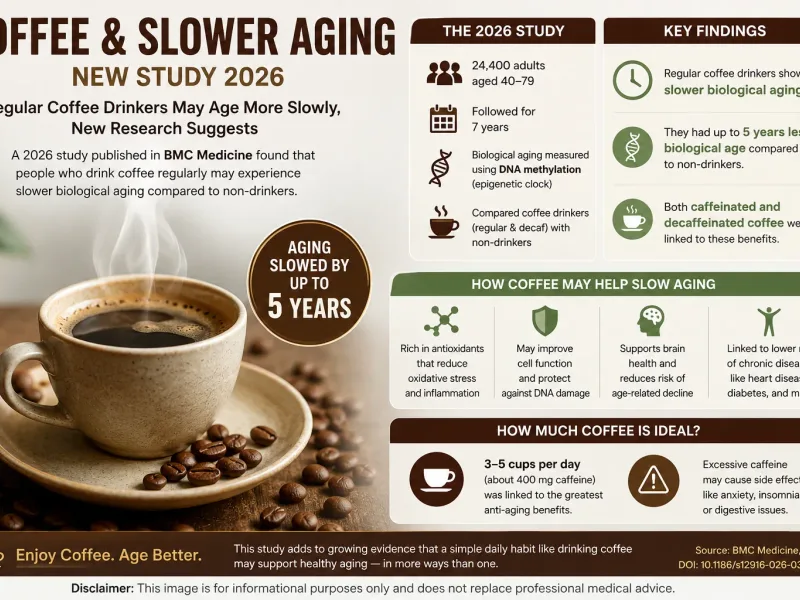
New research published in 2026 suggests that filtered coffee is associated with slower biological aging, while instant coffee may have the opposite effect — and scientists have identified a potential biological mechanism that could explain why. These findings come from two separate peer-reviewed studies, one analyzing nearly 50,000 adults and another pinpointing a protective cellular receptor that coffee compounds appear to switch on. Neither study proves coffee causes people to age more slowly, but together they offer the most detailed picture yet of how coffee and aging may be connected.
The most recent and largest of the 2026 studies was published in npj Science of Food in July 2026 by researchers at Chongqing Medical University. The team analyzed health data from 49,414 participants in the UK Biobank — a large, long-term health research database in the United Kingdom — with an average participant age of 56.4 years.
Biological aging was measured three ways: relative leukocyte telomere length (rLTL) — a measure of how well-preserved the DNA caps at the ends of chromosomes are — and two established biological age "acceleration" scores, PhenoAge Accel and KDM-BA Accel, derived from clinical blood markers. Longer telomeres and lower age acceleration scores suggest the body is aging more slowly relative to chronological age.
<cite index="31-1">The findings indicated that instant coffee correlated with accelerated biological aging as represented by increased scores in PhenoAge Accel and KDM-BA Accel and decreased relative telomere length compared to non-consumers.</cite> In contrast, <cite index="30-1">people who regularly drank filtered coffee generally had longer telomeres and lower biological age scores, suggesting their bodies may be aging more slowly.</cite>
Crucially, <cite index="33-1">the researchers stressed that the findings show an association, not a cause-and-effect relationship, and cautioned that lifestyle, diet, genetics, and other health factors may also influence the results.</cite> Prospective and intervention studies — where researchers follow people over time or randomly assign them to drink different types of coffee — are needed before the results can inform dietary guidelines, the authors wrote.
This is the question the study raises but does not fully resolve. The researchers identified inflammation and metabolic markers as potential statistical mediators — meaning these pathways may help explain some of the difference. <cite index="35-1">The study found that markers of metabolism and inflammation helped explain about 35 percent of instant coffee's negative effects on aging biomarkers.</cite>
One leading hypothesis involves the filtering process itself. Paper filters trap oily compounds called diterpenes — specifically kahweol and cafestol — that are present in unfiltered and instant coffee. These compounds have been shown to raise LDL cholesterol (the type associated with cardiovascular risk), and may have other physiological effects that interact with aging pathways. Filtered coffee retains more of its polyphenols and antioxidants while removing these oils.
The processing of instant coffee is also substantially different from filtered brewing. Instant coffee is typically spray-dried or freeze-dried from brewed coffee concentrate, a process that may degrade or alter heat-sensitive bioactive compounds that survive in freshly brewed filtered coffee. Which of these differences matters most for aging biology is not yet established.
[REVIEWER: add clinical insight here — e.g., what is currently understood about the physiological differences between filtered and instant coffee from a nutritional standpoint, and how a clinician or registered dietitian would counsel a patient asking whether to switch from instant to filtered coffee based on this research]
The Texas A&M Study: A Potential Biological Mechanism
A separate study, published in the journal Nutrients in March 2026, approached the coffee-aging question from a different direction — not population data, but cell biology. Researchers at the Texas A&M College of Veterinary Medicine and Biomedical Sciences focused on a receptor called NR4A1.
<cite index="25-1">The research focuses on a receptor known as NR4A1, described by researchers as an "aging protective gene" that helps the body respond to stress and damage. Researchers found compounds in coffee, particularly polyphenols and caffeic acid, can activate the NR4A1 receptor. According to the study, that activation may help reduce cellular damage and slow cancer cell growth in laboratory models.</cite>
<cite index="22-1">Caffeine wasn't the standout — instead, it was compounds like polyhydroxy and plant-based polyphenolic compounds that were "much more active," explained study author and professor Dr. Stephen Safe.</cite>
<cite index="24-1">Compounds in coffee appear to activate NR4A1, a receptor that helps protect cells from stress, inflammation, and damage. These protective effects disappeared when the receptor was removed, strengthening the connection.</cite>
This last point is important: the researchers showed that removing NR4A1 worsened cellular damage, suggesting the receptor plays a causal role in the protective effect rather than simply correlating with it. That kind of mechanistic evidence adds weight to the association data from population studies. As Dr. Safe noted, <cite index="25-1">"We think we linked how coffee might work and that wasn't known before. Coffee can work on many different mechanisms and we think we've identified a major mechanism."</cite>
The findings also support why decaffeinated coffee may share some of the health-associated benefits of regular coffee. If the active compounds are polyphenols rather than caffeine, decaf drinkers retain much of the relevant chemistry.
Telomeres and Mental Illness: A Third 2026 Study
A third relevant study — published in BMJ Mental Health in late 2025, widely covered in 2026 — added another dimension. Researchers from King's College London analyzed 436 adults with severe mental illness, a population whose biological aging tends to accelerate faster than average.
<cite index="27-1">Researchers found that drinking up to four cups of coffee a day was associated with longer telomeres — protective caps on chromosomes that serve as markers of cellular aging — in people diagnosed with schizophrenia, bipolar disorder and psychotic depression. Those who drank three to four cups daily had telomeres consistent with a biological age about five years younger than participants who didn't drink coffee at all.</cite>
<cite index="27-1">However, for those who drank more than four cups a day, the benefits disappeared, and they actually saw signs of more cellular stress.</cite> The apparent sweet spot aligns with established guidance from health agencies: <cite index="23-1">the 3–4 cup limit aligns with the daily maximum recommended by several major health agencies, including the NHS and the US Food and Drug Administration.</cite>
This study was also observational and cannot prove causation. Its participants were adults with psychiatric diagnoses, so results may not generalize to the broader population.
What the Research Cannot Tell Us Yet
All three studies share an important limitation: they are observational. They identify associations between coffee habits and aging biomarkers — they do not prove that coffee causes people to age more slowly.
People who drink filtered coffee may differ from instant coffee drinkers in income, diet quality, access to fresh food, and many other health behaviors. Researchers try to adjust for these confounding factors statistically, but it is very difficult to account for every variable. This is a standard limitation of nutritional epidemiology, and it means any advice about changing coffee habits based solely on these studies would be premature.
What the research does establish is a biologically plausible mechanism — the NR4A1 receptor pathway — and a consistent pattern across multiple large datasets linking moderate filtered coffee intake with favorable aging biomarkers. That combination makes the hypothesis worth investigating in prospective clinical trials.
[REVIEWER: add clinical insight here — e.g., how to discuss these study findings with patients who ask whether they should change their coffee habits based on the 2026 research, and what caveats a clinician would typically apply when discussing observational nutritional research in a consultation]
Practical Context: What Current Guidelines Say
No major health authority has issued new coffee recommendations based on the 2026 aging studies. Existing guidance from the FDA and NHS suggests that up to 400 milligrams of caffeine per day — roughly four standard cups of coffee — is generally safe for most healthy adults. Pregnant people and those with certain cardiovascular conditions are advised to consume less, and should discuss their individual situation with a healthcare provider.
The 2024 Food & Function NHANES study, which analyzed 13,384 US adults, found moderate coffee consumption was associated with reduced biological age as measured by PhenoAge and KDM-BA algorithms — consistent with the UK Biobank findings. Together, the studies suggest a convergent signal from multiple datasets and methodologies, rather than an isolated finding.
FAQ
Does coffee actually slow aging? Current research shows an association between moderate filtered coffee intake and slower biological aging biomarkers — but no study has proven that coffee directly causes people to age more slowly. A July 2026 study in npj Science of Food found filtered coffee was linked to longer telomeres and better biological age scores in nearly 50,000 adults, while a Texas A&M Nutrients study identified a cellular receptor (NR4A1) that coffee compounds appear to activate and that is associated with reduced cellular stress.
Is filtered coffee better than instant coffee for aging? A July 2026 UK Biobank study found filtered coffee was associated with slower biological aging markers, while instant coffee was associated with the opposite effect. The researchers do not yet fully understand why, but differences in the chemical composition — including polyphenol content and the retention of compounds like diterpenes in instant coffee — may play a role. The study is observational and cannot prove that switching from instant to filtered will change how you age.
How many cups of coffee a day is linked to slower aging? Studies suggest moderate consumption — around three to four cups of filtered coffee per day — is associated with the most favorable aging biomarkers. A BMJ Mental Health study in people with severe mental illness found three to four cups daily was associated with telomere length equivalent to being about five years biologically younger. Benefits appeared to level off or reverse at five or more cups per day, consistent with FDA and NHS guidance to limit caffeine to around 400 mg daily (roughly four cups).
Does decaf coffee have anti-aging benefits too? Possibly. The Texas A&M study found that the most active compounds in coffee for activating the NR4A1 cellular receptor were polyphenols and caffeic acid — not caffeine. Since decaffeinated coffee retains these compounds, it may share some of the same biological properties. Research specifically on decaf and aging biomarkers is limited, and no definitive conclusions can be drawn from current evidence.
Should I change my coffee habits based on these studies? Not based on these studies alone. The findings are observational and cannot prove causation. No health authority has updated coffee guidelines based on the 2026 research. If you currently drink moderate amounts of filtered coffee and tolerate it well, the existing evidence is reassuring. If you have questions about caffeine, blood pressure, or how coffee fits into your overall diet, consult your healthcare provider.
Practical Takeaway
The 2026 research on coffee and aging is genuinely interesting and moves toward a biological explanation — not just a statistical one — for why coffee has repeatedly been associated with longer life in large population studies. The signal is consistent: moderate filtered coffee intake is linked to better aging biomarkers; very high consumption and instant coffee appear less favorable. But "associated with" is not the same as "causes." If you already drink filtered coffee in moderate amounts and tolerate it well, the current evidence is broadly reassuring. If you have health conditions affecting your caffeine tolerance, discuss the specifics with your doctor before changing anything.
Sources
Wang Y, Xiang P, Liu Z, et al. Discrepancies between instant and filtered coffee in biological aging: evidence from the UK Biobank. npj Science of Food. 2026. DOI: 10.1038/s41538-026-00988-0.
Safe S, et al. Coffee compounds activate NR4A1 receptor associated with aging and disease protection. Nutrients. March 2026. Texas A&M College of Veterinary Medicine and Biomedical Sciences. (Reported by Detroit News, Click2Houston, ScienceDaily, May 2026)
Mlakar V, et al. Coffee consumption and telomere length in adults with severe mental illness. BMJ Mental Health. November 2025. King's College London.
Chen X, Yin X, Gao Y, et al. From cup to clock: exploring coffee's role in slowing down biological aging. Food & Function. 2024;15:5655–5663. DOI: 10.1039/D3FO04177H.
US Food and Drug Administration. Spilling the Beans: How Much Caffeine Is Too Much?
Filtered coffee links to slower biological aging while instant coffee shows the opposite. July 20, 2026.
Category
Nutrition & Diet / Healthy Aging / Research & Science
Image Suggestion
An editorial photograph of a pour-over or drip coffee setup — a glass carafe with a paper filter, freshly brewed coffee visible inside — on a clean kitchen countertop beside an open scientific journal or printed research paper. The image should evoke the intersection of everyday habit and scientific inquiry, not a spa or wellness aesthetic. Avoid generic stock imagery of smiling elderly people holding coffee cups.
Schema Suggestion
MedicalWebPage + FAQPage MedicalWebPage signals YMYL E-E-A-T credibility for a health and nutrition topic grounded in named peer-reviewed studies; FAQPage enables rich result display for all five FAQ entries in Google Search and AI Overviews, including the high-traffic "does coffee slow aging" and "how many cups" queries that align precisely with 2026 search trends.