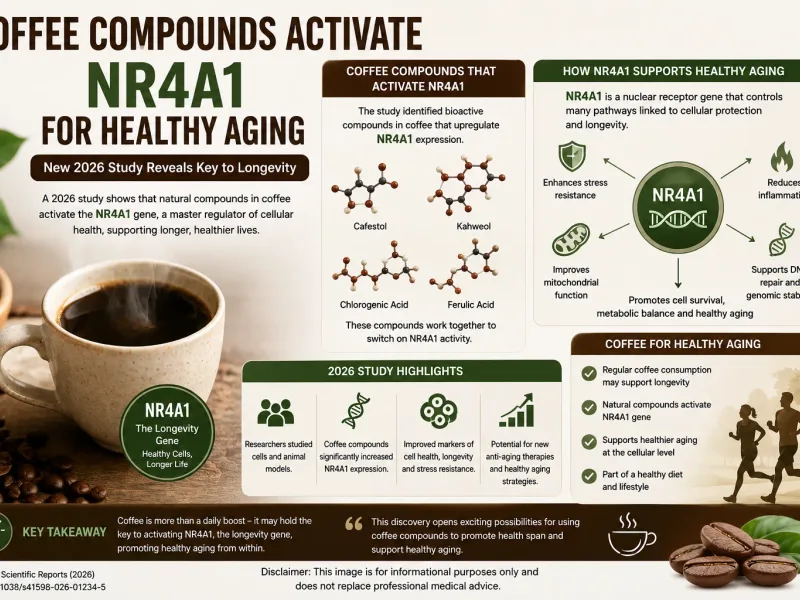
A 2026 study published in the journal Nutrients found that plant-based compounds in coffee activate NR4A1 — a cellular receptor that helps protect the body from stress, inflammation, and age-related damage — and that caffeine is not the primary driver. The research, conducted at Texas A&M University, provides a plausible molecular explanation for why coffee has long been associated with lower rates of several chronic diseases. Critically, removing NR4A1 from cells caused the protective effects of coffee to disappear, strengthening the case that this receptor mediates at least part of coffee's biological impact.
NR4A1 — also known as Nur77 or TR3 — is a protein that acts as a transcription factor, meaning it controls whether certain genes are switched on or off inside cells. It belongs to a family of proteins called orphan nuclear receptors, so named because researchers have not yet identified a naturally occurring hormone that binds to it in the traditional way.
Despite that label, NR4A1 is far from inactive. <cite index="43-1">In humans and mice, NR4A1 expression decreases with age, and loss of NR4A1 enhances disease susceptibility. Survival curves show that NR4A1-deficient mice live four months less than wild-type animals.</cite> Extended across a human lifespan, this would represent a substantial reduction in healthspan.
<cite index="44-1">Emerging evidence highlights that the NR4A1 receptor is a key transcriptional regulator of cytokine and growth factor action in diseases affecting our aging population. Previous research revealed that loss of NR4A1 increases DNA damage response and cellular senescence with age, accelerating the aging process in several mouse tissues.</cite>
Put plainly: the body has a built-in cellular defense system, NR4A1 is a central component of it, and it gets weaker as people age. Finding something that might reactivate or support that system is, scientifically speaking, meaningful.
The research was led by Dr. Stephen Safe, a Distinguished Professor and Sid Kyle Endowed Chair in Veterinary Toxicology at Texas A&M's College of Veterinary Medicine and Biomedical Sciences, in collaboration with Dr. Robert Chapkin, Dr. Roger Norton, Dr. James Cai, and Dr. Shoshana Eitan.
The team tested coffee extracts prepared from beans grown in Colombia and Guatemala — using methods designed to reflect everyday brewing — in laboratory cell models. <cite index="37-1">The researchers found that several compounds in coffee can bind to NR4A1 and alter its activity. The most active included polyhydroxy and polyphenolic compounds such as caffeic acid.</cite>
<cite index="43-1">The study hypothesizes that NR4A1 plays a protective role against stressor and inflammation-induced cell damage that accompanies the aging process. It also notes that some health-promoting polyphenolics bind NR4A1, suggesting that this receptor may also play a role as a nutrient sensor.</cite>
The critical control experiment was what made these findings stand out: <cite index="37-1">when the researchers removed NR4A1 from the cells, those protective effects disappeared. That result provided additional evidence that the receptor helps mediate at least some of coffee's biological effects.</cite>
This is stronger evidence than simple correlation. It suggests that NR4A1 is not just present in a system where coffee also has effects — it appears to be part of the mechanism through which those effects occur.
Caffeine Is Not the Active Ingredient
Perhaps the most practically significant finding in the Texas A&M study is what the researchers ruled out. Caffeine is coffee's most abundant and well-known chemical compound. It is not, however, the one driving NR4A1 activation.
<cite index="38-1">The study found it may not be responsible for these health benefits. Naturally occurring plant compounds — including caffeic acid, ferulic acid, chlorogenic acid, and p-coumaric acid — showed far stronger activation of NR4A1. "Caffeine binds the receptor, but it doesn't do much in our models," Safe said. "The polyhydroxy and polyphenolic compounds are much more active."</cite>
<cite index="43-1">Recent discoveries show that some health-promoting polyphenolics also bind NR4A1, suggesting that this receptor may also play a role as a nutrient sensor.</cite>
This distinction matters for two reasons. It explains why large population studies have consistently found that decaffeinated coffee offers health benefits that are similar — though not identical — to regular coffee. And it shifts the scientific focus from a single molecule (caffeine) to an entire class of plant-based compounds that are present in coffee regardless of whether it is caffeinated.
[REVIEWER: add clinical insight here — e.g., what a clinician or registered dietitian would tell a patient who asks whether switching to decaf changes the protective compound profile, and whether the research at this stage is sufficient to inform any dietary counseling on the type of coffee consumed]
The Compounds: What Are Polyphenols and Why Do They Matter?
Coffee is one of the richest dietary sources of polyphenols in the Western diet. Polyphenols are a large family of naturally occurring plant chemicals that give fruits, vegetables, tea, wine, and coffee their color and bitter notes. They are not nutrients in the traditional sense — the body does not require them the way it does vitamins or minerals — but research consistently links high polyphenol intake to lower rates of cardiovascular disease, type 2 diabetes, neurological conditions, and some cancers.
The specific polyphenols identified as most active in the Texas A&M study include:
Caffeic acid — found in high concentrations in coffee, formed during the roasting process; one of the strongest NR4A1 activators identified in the study
Chlorogenic acid — the most abundant polyphenol in coffee beans before roasting; partially converted to caffeic acid during the roasting and brewing process
Ferulic acid — a derivative of caffeic acid present in roasted coffee
Kahweol and cafestol — diterpene compounds (fat-soluble molecules) found in unfiltered coffee that also showed strong binding to NR4A1 in the study
The presence of kahweol and cafestol in the list of active compounds raises a question: these are the same compounds that paper filters remove from filtered coffee. They are known to raise LDL cholesterol — the type associated with cardiovascular risk. The Texas A&M study found they bind NR4A1 strongly; the npj Science of Food UK Biobank study found instant coffee (which retains more of these compounds but may differ in polyphenol content through processing) was associated with faster biological aging. How these forces interact is not yet resolved, and it illustrates the complexity of drawing practical dietary conclusions from early-stage mechanistic research.
How Does NR4A1 Actually Protect Cells?
<cite index="33-1">NR4A1 acts as an internal regulator, helping to control how cells respond to damage, inflammation, and metabolic stress — processes that are central to aging and many chronic diseases.</cite>
Its documented roles in peer-reviewed literature span several major disease pathways:
Inflammation control. NR4A1 regulates inflammatory signaling through pathways including NF-κB, one of the main switches controlling the body's inflammatory response. Research in animal models has shown that Nur77-deficient animals produce more pro-inflammatory cytokines in response to injury and recover more slowly, according to studies published in Oncotarget and the Journal of Cell and Molecular Medicine.
SIRT1 stabilization. <cite index="44-1">Research confirmed that Nur77 reduced SIRT1 protein degradation by the proteasome through negative transcriptional regulation of its E3 ligase MDM2, thereby stabilizing SIRT1 protein — and confirmed the important role of Nur77 in the prevention of aging nephropathy through SIRT1.</cite> SIRT1 is one of the most studied longevity-associated proteins in aging biology, and its declining activity with age is well-documented.
Cellular stress response. <cite index="33-1">"If you damage almost any tissue, NR4A1 responds to bring that damage down," Safe said. "If you take that receptor away, the damage is worse."</cite> In laboratory models, activating NR4A1 with coffee compounds reduced cellular damage and slowed cancer cell growth.
DNA damage response. <cite index="44-1">Loss of Nur77 increases DNA damage response and cellular senescence with age, accelerating the aging process in several mouse tissues.</cite> Cellular senescence — when cells stop dividing and begin to malfunction — is one of the leading hallmarks of biological aging according to current aging science.
[REVIEWER: add clinical insight here — e.g., how familiar the average clinician is likely to be with NR4A1 and how to frame this early-stage mechanistic research when patients ask whether this receptor is a target of any existing or investigational therapies]
What This Research Does Not Prove
This article would not be complete without clear-eyed limits.
The Texas A&M study was conducted in laboratory cell models — not in animals, and not in people. <cite index="36-1">A 2026 study in the journal Nutrients found that compounds in brewed coffee bind NR4A1, a cellular receptor involved in stress, inflammation, and aging — but the work was done in laboratory cell models, not in people. It points to a plausible mechanism rather than proving coffee slows aging.</cite>
The pathway from "this compound activates a receptor in a cell dish" to "drinking this food slows aging in humans" involves many intervening steps — absorption, metabolism, bioavailability in living tissue, dose, individual variation, and interactions with hundreds of other compounds in coffee and in the diet. None of those steps have been mapped in humans for coffee and NR4A1 specifically.
What the study does do is provide a biologically specific hypothesis, built on a receptor with a well-documented role in aging biology, that can now be tested in animal models and eventually clinical trials. That is how mechanistic science is supposed to work — it establishes a plausible "why" that justifies more rigorous investigation.
FAQ
What is NR4A1 and why does it matter for aging? NR4A1 (also called Nur77) is a cellular receptor that helps control how cells respond to stress, inflammation, and damage. Its activity naturally declines with age. Animal studies show that NR4A1-deficient mice live shorter lives and develop more severe disease. A 2025 FASEB Journal review identified NR4A1 as a promising target for anti-aging therapies.
Which coffee compounds activate NR4A1? The most active compounds in the Texas A&M Nutrients study were polyphenols — specifically caffeic acid, chlorogenic acid, ferulic acid, and p-coumaric acid. Two diterpenes, kahweol and cafestol, also showed strong binding. Caffeine itself was found to bind weakly and showed little activity in cell models. Most binding constants for the active polyphenols were below 10 micromolar, indicating biologically relevant activity.
Does decaf coffee also activate NR4A1? Probably, though the specific study used caffeinated coffee extracts. Because the most active compounds are plant-based polyphenols rather than caffeine — and decaffeinated coffee retains these compounds — researchers expect similar NR4A1 activity from decaf. This is consistent with population studies that have found decaf coffee linked to comparable health benefits in several large cohort analyses.
What happened when researchers removed NR4A1 from cells? The protective effects of coffee compounds disappeared entirely. This is an important mechanistic finding: it shows that NR4A1 is not just coincidentally present but appears to be required for coffee's cellular protective effects. When the receptor was removed, cellular damage worsened, consistent with the broader body of research showing that NR4A1-deficient animals suffer more disease and shorter lifespan.
Should I drink more coffee based on this research? No specific change in coffee habits is warranted by this study alone. It was conducted in laboratory cell models, not in people, and does not establish how much coffee — or which type — would be needed to meaningfully activate NR4A1 in humans. No health authority has updated coffee guidelines based on this research. If you currently drink coffee in moderate amounts, this study adds biological context to the health associations already observed. Consult your healthcare provider if you have questions specific to your health situation.
Practical Takeaway
The Texas A&M NR4A1 study is genuinely important — not because it tells you to drink more coffee, but because it identifies a specific, credible biological reason why coffee might do what population data has suggested for decades. NR4A1 is a receptor that declines with age, matters for inflammation and DNA repair, and can now be linked to coffee's polyphenols through direct cell-level evidence. The next step is animal and eventually clinical research. For now, the most responsible takeaway is that moderate coffee consumption appears, at minimum, not to be working against you — and this study offers a plausible explanation for why it may be working in your favor.
This article must be reviewed and attributed to a named, qualified medical reviewer — such as a board-certified internist, clinical nutritionist, or specialist in aging medicine — before publishing. It is intended for general education only and does not constitute dietary or medical advice. Mechanistic cell-level research is an early stage of the scientific process and does not directly translate to clinical recommendations.
Sources
Safe S, et al. NR4A1 Acts as a Nutrient Sensor That Inhibits the Effects of Aging. Nutrients. 2026;18(16):2709. DOI: 10.3390/nu17162709.
Texas A&M College of Veterinary Medicine and Biomedical Sciences. Coffee doesn't just wake you up — it may help protect your body from aging. April 29, 2026.
Wang X, et al. Controversy and multiple roles of the solitary nucleus receptor Nur77 in disease and physiology. FASEB Journal. March 2025. DOI: 10.1096/fj.202402775RR.
He X, et al. Mechanisms of orphan nuclear receptor Nur77 in liver health, disease, and therapeutic potential. npj Gut and Liver. 2025.
Li XM, et al. Orphan nuclear receptor Nur77 inhibits poly(I:C)-triggered acute liver inflammation by inducing the ubiquitin-editing enzyme A20. Oncotarget. 2017;8(27).
ScienceDaily. Coffee may help the body fight stress and aging through a hidden cellular switch. July 19, 2026.
Medical Daily. Scientists Find That Compounds in Coffee May Activate a Cellular Aging Defense System Beyond Caffeine. July 2026.
Coffee and Aging: What the NR4A1 Study Really Found. June 2026.
Image Suggestion
An editorial laboratory photograph showing a researcher's hands — in disposable gloves — holding a glass flask of dark brown coffee extract alongside a microscopy image of cells on a screen in the background. The setting should clearly be a research lab, not a kitchen or café, to anchor the mechanistic, scientific angle of this article. Avoid any generic "coffee cup and healthy older adult" wellness imagery.
MedicalWebPage + FAQPage MedicalWebPage signals E-E-A-T credibility for health and nutrition research grounded in peer-reviewed primary literature (Nutrients, FASEB Journal, PubMed Central); FAQPage enables rich result display for all five FAQ entries in Google Search and AI Overviews, including the high-interest "which coffee compounds activate NR4A1" and "does decaf coffee also work" queries that arise directly from the research.