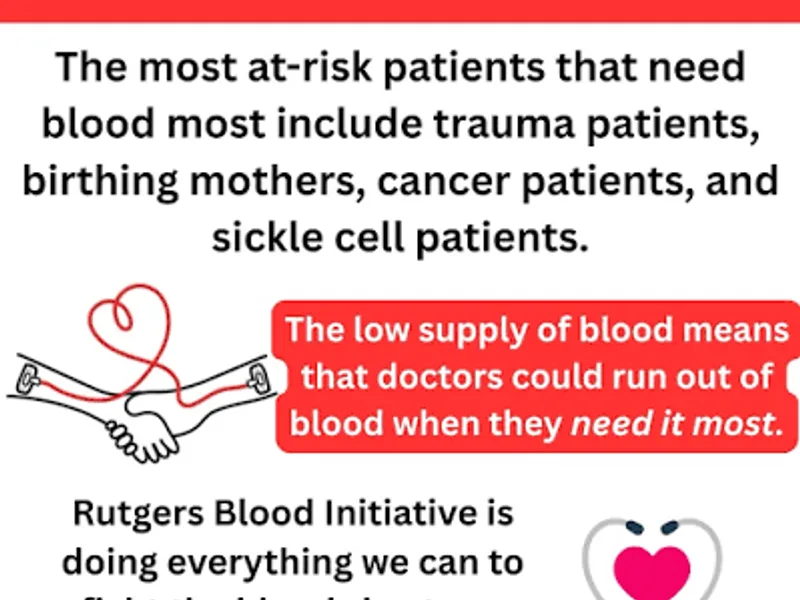
A community blood donation shortage can become a healthcare problem surprisingly quickly. When fewer eligible people donate, blood centres have less room to respond to accidents, surgery, childbirth emergencies and patients who depend on regular transfusions.
The problem is not simply the number of people willing to donate. Blood has a limited storage life, different blood groups are needed, and donations must be collected, tested, separated and stored safely. WHO says regular voluntary, unpaid donors are the backbone of a safe and sufficient blood supply.
Why communities experience blood shortages
Blood shortages rarely have one single cause. Donation numbers can fall during holidays, severe weather, outbreaks of illness, exam periods, travel seasons or when regular donation camps are cancelled.
There is also a basic supply problem: people do not need blood on a predictable schedule. A major accident can create sudden demand, while a quiet week may leave a blood centre with a very different inventory.
WHO notes that blood cannot be stored indefinitely, which means health systems need continuing donations rather than relying on occasional large campaigns.
Doctar's guide on [how often you can donate blood] How Often Can You Donate Blood? explains that whole-blood, platelet and plasma donations have different rules and recovery periods. The exact eligibility and donation interval should always be confirmed with the local blood centre.
Who depends on donated blood?
Blood transfusion is used in many parts of medicine. Trauma patients may need blood after severe bleeding, while some surgical patients require blood components during or after an operation.
People with conditions such as thalassaemia, sickle-cell disease and some cancers may require repeated transfusions. Blood can also be needed for serious anaemia and complications during pregnancy or childbirth.
Doctar's article on [acute anaemia caused by blood loss] Acute Anaemia From Blood Loss explains why sudden major blood loss can become a medical emergency.
For patients needing transfusion during pregnancy or other serious situations, Doctar also covers [blood transfusion in Deoghar] Female Blood Transfusion in Deoghar. The article discusses blood components, compatibility testing and the role of trained medical teams.
Blood is more than one product
A donated unit of whole blood can be separated into components. Depending on the patient's needs, hospitals may use red blood cells, platelets, plasma or other components rather than giving whole blood.
That distinction matters during a shortage. A centre may have adequate supplies of one component or blood group while another is running low.
Doctar's information on [low platelet counts and platelet transfusion] Low Platelet Count and Platelet Transfusion explains why platelets can be particularly important for some patients undergoing cancer treatment.
The site also discusses [thrombocytopenia and HIV] Thrombocytopenia and HIV, showing how low platelet counts can occur in certain medical conditions.
Plasma is another important component. Doctar's [plasma donation guide] How Often Can You Donate Plasma in India? explains how plasma donation differs from whole-blood donation.
Why regular donors matter
One large blood donation camp can create a useful short-term increase, but it cannot replace a stable donor base. Communities need people who return when they are eligible and healthy enough to donate.
WHO's current guidance continues to emphasise voluntary, unpaid donation and stronger donor systems as the foundation of a reliable blood supply.
In clinical practice, this is often missed because attention turns to blood donation only when a relative urgently needs a unit. The more dependable approach is quieter: build a community of regular donors before an emergency happens.
Doctar's [blood type guide] Understanding Blood Types in India also explains why knowing the ABO and Rh blood groups matters when blood is needed for transfusion.
Donating safely is part of the solution
A shortage should never lead people to ignore donor screening. Blood centres assess donors because the process must protect both the person donating and the person receiving the blood.
Eligibility can be affected by current illness, haemoglobin levels, recent procedures, certain medicines and other health factors. Doctar's [blood donation eligibility guide] Blood Donation Eligibility and Frequency Guide discusses these issues in the Indian context.
Someone who has recently had a tattoo may also have to wait before donating. Doctar's [tattoos and blood donation guide] Can You Donate Blood If You Have a Tattoo? explains why donation centres ask about tattoos, piercings and possible exposure to blood-borne infections.
Frequent donors should also pay attention to iron status. Doctar's article on [blood donation and anaemia] Can Donating Blood Cause Anaemia? explains why repeated blood donation can contribute to iron depletion in some people.
Do not start iron supplements simply because you donate blood. If you have concerns about fatigue, anaemia or iron levels, speak with a qualified doctor.
What communities can do
The most useful response is usually practical rather than dramatic. Local organisations, colleges, workplaces, resident groups and community associations can work with licensed blood centres to organise properly screened donation drives.
People can also encourage eligible friends and family members to become regular donors rather than waiting for emergency appeals.
For someone considering plasma donation, Doctar's [plasma donation information] Plasma Donation in India provides background on the process and donor screening.
Blood donation is different from bone-marrow donation, which involves a separate donor-registration and matching process. Doctar's [bone marrow donation guide] Bone Marrow Donation Guide for Indian Donors explains that process for people interested in becoming potential stem-cell donors.
Where blood banks fit into the system
Hospitals and blood centres are the operational link between donors and patients. They collect donations, screen them, determine blood groups, process components, store them under controlled conditions and release them when clinically required.
Doctar's hospital directory includes facilities that list blood-bank services, such as [Sathya Kidney Center in Hyderabad] Sathya Kidney Center, Hyderabad, [Motherhood Hospital in Chennai] Motherhood Hospital, Chennai and [Aster Aadhar Hospital in Kolhapur] Aster Aadhar Hospital, Kolhapur. These listings are useful for understanding where blood-bank services are available, but patients should confirm current availability directly with the facility.
Other Doctar listings that mention blood-bank facilities include [Apollo Hospital in Bilaspur] Apollo Hospital, Bilaspur, [Fortis Hospital on Cunningham Road] Fortis Hospital, Bangalore and [Apollo Hospitals Noida] Apollo Hospitals, Noida. Availability can change, so a hospital page should not be treated as real-time blood-stock information.
Doctar also lists [Prayag Hospital in Noida] Prayag Hospital, Noida, [KIMS Hospital in Hyderabad] KIMS Hospital, Hyderabad and [AIG Hospital in Hyderabad] AIG Hospital, Hyderabad with blood-bank facilities in their profiles.
Further Doctar listings include [Medicover Hospitals in Secunderabad] Medicover Hospitals, Secunderabad, [Owaisi Hospital in Hyderabad] Owaisi Hospital, Hyderabad, [Nazreth Hospital in Allahabad] Nazreth Hospital, Allahabad and [Vadamalayan Hospitals in Dindigul] Vadamalayan Hospitals, Dindigul. [Motherhood Hospital in Indore] Motherhood Hospital, Indore, [Safe Super Speciality Hospitals in Hyderabad] Safe Super Speciality Hospitals, Hyderabad, [Nextgen Hospitals in Hyderabad] Nextgen Hospitals, Hyderabad and [Valluvanad Hospital in Palakkad] Valluvanad Hospital, Palakkad also list blood-bank services.
How to check blood availability
If a patient needs blood now, social media appeals should not be the only source of information. India's official e-RaktKosh system provides a [blood availability search] e-RaktKosh Blood Availability Search that allows users to search registered blood centres by state, district, blood group, component and location.
Availability shown online can change quickly. For an urgent transfusion, the treating hospital or blood centre should be contacted directly and followed as the primary source of information.
The community role is bigger than one donation camp
A blood shortage is not solved by asking the same small group of donors to give more often. Donation must remain medically safe for donors, and blood centres need enough regular participation to maintain supply across different blood groups and components.
The strongest community response is therefore consistent: donate when eligible, encourage others to do the same, support properly organised blood drives and share verified information about where donations are accepted.
WHO India reports that India requires millions of units of blood each year and promotes voluntary, non-remunerated blood donation as part of a safe and sufficient blood supply.