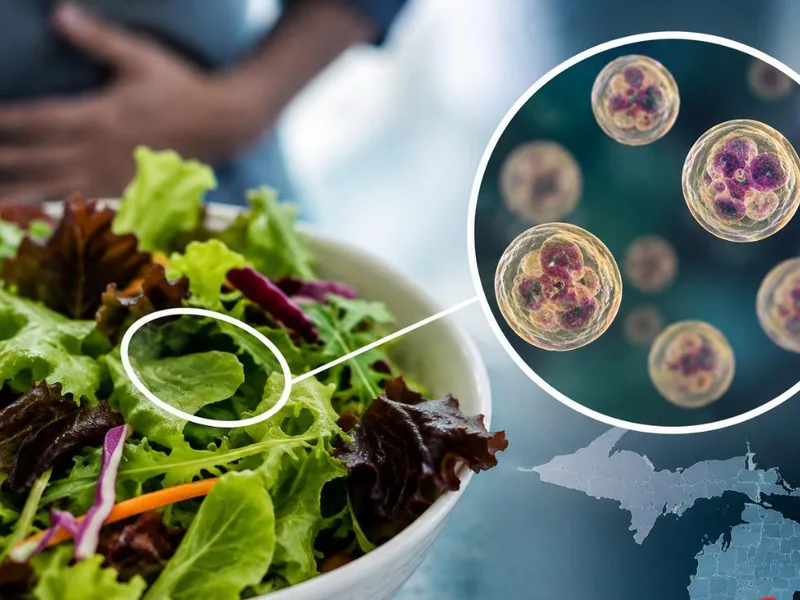
Cyclospora cayetanensis is a single-celled, spherical parasite, too small to see without a microscope, first formally described in humans in 1994. It belongs to a group called coccidian protozoa — microscopic organisms that complete their entire life cycle inside a host. The intestinal illness it causes is called cyclosporiasis.
Cyclospora completes its life cycle in humans, but the oocysts (egg-like cells) shed in the feces of an infected person must mature outside the host, in the environment, before they become infectious to someone else. This process is thought to take at least one to two weeks under favorable conditions. That delay is why you can't catch it directly from a sick person the way you might catch a cold.
This is not a rare historical curiosity. In 2026 alone, over 11,000 confirmed U.S. cases have been reported to the CDC — compared to roughly 2,700 cases in all of 2025. Federal agencies announced on July 16 that many cases have been traced to Taylor Farms lettuce supplied to Taco Bell restaurants throughout the Midwest. On July 17, 2026, Taylor Farms initiated a recall of all iceberg lettuce involved in the outbreak.
The scale of this year's outbreak has made Cyclospora a legitimate public health priority.
How Does Cyclospora Spread?
Cyclospora spreads when people eat food or drink water contaminated with feces containing the parasite. Fresh produce is commonly involved in outbreaks because the parasite can be introduced through contaminated irrigation water or during growing and harvesting.
One important thing to know: you cannot see, smell, or taste Cyclospora on contaminated food. There's no visible sign that a head of lettuce or a bag of herbs is carrying it.
Past U.S. foodborne outbreaks have been linked to various types of imported fresh produce, including basil, raspberries, and snow peas. However, the FDA detected the first evidence of C. cayetanensis in locally grown produce — cilantro — in 2018, and since then the parasite has been increasingly detected in domestic food and surface water.
Direct person-to-person transmission is not a typical route, because the oocysts must first sporulate in the environment for one to two weeks before becoming infectious.
Cyclospora infects the small intestine and usually causes watery diarrhea with frequent and sometimes explosive bowel movements. If not treated, the illness may last from a few days to over a month. Symptoms may seem to go away and then return one or more times.
Other symptoms include cramping, gas, nausea, fatigue, and loss of appetite.
The time between becoming infected and becoming sick is usually about one week, but can range from two days to two weeks or more.
Not everyone gets equally sick. People infected with Cyclospora may or may not experience symptoms, and cyclosporiasis is not usually life-threatening. That said, the relapsing nature of the illness — where you feel better and then get sick again — catches many people off guard and can lead to significant dehydration.
[REVIEWER: add clinical insight here — for example, observations from seeing patients with cyclosporiasis who were initially misdiagnosed with IBS or another GI condition due to the waxing-and-waning symptom pattern]
Who Is Most at Risk?
Anyone can be at risk for infection, though people living or traveling in the tropics and subtropics may be at increased risk because cyclosporiasis is endemic in some countries in these zones.
Associated symptoms can be more severe in infants, and immune dysfunction has been noted in some cases. People who are immunocompromised — including those on immunosuppressive medications or living with HIV — face a greater risk of prolonged or complicated illness.
In active outbreak situations, anyone who has eaten recalled or potentially contaminated produce in the weeks before falling ill should consider getting tested.
How Is It Diagnosed?
Diagnosis is where things get tricky — and where many cases fall through the cracks.
Many cases of cyclosporiasis are never caught because the parasite isn't on every diagnostic panel, and clinicians often have to proactively think of the infection to order the right test.
If a healthcare provider suspects cyclosporiasis, they'll recommend a stool test. A lab will look for C. cayetanensis in the sample. Some days there may be a large number of parasites present; other days there may not — so multiple samples over several days may be needed for an accurate diagnosis.
The molecular diagnosis of C. cayetanensis is increasingly done via multiplex assays for a variety of gastrointestinal pathogens. Diagnosis is sometimes made only when intracellular parasite stages are detected in biopsies of intestinal tissue.
If you've had persistent, relapsing watery diarrhea for more than a week — especially after eating fresh produce or traveling abroad — tell your doctor specifically to test for Cyclospora. Don't assume it's on the standard panel.
[REVIEWER: add clinical insight here — e.g., practical guidance on when to order PCR vs. microscopy, and what to tell patients about the multi-sample requirement]
Treatment: What Works?
The treatment of choice for cyclosporiasis is double-strength trimethoprim/sulfamethoxazole (TMP/SMX) for 7 to 10 days. This is a widely available generic antibiotic.
For people with a sulfa drug allergy, providers may prescribe ciprofloxacin or nitazoxanide instead.
Supportive care also matters. Antidiarrheal medications and adequate hydration — including water, electrolyte drinks, or IV fluids in severe cases — help prevent dehydration and preserve nutrients.
Most healthy people recover without treatment, but without antibiotics the illness may last for a month or longer and can relapse. Getting treated promptly shortens the illness and reduces the chance of recurrence.
How to Prevent Cyclospora Infection
There is no vaccine to prevent cyclosporiasis. Prevention is entirely behavioral.
Wash your hands and any fresh produce thoroughly under running water before eating, cutting, or cooking. Cooking can kill the parasite.
For travelers to endemic regions, standard chlorine or iodine water disinfection is unlikely to be effective against Cyclospora oocysts because they are extremely tolerant of halogens. Boiling water or using filtration systems rated for protozoa is more reliable.
Stay updated on active food recalls. During outbreak periods, checking the CDC's website for linked food products is a practical first step.
FAQ: People Also Ask
Can you get Cyclospora from another person?
Direct person-to-person transmission is unlikely because oocysts shed in feces must first mature in the environment for at least one to two weeks before they become infective. You get it from contaminated food or water, not from being near someone who is sick.
How long does a Cyclospora infection last?
Without treatment, the illness may last from a few days to over a month, and symptoms can relapse — seeming to go away and then return. With antibiotic treatment (TMP/SMX), most people recover within a week to ten days.
Does cooking kill Cyclospora?
Yes — cooking can kill the Cyclospora parasite. Thoroughly washing raw produce under running water also reduces risk, though it may not eliminate it entirely. Avoid eating unwashed fresh produce during active outbreaks.
How is Cyclospora different from food poisoning?
Cyclospora causes a slower-onset, longer-lasting illness than typical bacterial food poisoning. Symptoms usually appear about one week after infection — not within hours as with Salmonella or Staph — and the relapsing diarrhea pattern is a distinguishing feature.
Who should see a doctor for possible Cyclospora infection?
Anyone with watery diarrhea lasting more than a few days — especially after consuming recalled produce, traveling to tropical regions, or during an active outbreak — should seek medical evaluation. Ask specifically for Cyclospora testing, as routine stool tests don't always screen for this parasite.
Practical Takeaway
If you've had relapsing watery diarrhea and recently ate fresh produce — particularly during the current 2026 outbreak — ask your doctor directly about Cyclospora testing. The illness responds well to antibiotics when caught early. In the meantime, wash all produce under running water, stay hydrated, and check the CDC's active outbreak page for the latest recalled food products.
5. Sources
CDC — About Cyclosporiasis:
CDC — Clinical Overview of Cyclosporiasis:
CDC Yellow Book 2024 — Cyclosporiasis (Travel):
CDC — Cyclospora Outbreak Linked to Iceberg Lettuce, 2026:
Merck Manual Professional — Cyclosporiasis:
Cleveland Clinic — Cyclosporiasis:
Li et al. (2020). Advances in Cyclosporiasis Diagnosis and Therapeutic Intervention. Frontiers in Cellular and Infection Microbiology. PMC7026454
MMWR (2019). Cyclosporiasis Surveillance — United States, 2011–2015. PMC6476303
American Medical Association — Cyclospora:
7. Category
Infectious Diseases / Food Safety / Travel Health
8. Image Suggestion
A close-up photomicrograph-style illustration of Cyclospora cayetanensis oocysts, alongside a split-frame showing fresh leafy produce being washed under running tap water — visually connecting the microscopic pathogen to its real-world transmission route. Avoid generic stock-photo hands and salad bowls; the microscope element makes it distinctive and medically credible.
9. Schema Suggestion
MedicalWebPage + FAQPage — MedicalWebPage signals to Google that this is health-related YMYL content subject to E-E-A-T evaluation; FAQPage enables FAQ rich results in search, increasing click-through rate from People Also Ask boxes and AI Overview citations.