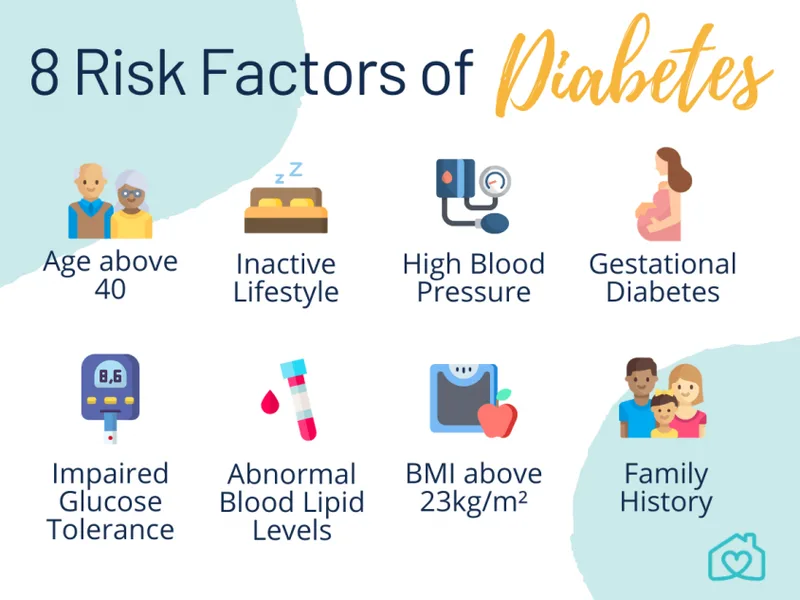
Diabetes risk factors fall into two categories: <cite index="148-1">modifiable risk factors, which can be changed through lifestyle choices, and non-modifiable risk factors, which increase risk but can't be changed, such as family history.</cite> Knowing both categories matters — modifiable factors are where prevention efforts have real impact, while non-modifiable ones help identify who should be tested earlier and more often.
[REVIEWER: add clinical insight here — e.g., how you discuss non-modifiable risk factors with patients who feel like their risk is already "decided"]
These factors raise risk but are fixed, regardless of lifestyle choices. <cite index="148-1">Family history is one of the clearest examples — risk is higher if a parent or sibling has diabetes, and sharing family health history with a healthcare provider can help guide care and screening decisions.</cite>
Age and ethnicity are similarly fixed contributors. <cite index="146-1">People over 65 and those of African American descent are at greater risk of developing type 2 diabetes, though neither of these factors can be controlled.</cite> Genetics plays a substantial role too — one that's often underestimated. <cite index="149-1">Type 2 diabetes is estimated to be between 30% and 70% heritable, and genetic risk remains strongly associated with prediabetes, undiagnosed diabetes, and future type 2 diabetes even within specific categories of other, nongenetic risk factors.</cite>
It's worth being clear that "can't be changed" doesn't mean "doesn't matter" — quite the opposite. <cite index="146-1">Genetics functions like being handed a loaded gun, while lifestyle behaviors like overeating and inactivity are what pull the trigger,</cite> which is a useful way to think about why non-modifiable and modifiable risk factors interact rather than operate independently.
Modifiable Risk Factors: What Can Be Changed
This is where prevention efforts have genuine traction. <cite index="144-1">Excess weight — overweight and obesity — is considered the major modifiable risk factor for type 2 diabetes,</cite> and it's been studied extensively across different populations and settings.
Other modifiable factors compound that risk further. Research identifying modifiable risk factors associated with prediabetes has consistently pointed to a similar cluster: <cite index="145-1">low physical activity, inadequate diet, smoking, alcohol consumption, hypertension, and dyslipidemia (abnormal cholesterol or fat levels in the blood) are among the modifiable factors studied in relation to prediabetes risk, with abdominal obesity, low HDL cholesterol, and hypertension showing particularly strong, independent associations.</cite>
Physical activity deserves particular attention because of how directly it's tied to outcomes across multiple studies. Research in resource-limited settings examining hypertension and type 2 diabetes together found that <cite index="150-1">factors like low physical activity, high television viewing time, and low fruit and vegetable intake were measurably associated with these conditions,</cite> reinforcing that these aren't abstract risk categories — they show up consistently across very different populations and geographies.
[REVIEWER: add clinical insight here — e.g., which modifiable risk factor you find patients are most able to act on, or how you help someone prioritize when several risk factors apply at once]
Why Family History Matters More Than It Seems
Family history sits in an interesting spot: it's non-modifiable, but it isn't purely genetic either. <cite index="148-1">Part of why family history raises risk is genetic, but family members often share certain habits too, which can independently increase risk beyond genetics alone.</cite> This is a useful reframe — a family history of diabetes is both a signal to get tested earlier and, in some cases, a reason to look closely at shared household habits that might be modifiable even if genetics aren't.
How Common Is Diabetes Risk, Really?
The scale of this is larger than most people realize. <cite index="148-1">In the United States, about 115.2 million adults age 18 or older — including 31.3 million adults 65 or older — may have prediabetes, and many people with type 1 and type 2 diabetes don't know they have it.</cite> That combination — high prevalence and low awareness — is exactly why understanding personal risk factors matters, even without symptoms.
A Quick Way to Check Personal Risk
For anyone wondering where they fall, a validated self-assessment exists specifically for this purpose. <cite index="152-1">A CDC-adapted risk test, validated using CDC data, includes only health traits a person would already know about themselves — such as age, height, and weight — without requiring blood sugar or cholesterol test results. A score of 5 or higher on the test indicates significant risk for prediabetes.</cite>
The scoring itself reflects the risk factors covered above. <cite index="151-1">Points are added for each risk factor present — for example, answering yes to having a parent or sibling with diabetes adds a point for family history, while a "no" answer to ever being diagnosed with high blood pressure adds zero points for that category. A total score of 5 or higher is considered high risk for prediabetes.</cite> It takes about a minute and can be a reasonable first step before a formal blood test.
Practical Takeaway
Diabetes risk isn't a single number — it's a combination of fixed factors like family history, age, and genetics, and changeable factors like weight, activity level, and diet. The fixed factors are worth acknowledging honestly rather than dismissing, since they help determine who should be tested earlier or more often. The modifiable factors are where meaningful prevention happens, and they matter regardless of how strong someone's genetic or family risk already is. A quick risk-test self-assessment, followed by an actual blood sugar test if the score is high, is a reasonable and low-effort way to find out where things stand.
Frequently Asked Questions
What is the biggest risk factor for type 2 diabetes? Excess weight, particularly overweight and obesity, is generally considered the most significant modifiable risk factor for type 2 diabetes. Non-modifiable factors like family history, age, and genetics also play a substantial role, often interacting with weight and lifestyle factors.
Can you have diabetes risk factors and never develop diabetes? Yes. Risk factors increase the likelihood of developing diabetes but don't guarantee it, especially when modifiable factors like weight, diet, and activity are actively managed. This is part of why addressing modifiable risk factors matters even for someone with strong non-modifiable risk, like family history.
Is diabetes purely genetic? No. While genetics plays a substantial role — type 2 diabetes is estimated to be 30% to 70% heritable — lifestyle factors like diet, physical activity, and weight significantly influence whether that genetic risk actually develops into diabetes.
How can I check my own diabetes risk? A short, validated self-assessment developed with CDC data can estimate risk using traits like age, height, and weight, without needing lab results. A score of 5 or higher suggests significant risk for prediabetes and is worth following up with an actual blood sugar test.
Does family history guarantee I'll get diabetes? No. Family history raises risk, partly through genetics and partly through shared household habits, but it doesn't guarantee diabetes will develop. Modifiable factors like weight and physical activity still meaningfully affect whether that elevated risk actually leads to diabetes.