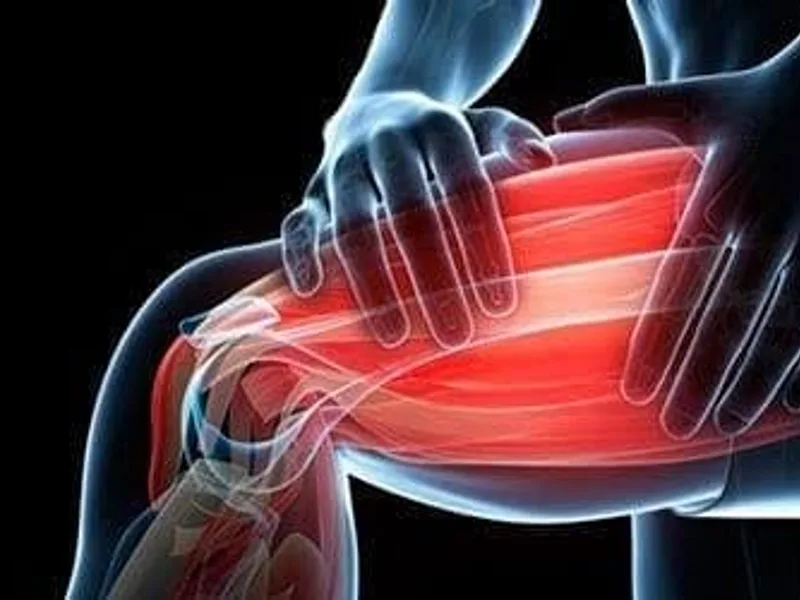
You did one extra set of squats on Monday, and by Wednesday you're gripping the stair rail like it owes you money. That's delayed onset muscle soreness, or DOMS, and almost everyone who's ever started a new workout routine knows the feeling.
It's uncomfortable, but it's not usually a sign that anything's wrong. Still, the way people try to "fix" it is often based on habit rather than evidence. Some of it helps a little. Some of it does basically nothing. Worth sorting out which is which before you spend money on the wrong thing.
Why Sore Muscles Happen at All
DOMS shows up after unfamiliar or unusually intense exercise, especially anything involving eccentric movement, where a muscle lengthens under tension. Think the lowering phase of a squat, or running downhill.
The current understanding is that this kind of loading causes tiny amounts of damage to muscle fibers and the connective tissue around them. That triggers a mild inflammatory response, which is part of why the area feels tender and stiff rather than sharply painful. The soreness usually peaks somewhere between 24 and 72 hours after the workout, then fades on its own within a few days to a week.
It's not lactic acid, by the way. That old gym myth still gets repeated a lot, but lactic acid clears from muscle tissue within an hour or so of finishing exercise. DOMS is a slower, separate process.
What Actually Helps
Light movement tends to help more than complete rest. Gentle activity increases blood flow to the sore area, and many people find it genuinely eases the stiffness, even if it doesn't speed up the underlying repair process by much.
Sleep matters more than most people give it credit for. Muscle repair happens largely during deep sleep, and cutting sleep short after a hard training session is one of the more overlooked reasons recovery drags on. In clinical practice, this is often missed because people focus entirely on what they do in the gym and ignore the eight hours afterward that actually do the repair work.
Hydration and adequate protein intake support the repair process too, though neither will make DOMS disappear overnight. If your diet is inconsistent, a conversation with a dietitian near you can help you figure out whether nutrition is part of why you're always sore and slow to bounce back.
Massage and foam rolling have some evidence behind them for short-term relief of soreness and stiffness, though the effect size in research is modest, not dramatic. Cold water immersion has mixed results in studies, and honestly, a lot of that evidence is weaker than the ice-bath trend on social media would suggest. If it feels good to you and you enjoy the ritual, that's a fine reason to keep doing it. Just don't expect it to work miracles.
What Doesn't Help Much
Stretching before or after a workout doesn't meaningfully prevent or reduce DOMS, despite being one of the most repeated pieces of gym advice out there. It's still useful for other reasons, like maintaining range of motion, but soreness prevention isn't really one of them.
Over-the-counter anti-inflammatory painkillers can ease the discomfort short-term, but they're not something to lean on repeatedly without medical advice, especially since some research suggests frequent use may blunt the muscle's adaptation response over time. If pain is significant enough that you're reaching for medication often, that's worth mentioning to a doctor rather than self-managing indefinitely. A general physician near you can advise on safe, occasional use based on your health history.
When Soreness Isn't Just DOMS
Here's the honest question to ask yourself: is this soreness, or is this something else wearing a soreness costume?
DOMS is diffuse. It affects a broad muscle area, feels worse with pressure or stretching, and improves steadily day by day. If pain is sharp, localized to one specific spot, or gets worse instead of better after 72 hours, that's not typical DOMS anymore.
Dark, cola-colored urine after an unusually intense workout is a genuine red flag. It can point to rhabdomyolysis, a rare but serious condition where damaged muscle tissue releases a protein that can strain the kidneys. This is uncommon, but it's exactly the kind of thing that shouldn't be brushed off as "just sore." If this happens, seek medical care promptly rather than waiting it out, and don't hesitate to use emergency services near you if symptoms feel severe.
Swelling, bruising you can't explain, or a joint that feels unstable rather than just stiff are also reasons to get checked rather than assume it's ordinary soreness. An orthopedist near you can rule out a strain or tear that's being mistaken for DOMS. If a checkup is hard to schedule around work, a home visit doctor can do an initial assessment, and if bloodwork is needed, a diagnostic center near you can check markers like creatine kinase