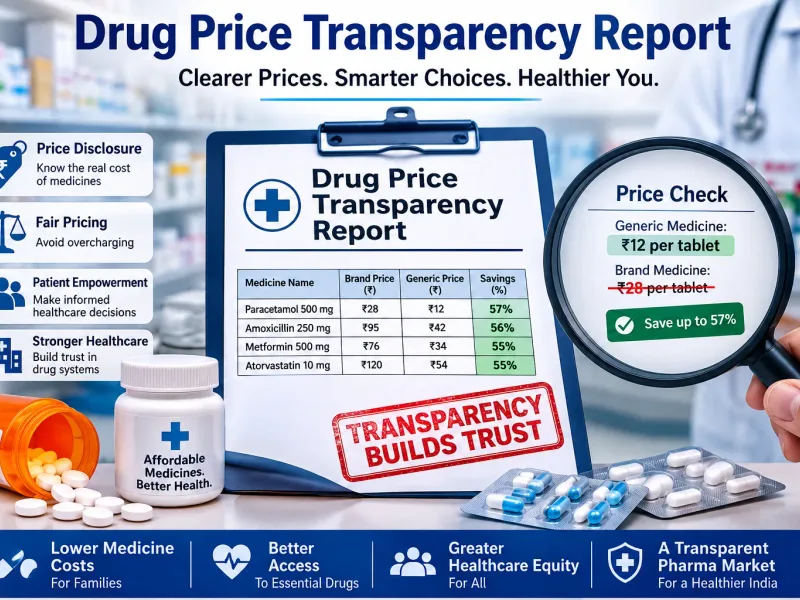
Drug price transparency is about more than the number on the packet
A medicine's price tag does not always tell the whole financial story. Patients may see an MRP on a strip, but the eventual cost of treatment can also depend on the drug's formulation, quantity, pharmacy, insurance coverage and whether a lower-cost equivalent is available.
India does have a formal system for regulating prices of many medicines. The National Pharmaceutical Pricing Authority (NPPA) fixes ceiling prices for medicines covered under the Drugs (Prices Control) Order, 2013, while also fixing retail prices for certain new drugs. The agency's current public information shows that hundreds of formulations fall under notified ceiling prices.
For patients, however, the practical question is simpler: How much will this prescription actually cost me?
That is where better price information can make a difference.
What does drug price transparency mean?
Drug price transparency means making the factors behind medicine costs easier to understand and compare. It includes the listed retail price, applicable price controls, differences between brands, generic availability and the patient's likely out-of-pocket expense.
It does not mean every medicine in India has one nationally fixed retail price. The pricing system is more complicated. Scheduled medicines can be subject to NPPA ceiling prices, while other medicines may follow different pricing rules.
The NPPA explains that ceiling prices are calculated using a prescribed methodology, including the average price to retailer and a retailer margin. The resulting ceiling price, along with applicable local taxes, is used to determine the maximum retail price for regulated formulations.
Patients can also review the NPPA's [2026 Compendium of Prices] 2026 Compendium of Prices and [therapeutic-category ceiling price lists] Therapeutic Category Wise Ceiling Price List when checking regulated medicine prices.
Why the same medicine can cost different amounts
The active ingredient is only one part of the pricing picture. Two products containing the same medicine can have different brand positioning, manufacturers, packaging, formulations or retail prices.
Generic medicines can offer a lower-cost option in many cases. Doctar's guide on [generic versus branded medicines] Generic vs Branded Medicines: Cost and Affordability explains why generic versions are often cheaper while containing the same active ingredient.
But patients should not change a prescribed medicine simply because another product is cheaper. The formulation, strength and clinical suitability still matter. A doctor or pharmacist should confirm whether an alternative is appropriate.
Doctar's [Metformin cost guide] Metformin Cost and Affordability Guide illustrates how manufacturer, formulation, quantity and insurance can influence the final expense.
Price transparency matters most for long-term treatment
A small monthly difference can become meaningful when a medicine is taken for years. This is particularly relevant for people managing chronic conditions such as diabetes, high blood pressure, cardiovascular disease or long-term neurological conditions.
For example, Doctar's resources on [rosuvastatin and Crestor costs] Rosuvastatin and Crestor Cost Guide, [losartan costs] Losartan Cost and Savings Guide and [lisinopril costs] Lisinopril Cost Guide show why medicine costs should be assessed using the specific product and current pharmacy price rather than a generic estimate.
In clinical practice, this is often missed because conversations focus heavily on whether a medicine works, while affordability is treated as an afterthought. Yet a prescription that a patient cannot consistently afford is not a practical treatment plan.
Insurance does not automatically mean low medicine costs
Health insurance can reduce healthcare expenses, but outpatient medicines are not necessarily covered in the same way as hospitalisation. Coverage depends on the individual policy and its terms.
Patients may need to check exclusions, limits, co-payments, deductibles and whether prescription medicines are covered at all. Doctar's [guide to prescription drug coverage] Prescription Drug Coverage Guide discusses these cost components for Indian readers.
Specialist medicines can create an even larger financial gap. Doctar's information on [biologic treatment costs and insurance questions] Questions About Biologic Treatment Costs highlights the need to ask about expected out-of-pocket expenses before treatment begins.
For expensive medicines, patients may also need to ask about manufacturer assistance programmes, hospital financial support or other legitimate sources of help. Doctar's [Otezla cost guide] Otezla Cost Guide and [Prolia cost guide] Prolia Cost and Savings Guide provide examples of how these factors can affect treatment expenses.
How patients can compare medicine costs safely
Price comparison should start with the exact prescription. Check the medicine name, strength, dosage form and pack size rather than comparing products based only on similar-looking brand names.
A pharmacist can help identify whether a generic equivalent exists and whether the formulation is appropriate. Patients can also compare reputable pharmacy listings. Doctar's [pharmacy search] Find Pharmacies on Doctar and [Salt Lake pharmacy listings] Pharmacies Near Salt Lake, Kolkata can help patients locate pharmacies, although availability and prices can change.
Doctar also advises checking current pharmacy information because medicine availability and operating hours can change.
Patients looking for pharmacies in other Kolkata areas can also use [Shyambazar pharmacy listings] Pharmacies Near Shyambazar, Kolkata and [Taltala pharmacy listings] Pharmacies Near Taltala, Kolkata.
Government price controls provide an important check
Drug price transparency is not based only on private price comparisons. Government regulation is a major part of the system.
The NPPA publishes notified prices and maintains information on price-controlled formulations, new drug retail prices and overcharging. Its public database includes [DPCO 2013 information] DPCO 2013 Price Information and an [overcharging-status section] NPPA Overcharging Status and Price Information.
The agency also publishes [drug-pricing FAQs] NPPA Drug Pricing FAQs explaining concepts such as ceiling prices and regulated medicines.
This matters because a patient who suspects that a regulated medicine has been sold above the permitted price has a route for checking the official information rather than relying only on word of mouth.
What happens when a prescription becomes unaffordable?
Do not quietly stop or alter a prescribed medicine because the price is too high.
Instead, tell the prescribing doctor that cost is a problem. Depending on the medicine and medical situation, the clinician may be able to discuss a suitable generic, another formulation or a different treatment approach.
A [general physician near you] Find a General Physician Near You can help with many routine prescription and chronic-care concerns. For specialist treatment, patients can also explore appropriate doctors through Doctar's [doctor directory] Find Doctors on Doctar.
Doctar's practical guide on [affording medicines in India] Affording Medicines in India recommends discussing affordability openly with doctors and pharmacists instead of making medication changes independently.
What a useful drug price transparency report should include
A credible report should separate facts from estimates. It should identify the medicine, active ingredient, strength, pack size, manufacturer, applicable MRP or ceiling price, date checked and source of the pricing information.
It should also explain whether the quoted price is a pharmacy retail price, an official ceiling price or an estimated treatment cost. Mixing those categories can give patients a misleading picture.
For individual medicines, Doctar's [omeprazole cost information] Omeprazole Cost Guide, [azithromycin cost guide] Azithromycin Cost Guide, [ciprofloxacin cost guide] Ciprofloxacin Cost Guide and [duloxetine cost information] Duloxetine Cost Guide demonstrate how product-specific information can be presented.
Other Doctar resources, including [gabapentin cost information] Gabapentin Treatment and Cost Guide, Meloxicam Cost Guide andPregabalin Cost and Savings Guide can help readers understand how prices vary across medicines.