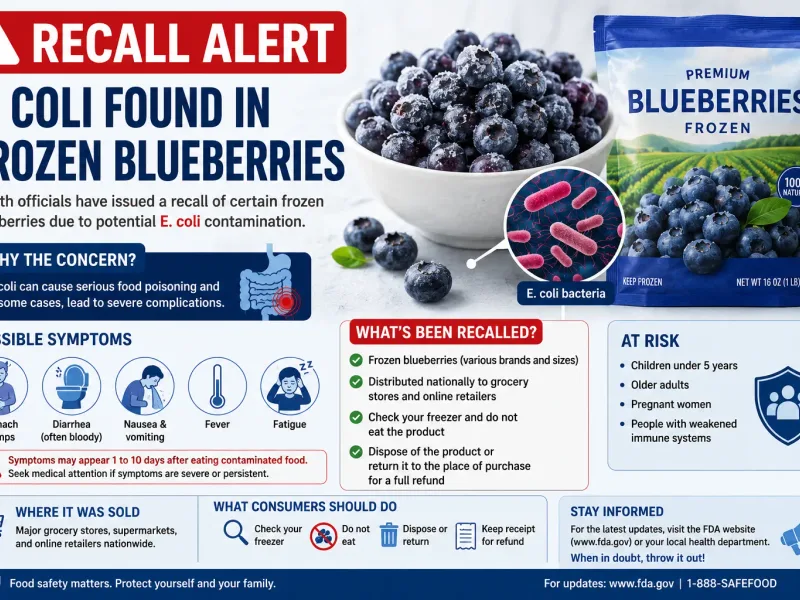
The FDA and CDC are investigating a multistate outbreak of E. coli O145:H28 — a type of Shiga toxin-producing bacteria — linked to frozen GreenWise Organic IQF Blueberries sold at Publix stores in eight states. The recall covers a single lot (lot code 60401, best-by February 9, 2028) in 10-ounce bags distributed to Alabama, Florida, Georgia, Kentucky, North Carolina, South Carolina, Tennessee, and Virginia. Twelve confirmed illnesses and four hospitalizations were reported between May 11 and June 5, 2026.
On July 3, 2026, Frutas y Hortalizas del Sur S.A. — a Chilean grower-packer operating under the Comfrut brand — voluntarily recalled its GreenWise Organic IQF (individually quick frozen) Blueberries after the product tested presumptively positive for E. coli O145:H28, according to the FDA outbreak investigation page.
The recall is narrow but specific:
Product: GreenWise Organic IQF Blueberries (frozen), 10-oz bags
Lot code: 60401 (printed on the package)
Best-by date: February 9, 2028
Sold at: Publix stores in Alabama, Florida, Georgia, Kentucky, North Carolina, South Carolina, Tennessee, and Virginia
Recall date: July 3, 2026 (Publix completed its removal by July 3)
No other GreenWise products and no other lot codes are included in the recall. However, because Publix advises consumers to discard any GreenWise frozen blueberries purchased on or before July 3, 2026, the safest step is to check the lot code before consuming any GreenWise frozen blueberries from that period.
What to Do Right Now
The CDC and FDA are unambiguous: do not eat the recalled blueberries. Throw them away in a sealed bag or container, or return them to the Publix store where you purchased them for a full refund.
Freezing does not kill E. coli. The bacteria survive in frozen conditions and can cause illness when the product is thawed and consumed, even if the berries appear and smell normal.
After discarding the product:
Wash any surfaces, containers, utensils, or refrigerator drawers that may have come into contact with the recalled berries using hot soapy water or run them through a dishwasher.
Wash your hands thoroughly with soap and water after handling the product or cleaning contaminated surfaces.
If you are a retailer or food service operator who received this product, the FDA advises not selling or serving it and sanitizing any surfaces that came into contact with the recalled lot.
Not all E. coli bacteria are harmful — most strains live harmlessly in the human gut. The strain linked to this outbreak, E. coli O145:H28, belongs to a category called Shiga toxin-producing E. coli (STEC). These bacteria produce toxins that attack the lining of the intestines and, in severe cases, the blood vessels in the kidneys.
E. coli O145 is not as widely known as E. coli O157:H7 — the strain associated with beef and spinach outbreaks — but it is considered one of the most clinically significant non-O157 STEC serotypes. UK health authorities identified O145:H28 as one of the most common STEC serotypes they now detect, according to Food Safety News. A 2024 national O145:H28 outbreak in the United Kingdom reached nearly 300 cases, with 11 cases of hemolytic uremic syndrome (HUS) and two deaths, linked to contaminated lettuce.
[REVIEWER: add clinical insight here — e.g., how E. coli O145 infections are diagnosed in clinical practice, why clinicians must specifically request non-O157 STEC testing, and how the clinical presentation compares with O157 infections]
E. coli O145 Symptoms
Symptoms of STEC infection typically appear 1 to 10 days after eating contaminated food, with most cases beginning 3 to 4 days after exposure, according to the New York State Department of Health's STEC fact sheet. They include:
Most healthy adults recover within five to seven days without specific treatment, according to the CDC. But for a subset of patients — particularly children under five, older adults, and people with weakened immune systems — the infection can escalate rapidly into a life-threatening complication.
The Serious Risk: Hemolytic Uremic Syndrome (HUS)
The most dangerous consequence of STEC infection is hemolytic uremic syndrome, or HUS. The name refers to what happens in the body: the Shiga toxins damage the lining of tiny blood vessels, triggering a cascade that destroys red blood cells and clogs the kidneys' filtering system.
About 5 to 10 percent of people diagnosed with STEC infections develop HUS, according to the New York State Department of Health. Symptoms of HUS include decreased urination, extreme fatigue, and pale skin. The condition often requires hospitalization, and treatment may involve blood transfusions, plasma exchange, or kidney dialysis, according to the STEC fact sheet from the New York State Department of Health.
HUS is the leading cause of acute kidney failure in children in the United States, according to a CDC Emerging Infectious Diseases review. It can also cause high blood pressure, chronic kidney disease, and neurological complications.
The FDA's outbreak notice for the blueberry recall specifically warns: "Some infections can cause severe bloody diarrhea and lead to life-threatening conditions, such as a type of kidney failure called hemolytic uremic syndrome (HUS), or the development of high blood pressure, chronic kidney disease, and neurologic problems."
[REVIEWER: add clinical insight here — e.g., what signs prompt a clinician to suspect impending HUS in a child or adult with STEC diarrhea, and what the treatment approach looks like in the first 24–48 hours after diagnosis]
How Frozen Produce Gets Contaminated
Frozen fruit may seem inherently safe — but the freezing process does not sterilize produce. Contamination with STEC typically occurs before freezing, most often through contact with animal waste (feces) in the field or during processing, or through contaminated irrigation water.
The recalled blueberries were sourced from San Carlos, Chile, and distributed to Publix exclusively. The FDA's traceback investigation into the supply chain was ongoing as of mid-July 2026. The strain identified — O145:H28 — is the same serotype that caused the 2024 UK lettuce outbreak, but investigators have not confirmed any direct epidemiological link between the two events.
Freezing at commercial temperatures halts bacterial growth but does not kill STEC. When consumers thaw the product — or eat it partially frozen, as is common with smoothie ingredients — the bacteria become active again. Cooking the berries to an internal temperature sufficient to kill the bacteria would eliminate the risk, but most consumers eat frozen blueberries without cooking them.
Who Got Sick and How Investigators Found the Source
The Florida Department of Health flagged the cluster on July 1, 2026, after noticing a pattern of E. coli O145 illnesses. Interviews with affected patients identified frozen GreenWise blueberries purchased at Publix as a common food item, according to the FDA outbreak investigation page. The outbreak interval covered illnesses from May 11 through June 5, 2026 — a window consistent with product distributed before July 3.
Of the 12 confirmed cases, four people were hospitalized. No deaths have been reported in connection with this outbreak.
Investigators note that the true case count is likely higher. Many people with STEC infections do not see a doctor; of those who do, testing for non-O157 STEC strains requires a specific laboratory request. Routine stool cultures at many labs do not automatically screen for O145 and other non-O157 serotypes.
FAQ
What lot code of GreenWise frozen blueberries is recalled? The recall covers one specific lot: GreenWise Organic IQF Blueberries in 10-oz packages with lot code 60401 and a best-by date of February 9, 2028. Only this lot, sold at Publix stores in Alabama, Florida, Georgia, Kentucky, North Carolina, South Carolina, Tennessee, and Virginia, is affected. Other lot codes and brands are not part of this recall.
Can freezing kill E. coli bacteria in frozen blueberries? No. Freezing does not kill E. coli or other STEC bacteria — it only stops them from growing. When frozen berries thaw, the bacteria become active again and can cause illness. The CDC recommends discarding the recalled lot and thoroughly cleaning any surfaces that contacted the product.
What are the symptoms of E. coli O145 infection? Symptoms typically include severe stomach cramps, diarrhea (often bloody), vomiting, and sometimes low-grade fever. They usually begin 1 to 10 days after eating contaminated food, with 3 to 4 days being most common. Most healthy adults recover in five to seven days, but some people — especially young children, older adults, and the immunocompromised — can develop life-threatening kidney failure (HUS).
What is HUS and who is most at risk? Hemolytic uremic syndrome (HUS) is a serious complication of STEC infection in which toxins damage blood vessels in the kidneys, causing kidney failure. About 5 to 10 percent of STEC cases develop HUS, according to the New York State Department of Health. Children under five, older adults, and people with weakened immune systems are most at risk. Signs include reduced urination, fatigue, and pale skin — seek emergency care immediately if these develop after a STEC infection.
When should I call a doctor after eating recalled blueberries? The CDC advises contacting a healthcare provider if you develop severe stomach cramps, bloody diarrhea, or signs of dehydration — especially if you ate the recalled product within the past one to ten days. Tell your doctor about the potential exposure; specific laboratory tests are required to diagnose STEC infections, and clinicians need to request testing for non-O157 strains explicitly.
Practical Takeaway
Check your freezer now. If you have GreenWise Organic IQF Blueberries in a 10-oz bag with lot code 60401 and a best-by date of February 9, 2028, throw them away immediately in a sealed bag — or return them to Publix for a full refund. Clean any surface or container that touched the product with hot soapy water. If you ate the berries recently and develop severe stomach cramps, bloody diarrhea, or notice signs of reduced urination and fatigue, see a doctor promptly and mention the potential exposure. Early medical attention is especially critical for children under five, adults over 65, and anyone immunocompromised.
This article must be reviewed and attributed to a named, qualified medical reviewer — such as a board-certified infectious disease physician or gastroenterologist — before publishing. It is intended for general education only and does not constitute medical advice. Outbreak figures are subject to change; consult the CDC and FDA outbreak pages for the most current case counts and investigation status.
Sources
US Food and Drug Administration (FDA). Outbreak Investigation of E. coli: Frozen Blueberries (July 2026).
US Centers for Disease Control and Prevention (CDC). E. coli Outbreak Linked to Frozen Blueberries.
CDC Newsroom. CDC Warns of E. coli Outbreak Linked to Frozen Blueberries, July 2026.
Food Safety News. Frozen Blueberries Recalled, Linked to E. coli Outbreak, July 2026.
New York State Department of Health. Shiga Toxin-Producing E. coli (STEC) Infections Fact Sheet.
Progressive Grocer. Publix Recalls Frozen Organic Blueberries Due to E. coli, July 2026.
Barskey et al. Hemolytic Uremic Syndrome Surveillance to Monitor Trends in Infection with STEC. CDC Emerging Infectious Diseases, 1997.
Marler, Bill. E. coli O145:H28: What Is the Bug in the Blueberries. Marler Blog, July 2026.
Image Suggestion
A close-up editorial photograph of a bag of frozen blueberries on a kitchen countertop next to a printed FDA recall notice — the bag's lot code and best-by date visible on the label. The framing should be clean and informational, not alarming: the focus is on helping consumers identify the specific product, not on evoking fear.
Schema Suggestion
MedicalWebPage + FAQPage MedicalWebPage signals YMYL E-E-A-T credibility appropriate for a health and food safety article with named clinical and regulatory sources; FAQPage enables rich result display for all five FAQ entries in Google Search and AI Overviews, including the product-identification answer that consumers most urgently need.