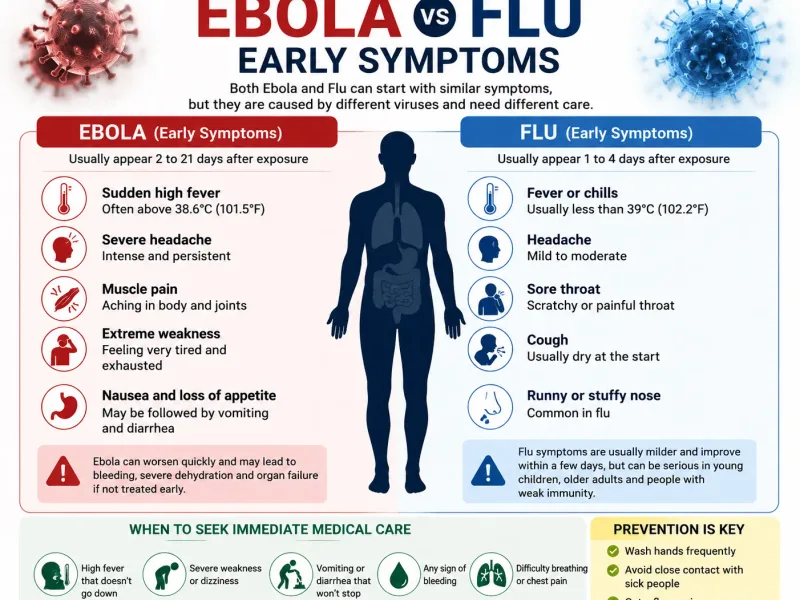
In the first one to three days of illness, Ebola and influenza can be almost impossible to distinguish by symptoms alone. Both typically begin with fever, headache, muscle and joint pain, sore throat, and fatigue. The real difference isn't in the symptoms themselves — it's in exposure history, and in how the illness progresses after the first few days.
Shared early symptoms include sudden fever, headache, muscle and joint pain, sore throat, and general weakness or fatigue. According to the Cleveland Clinic, <cite index="17-1">Ebola usually starts with flu-like symptoms</cite>, which is precisely what makes early recognition so difficult for both patients and clinicians.
The CDC publishes a side-by-side comparison specifically because the overlap is so significant — <cite index="14-1">a printable infographic-style factsheet comparing flu and Ebola symptoms</cite> is distributed to healthcare communities to help with early triage decisions.
Where Ebola tends to diverge is in what comes next. Los Angeles County Public Health notes that <cite index="19-1">seasonal flu and Ebola share a few overlapping symptoms, like fever and weakness, but that shared symptom list is where the similarity largely ends</cite> once the disease progresses. Ebola symptoms typically escalate to nausea, vomiting, diarrhea, and in more severe cases, unusual bleeding or bruising — symptoms flu does not typically cause. The Cleveland Clinic describes this as a phased illness: <cite index="17-1">flu-like symptoms come first, with later stages that can become severe</cite>.
Flu, by contrast, more commonly features prominent respiratory symptoms — cough, nasal congestion, chest discomfort — that are less typical of early Ebola.
Ebola's incubation period runs far longer than the flu's. The Cleveland Clinic notes <cite index="17-1">Ebola symptoms may appear anywhere from two days to three weeks after exposure</cite>, with most cases emerging in the range of about a week to ten days after contact with the virus. Flu, in comparison, typically causes symptoms within one to four days of exposure.
This gap matters clinically. A patient who develops flu-like symptoms more than four or five days after a potential flu exposure — but who also has a plausible Ebola exposure in that same window — warrants a closer look at travel and contact history rather than a default flu diagnosis.
Why Exposure History Is the Real Differentiator
Symptoms alone can't reliably separate the two illnesses. What can is a simple set of questions: Has the person traveled recently to a region with an active Ebola outbreak? Have they had direct contact with the blood, vomit, saliva, or other body fluids of someone sick with or who died from Ebola?
This is the exact approach public health guidance recommends. A Texas Tech University Health Sciences Center FAQ puts it directly: <cite index="20-1">flu symptoms like fever, headache, and muscle pain closely resemble Ebola, but without travel to an affected region or close contact with an Ebola patient, Ebola is not a realistic concern</cite>.
Recent clinical guidance reinforces the same point for 2026's active outbreak. Reporting on new CMAJ guidance notes that <cite index="15-1">both Ebola and hantavirus can start with symptoms that resemble the flu, and the window for effective intervention can close quickly if the exposure history isn't recognized early</cite>. That guidance specifically instructs clinicians to ask about travel to the affected provinces of the Democratic Republic of the Congo, and to contact a health care provider before an in-person visit if a patient reports both flu-like symptoms and relevant travel.
[REVIEWER: add clinical insight here — e.g., how you personally approach a patient presenting with flu-like symptoms and a travel history that puts Ebola on the differential, and what specific questions or triage steps you use in that first visit]
How Ebola Actually Spreads (and Why That Matters for Risk)
One of the most important practical differences between Ebola and flu is transmission route, not symptoms. Influenza spreads easily through airborne droplets from coughing and sneezing, which is why it moves through households, schools, and offices so readily.
Ebola spreads only through direct contact with the body fluids of a person who is symptomatic or has died from the disease — not through the air, water, or food, and not through casual contact. As the Texas Tech FAQ explains, <cite index="20-1">Ebola is spread through direct contact with blood and body fluids, along with contaminated objects like needles, but not through air, water, or food</cite>. This is a major reason global risk from Ebola stays low for people without a specific, identifiable exposure, even during an active outbreak.
Why This Distinction Matters Right Now
The overlap between Ebola and flu symptoms isn't just a textbook curiosity in 2026. The Democratic Republic of the Congo is in the midst of an outbreak of Bundibugyo ebolavirus that has been described by health officials as the fastest-growing Ebola outbreak on record, with more than 1,000 confirmed deaths as of late July. At the same time, clinicians in parts of the U.S. have been asked to stay alert for an unrelated hantavirus cluster that also begins with flu-like symptoms.
Health reporting on this overlap has been blunt about the stakes: <cite index="15-1">two dangerous viral diseases were circulating at unusual levels in 2026, and both begin with the same flu-like symptoms clinicians see routinely, with exposure history the only real distinguishing factor in the first critical days</cite>. That's not a reason for alarm about ordinary flu or cold symptoms — it's a reason exposure history deserves a direct, specific question rather than an assumption either way.
[REVIEWER: add clinical insight here — e.g., what "early supportive care" looks like once Ebola is suspected or confirmed, and why early presentation to care meaningfully changes outcomes]
FAQ
Can you tell Ebola and flu apart just by symptoms? Not reliably in the first few days. Both often cause fever, headache, muscle aches, sore throat, and fatigue. The clearest distinguishing factor is exposure history — recent travel to an area with an active Ebola outbreak, or direct contact with an infected person's body fluids — not the symptoms themselves.
How long after exposure do Ebola symptoms appear compared to flu? Ebola symptoms typically appear 2 to 21 days after exposure, most often around 8 to 10 days. Flu symptoms usually appear much faster, within 1 to 4 days of exposure. This longer, more variable incubation period is one practical difference between the two illnesses.
What symptoms suggest Ebola rather than flu? Later-stage symptoms such as persistent vomiting, diarrhea, unexplained bruising, or bleeding are more typical of progressing Ebola than of flu. Prominent cough and congestion lean more toward flu. But these patterns only become useful in combination with a relevant exposure history.
Should I be worried about Ebola if I have flu-like symptoms but haven't traveled anywhere? Generally, no. Without recent travel to a region with an active Ebola outbreak or direct contact with a confirmed or suspected Ebola patient, ordinary flu-like symptoms are far more likely to be a common seasonal illness. Ebola risk for the general public without a specific exposure remains low.
When should someone with flu-like symptoms seek care immediately? Anyone with flu-like symptoms who has traveled to an area with an active Ebola outbreak, or had contact with someone confirmed or suspected to have Ebola, should call a health care provider before visiting in person and disclose that exposure clearly, so appropriate precautions can be taken.
Practical Takeaway
Ebola and flu genuinely look alike in their first days, and that overlap is exactly why exposure history — not symptoms — does the real work of telling them apart. If flu-like symptoms show up alongside recent travel to an area with an active Ebola outbreak, or contact with someone sick with Ebola, that combination is what warrants an immediate call to a health care provider, clear disclosure of the travel or contact, and care before an in-person visit rather than a standard walk-in.
This article must be reviewed and attributed to a named, qualified medical reviewer — such as a board-certified infectious disease physician or family medicine physician — before publishing. This article is intended for general education only and does not constitute medical advice or a diagnosis. Anyone with symptoms and a relevant exposure history should contact a health care provider directly.
Sources
US Centers for Disease Control and Prevention (CDC). Is It Flu or Ebola? cdc.gov
Cleveland Clinic. Ebola Virus: Causes, Symptoms, Treatment & Prevention. my.clevelandclinic.org
Los Angeles County Department of Public Health. What's the Difference? Seasonal Flu and Ebola Virus. publichealth.lacounty.gov
Texas Tech University Health Sciences Center. Ebola: Frequently Asked Questions. ttuhsc.edu
CMAJ (Canadian Medical Association Journal) clinical guidance on Ebola and hantavirus early recognition, as reported by Medical Daily, July 2026.
US CDC Health Alert Network advisories HAN 530 (Ebola) and HAN 528 (hantavirus). cdc.gov/han
Category
Infectious Disease / Public Health / Patient Education
Image Suggestion
A clean, realistic split-panel graphic showing a thermometer and calendar icon representing "days since exposure" for flu (1–4 days) versus Ebola (2–21 days), styled as a simple clinical infographic rather than a generic stock photo of a sick person.
Schema Suggestion
MedicalWebPage + FAQPage — MedicalWebPage supports YMYL/E-E-A-T signals appropriate for symptom-comparison health content; FAQPage enables rich-result and AI Overview eligibility for the direct symptom and exposure-history questions in the FAQ section.