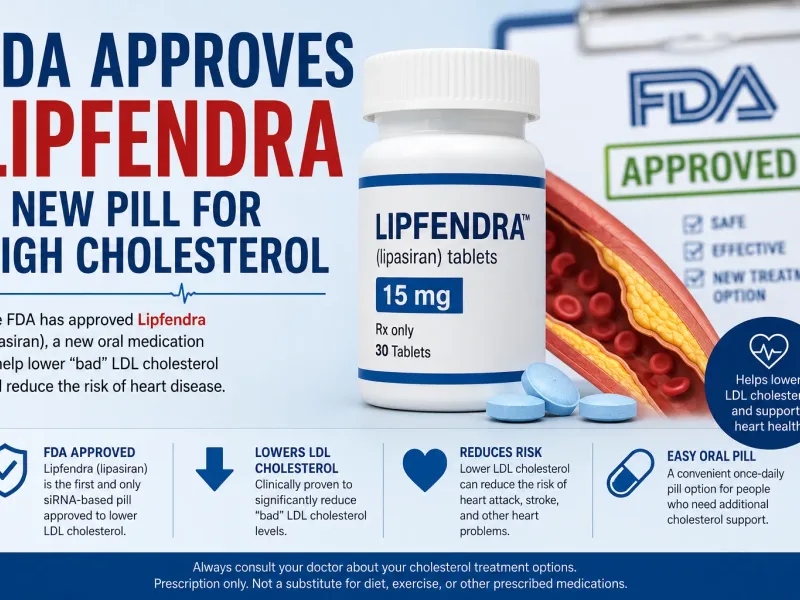
A Cholesterol Pill That Works Like an Injection
For almost a decade, if your doctor wanted to hit your LDL — the "bad" cholesterol that clogs arteries — hard, you were looking at a needle. PCSK9 inhibitors, drugs like Repatha and Praluent, have been genuinely effective. They just came as injections, usually every two to four weeks.
That changed on July 16, 2026. The FDA approved Lipfendra (enlicitide), Merck's once-daily pill, as the first oral drug in this class. It's meant to be taken alongside diet changes and, in most cases, on top of a statin, in adults with high cholesterol or an inherited form called heterozygous familial hypercholesterolemia.
Why does the oral part matter so much? Needle aversion is a real, under-discussed reason people quietly stop their cholesterol medication. In clinical practice, this is often missed because patients rarely bring it up unprompted — they just stop refilling the prescription, and the drop-off shows up months later as a rising LDL number nobody flagged early.
What the Trial Data Actually Showed
Lipfendra's approval rested on two Phase 3 trials involving just over 3,200 adults already on the highest statin dose they could tolerate. After 24 weeks, LDL cholesterol dropped by roughly 56% in the main trial and about 59% in the trial focused on familial hypercholesterolemia patients, compared with placebo.
Side effects were reportedly similar to placebo in the larger trial, according to Merck's own reporting. That's reassuring, but it's also worth saying plainly: we don't yet have long-term data proving Lipfendra prevents heart attacks or strokes the way the injectable PCSK9 drugs eventually did after years of follow-up. The company expects similar benefits, and the biology strongly suggests it, but "expected" isn't the same as "proven." That distinction matters if you're deciding between an existing injectable with a longer track record and a newer pill.
The Guidelines Changed Too — And That's the Bigger Story for Most People
Here's the part that will actually affect more readers than the drug itself. In March 2026, the ACC and AHA released their first updated dyslipidemia guideline since 2018, and it changes how your risk gets calculated in the first place.
A few things shifted:
Lower LDL targets are back. The 2018 guideline downplayed hard numeric goals. The 2026 version reintroduces them — under 55 mg/dL for people at very high cardiovascular risk, under 70 mg/dL for others with existing heart disease.
A new risk calculator. The old Pooled Cohort Equations are being replaced by PREVENT, which projects both 10-year and 30-year risk, factors in kidney function, and covers ages 30 to 79 instead of 40 to 75.
Universal Lp(a) testing. Every adult is now recommended to get lipoprotein(a) checked at least once. It's a genetic risk factor that a standard cholesterol panel won't catch, and most people have never heard of it.
Screening starts younger. Kids aged 9 to 11 are now recommended for a baseline lipid check, especially if there's a family history of early heart disease.
One outside estimate suggests roughly a third of American adults without existing heart disease now have LDL levels above what the new guideline considers acceptable — not because their cholesterol changed, but because the bar moved. That's an important nuance if you get a call from your doctor's office about "new" numbers that are actually the same blood test read against a stricter standard.
Who Should Actually Ask About Lipfendra
This isn't a first-line drug. It's built for people already on a statin whose LDL still isn't where it needs to be, or people with familial hypercholesterolemia who need more aggressive lowering than diet and a statin alone can deliver.
If that sounds like you, the conversation to have with a cardiologist isn't "should I switch to the new pill" — it's "where does my LDL actually stand under the new guideline, and what's the safest way to close that gap." A quick lipid panel and, ideally, a one-time Lp(a) check will tell you more than any headline about a new drug.
A Practical Takeaway
Don't self-diagnose off a percentage in a press release. Get an updated lipid panel, ask specifically whether you've ever had Lp(a) tested, and if your numbers sit above the new targets, ask your doctor whether your current statin dose is maxed out before any conversation about add-on therapy like Lipfendra even starts. That order matters — statins first, additional agents second.
Related Doctar Resources
For readers who want to act on this — get tested, find a specialist, or fill a prescription — these are relevant, live pages on Doctar: Cardiologist near you, book any doctor, find doctors near me, search hospitals, hospitals near me, diagnostic centers, diagnostics near me, order medicines, diabetes care products, healthcare equipment, pharmacy near me, talk to an endocrinologist, ask a dietitian, home visit doctors, nurse at home, physiotherapist near me, compounder services, angioplasty details, bypass surgery info, browse all surgeries, general physician near you, emergency services, ayurveda near me, about Doctar, read more health articles, find doctors across India.