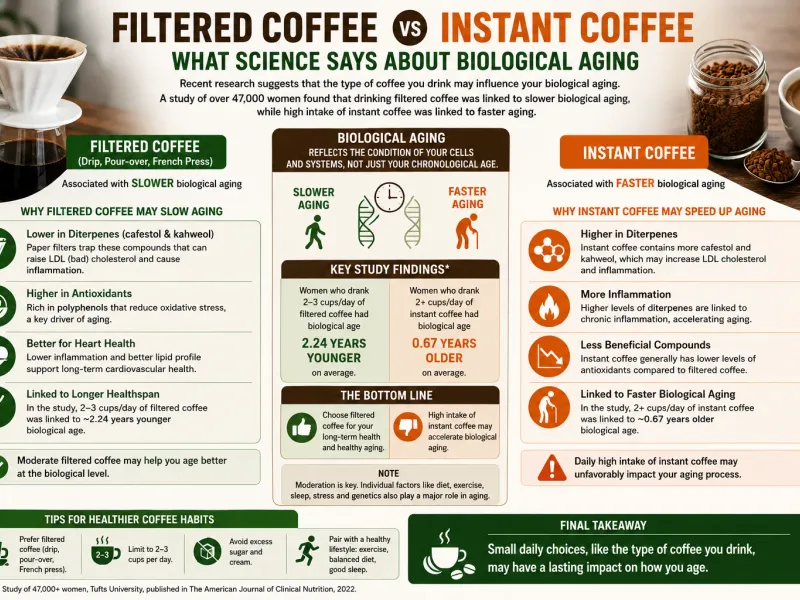
A 2026 study published in npj Science of Food found that filtered coffee consumption was associated with a more favorable biological-aging profile than instant coffee, based on data from 49,414 UK Biobank participants. People who drank more filtered coffee tended to have longer telomeres and lower biological age-acceleration scores, while people who drank more instant coffee showed the reverse pattern. The findings are observational, so they show an association, not proof that either coffee type directly causes faster or slower aging.
Researchers led by Wang and colleagues drew on dietary and health data from the UK Biobank, a large long-term study of adults in the United Kingdom. Coffee intake was captured through food frequency questionnaires and repeated 24-hour dietary recalls, which let researchers separate filtered coffee, instant coffee, and other brewing types rather than lumping all coffee together.
To assess aging, the study used three separate biological measures: relative leukocyte telomere length (a measure of how "worn down" a cell's chromosomes are, with shorter telomeres generally reflecting more cellular aging), PhenoAge Acceleration, and the Klemera-Doubal Method Biological Age Acceleration — two composite scores built from clinical and biochemical markers that estimate whether someone's body is aging faster or slower than their actual age would suggest.
The study population averaged 56.4 years old, and average daily intake was modest — about 0.7 cups of filtered coffee and 1.5 cups of instant coffee per day across the group, reflecting how much more common instant coffee is in the UK than in some other countries.
The direction of the association was consistent across all three aging measures. Filtered coffee intake was linked to lower age-acceleration scores and generally longer telomeres — a pattern the researchers associated with more favorable biological aging. Instant coffee intake showed the opposite association: higher age-acceleration scores and shorter telomeres, a pattern consistent with faster biological aging.
The size of the effect was small for any one person. One summary of the findings noted that <cite index="30-1">most estimates linked to instant coffee consumption corresponded to only about 0.1 to 0.2 years of biological age acceleration</cite>, which the researchers themselves described as having limited significance for an individual, even though the pattern was statistically consistent across a large population.
The dose mattered. In the study's own reported model, compared with drinking no coffee at all, instant coffee intake of more than three cups a day was associated with a statistically significant increase in one age-acceleration measure, with a clear trend of increasing effect at higher intake. Filtered coffee showed the opposite dose-response pattern — the more cups per day, the lower the age-acceleration score, in the study's fully adjusted models.
Who Showed the Strongest Effects
The link between instant coffee and faster biological aging wasn't uniform across the whole group. It was strongest in men, in adults 60 and older, and in current smokers, particularly those drinking more than three cups of instant coffee daily. Interestingly, one summary of subgroup results also noted that men who drank higher amounts of filtered coffee showed the most favorable age-acceleration metrics, suggesting the association in both directions may be more pronounced in men than in women.
Researchers also flagged that the results held up after adjusting for smoking, alcohol use, body mass index, and whether people added sugar or milk to their coffee — factors that could otherwise confound a simple coffee-and-aging comparison.
[REVIEWER: add clinical insight here — e.g., how you'd interpret a biological age-acceleration difference of 0.1–0.2 years for an individual patient, and whether coffee brewing method is something you'd realistically discuss in a clinical setting]
Why Might Brewing Method Matter?
The study's authors didn't establish a definitive mechanism, but they pointed to a few plausible explanations. Filtered coffee passes through a paper filter that removes diterpenes — oily compounds naturally present in coffee that are known to raise LDL cholesterol when unfiltered. Instant coffee, along with French press and other unfiltered methods, retains more of these compounds.
The researchers also identified specific biomarkers that appeared to partly explain the association: GlycA (a marker of systemic inflammation), cystatin C (a marker related to kidney function), and basal metabolic rate all showed up in mediation analysis as potential links between coffee type and the aging measures observed. That points toward inflammation and metabolic health as part of the explanation, though the study wasn't designed to prove a specific biological pathway.
This isn't the only research to flag instant coffee specifically. A separate, earlier UK Biobank analysis using Mendelian randomization — a method that uses genetic variants to test for likely causal relationships — found that <cite index="29-1">instant coffee intake was negatively correlated with telomere length, corresponding to roughly 0.38 years of age-related telomere shortening for each additional cup</cite>, while it found no significant association between filtered coffee and telomere length. That earlier study's genetic analysis supported a causal link specifically for instant coffee, which adds some weight to the newer findings, even though neither study alone proves causation on its own.
[REVIEWER: add clinical insight here — e.g., whether the diterpene/cholesterol mechanism or the inflammation-marker findings seem like the more clinically plausible explanation, and how you'd frame that nuance for a patient who asks about switching coffee types]
What This Study Doesn't Tell Us
The researchers were direct about the limitations, and they matter. The study was cross-sectional, meaning it captured a single snapshot of coffee habits and aging markers rather than tracking people over time — so it cannot show that switching from instant to filtered coffee would actually slow anyone's aging. Coffee intake was self-reported, which introduces potential recall error. The study population was predominantly White and drawn from a single country, which may limit how well the findings generalize elsewhere. And as with any large observational study, some residual confounding — unmeasured factors that happen to correlate with both coffee choice and aging markers — can't be fully ruled out.
The researchers themselves concluded that prospective and intervention studies — meaning studies that follow people forward in time or actually test a change in coffee habits — are needed before these findings could reasonably inform dietary guidance.
FAQ
Does filtered coffee really slow biological aging? A large UK Biobank study found filtered coffee was associated with longer telomeres and lower biological age-acceleration scores compared to instant coffee. It's an association, not proof of cause and effect, since the study was a single-timepoint snapshot rather than a long-term experiment.
Is instant coffee bad for aging? Instant coffee intake was linked to shorter telomeres and higher biological age-acceleration scores in the same study, with the clearest effects in people drinking more than three cups a day, older adults, men, and smokers. The size of the effect was small for any one person.
Why would filtered and instant coffee affect aging differently? Researchers point to filtered coffee's removal of diterpenes, compounds linked to higher cholesterol, and to differences in inflammatory markers between the two groups. The exact mechanism hasn't been proven, and the researchers describe these as plausible explanations rather than confirmed causes.
Should I switch from instant to filtered coffee based on this study? The researchers themselves say more research — specifically studies that follow people over time or test an actual change in coffee type — is needed before this finding should guide dietary decisions. Coffee choice is one small factor among many that affect long-term health.
What is biological age acceleration? It's a score derived from clinical and biochemical markers that estimates whether a person's body is aging faster or slower than their actual chronological age would suggest. It's a research tool used to compare aging patterns across groups, not a diagnostic measurement used in routine individual care.
Practical Takeaway
This study adds a genuinely new angle to coffee research — that brewing method, not just whether someone drinks coffee at all, may matter for biological aging markers — but the effect size for any one person is small, and the researchers are clear that cross-sectional data can't prove causation. If you already prefer filtered coffee, this is one more data point in its favor; if you drink instant coffee out of convenience, there's no basis here for alarm, just a signal worth watching as more rigorous studies are done. General coffee moderation and a balanced diet remain the more established levers for long-term health, and anyone with specific health concerns about coffee intake should talk to their doctor.
This article must be reviewed and attributed to a named, qualified medical reviewer — such as a physician specializing in preventive medicine or a registered dietitian — before publishing. This article is intended for general education only and does not constitute medical or nutritional advice.
Sources
Wang, Y., Xiang, P., Liu, Z., et al. Discrepancies between instant and filtered coffee in biological aging: evidence from the UK Biobank. npj Science of Food (2026).
Filtered coffee links to slower biological aging while instant coffee shows the opposite, July 20, 2026.
PMC / NCBI. Instant Coffee Is Negatively Associated with Telomere Length: Finding from Observational and Mendelian Randomization Analyses of UK Biobank.
Study Shows Coffee May Slow Ageing, But The Type You Drink Matters, July 2026.
CoffeeTalk. Study Suggests Filtered and Instant Coffee Consumption May Have Differing Impacts on Health, July 2026.
Category
Nutrition / Preventive Health / Longevity Research
Image Suggestion
A realistic side-by-side photograph of a pour-over filter coffee setup and a jar of instant coffee granules with a mug, styled as a clean kitchen-counter shot rather than a generic "coffee beans and clock" longevity stock image.
Schema Suggestion
MedicalWebPage + FAQPage — MedicalWebPage supports YMYL/E-E-A-T credibility appropriate for nutrition and longevity research reporting; FAQPage enables rich-result and AI Overview eligibility for the direct study-interpretation questions in the FAQ section.