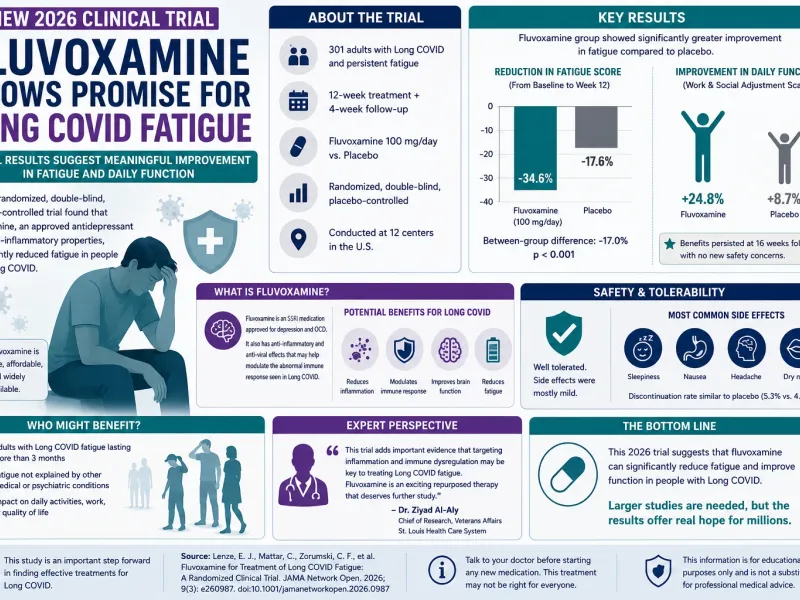
A randomized, placebo-controlled trial published in the Annals of Internal Medicine in March 2026 found that fluvoxamine — a low-cost antidepressant already widely available as a generic — significantly reduced fatigue and improved quality of life in adults with long COVID, with a 99% probability of outperforming placebo. The trial, known as REVIVE-TOGETHER, is one of the largest and most rigorously designed studies of a treatment for long COVID fatigue conducted to date, and its findings represent one of the first strong pieces of clinical evidence for managing what is the most prevalent and debilitating symptom of post-acute COVID-19.
Long COVID — officially defined by the World Health Organization as symptoms that persist at least three months after confirmed SARS-CoV-2 infection — affects an estimated 6% to 7% of adults globally, according to the Pharmacy Times summary of the trial. That figure represents tens of millions of people worldwide.
<cite index="97-1">Fatigue is the most common and debilitating symptom of long COVID, leaving many people unable to work, care for their families, or resume their normal lives. Despite its global impact, few proven treatments exist.</cite>
Most existing management approaches for long COVID fatigue are supportive — pacing activities, managing sleep, addressing co-existing conditions — rather than mechanistic treatments that address the underlying biology driving the exhaustion. The field has lacked a drug with proven efficacy in randomized trials. The REVIVE-TOGETHER trial sought to change that.
The trial was co-led by researchers at McMaster University, the University of British Columbia, Stanford University, and Brazilian institutions including those in Belo Horizonte and Minas Gerais, where the study sites were located. The senior author was Professor Edward Mills of McMaster's Department of Health Research Methods, Evidence, and Impact.
<cite index="95-1">The phase 3 REVIVE-TOGETHER trial (NCT06128967) enrolled 399 adults across 22 outpatient sites in Belo Horizonte and Minas Gerais, Brazil, between October 2023 and February 2025. Eligible participants had experienced new or worsening fatigue for at least 90 days — but no more than one year — following a confirmed COVID-19 infection.</cite>
Participants were randomly assigned to one of three groups:
Each group took their assigned treatment for 60 days. The primary outcome was change in score on the Fatigue Severity Scale (FSS) — a validated 9-item questionnaire measuring how much fatigue interferes with daily activities, with scores ranging from 1 to 7 and higher scores indicating more severe fatigue. Participants did not know which treatment they were receiving.
Results: What Fluvoxamine Did
The results favored fluvoxamine clearly and consistently.
<cite index="92-1">Fluvoxamine showed a significant reduction in fatigue compared with placebo at day 60 (mean difference, −0.43 [95% credible interval, −0.80 to −0.07]), with a sustained effect at day 90 (mean difference, −0.58 [CrI, −0.98 to −0.16]).</cite>
Importantly, the benefit did not diminish after treatment ended — it deepened. The FSS score difference between fluvoxamine and placebo was larger at 30 days after treatment stopped (day 90) than it had been at the end of the treatment period (day 60), suggesting a durable rather than merely symptomatic effect.
<cite index="95-1">At 30 days on medication, participants on fluvoxamine were approximately 50% more likely than those on placebo to report a fatigue score below 3 — a threshold considered indicative of clinically meaningful improvement.</cite>
<cite index="92-1">Fluvoxamine also improved quality-of-life scores with high posterior probability. Adverse events were less frequent with fluvoxamine (20.0%) than with metformin (28.8%) or placebo (29.7%). Grade 3 and higher adverse events were rare across all groups.</cite>
The finding that adverse events were lower in the fluvoxamine group than in the placebo group was notable: it means the drug was not only more effective but also better tolerated, which is an unusual profile and strengthens the case for clinical use.
Metformin: Why It Did Not Work Here
The trial also tested metformin — a widely used, inexpensive diabetes medication. Metformin had previously shown promise in a different context: the TOGETHER trial found that it reduced the risk of developing long COVID when taken during acute COVID-19 infection. The REVIVE-TOGETHER trial tested whether metformin could also help those who already had established long COVID fatigue.
<cite index="95-1">In contrast, metformin demonstrated no significant benefit for established long COVID fatigue.</cite>
This distinction is clinically important. Metformin may have a role in preventing long COVID from developing — but once fatigue has been present for 90 days or more, it does not appear to reduce it. The two drugs seem to act at different points in the disease trajectory. Fluvoxamine appears to have therapeutic value in the established chronic state; metformin's benefit, if any, may be preventive.
[REVIEWER: add clinical insight here — e.g., from a clinician managing long COVID patients, how the FSS score difference of −0.43 to −0.58 translates into real-world functional improvement — whether this is a large or modest effect by clinical standards — and what patient selection criteria (beyond the trial's eligibility criteria) should guide prescribing decisions]
How Fluvoxamine Works: The Sigma-1 Receptor Mechanism
Fluvoxamine is formally classified as a selective serotonin reuptake inhibitor (SSRI) — the same drug class as fluoxetine (Prozac) and sertraline (Zoloft). It is currently approved in the United States for obsessive-compulsive disorder and is available as a generic at low cost.
In standard psychiatric use, fluvoxamine works by increasing serotonin availability in the brain. But its effect in long COVID fatigue almost certainly operates through a different, additional mechanism: its unusually potent activity at the sigma-1 receptor (S1R).
<cite index="106-1">Fluvoxamine has been shown to have the strongest activity of all SSRIs at the sigma-1 receptor, with low-nanomolar affinity. S1R is a chaperone protein at the endoplasmic reticulum — the cell's protein-processing factory — with anti-inflammatory properties. Fluvoxamine's anti-inflammatory effects likely stem from its regulation of S1R, which modulates innate and adaptive immune responses.</cite>
In plain terms: the sigma-1 receptor acts as a cellular stress sensor. When it is activated by fluvoxamine, it suppresses a key inflammation pathway inside cells called the IRE1 pathway, which controls cytokine production — the release of inflammatory proteins that can cause widespread tissue damage. Dysregulated cytokine signaling is one of the leading biological hypotheses for why long COVID symptoms, including fatigue, persist long after the initial infection has cleared.
<cite index="101-1">Fluvoxamine acts as a potent sigma-1 receptor agonist that may decrease SARS-CoV-2 replication and subsequent endoplasmic reticulum stress and inflammation. Sigma-1 receptor agonists prevent inositol-requiring enzyme 1α from splicing of mRNA — a key step in inflammatory cytokine production.</cite>
This mechanism is also consistent with a second hypothesis for long COVID: persistent low-level viral reservoirs or immune dysregulation continuing to drive inflammation months after acute infection. By dampening that inflammatory response at a cellular level, fluvoxamine may be interrupting a cycle that would otherwise sustain fatigue.
What the Trial Cannot Tell Us
The REVIVE-TOGETHER trial was carefully designed but has acknowledged limitations.
The 90-day follow-up period limits conclusions about the durability of treatment effects beyond three months. Most long COVID patients have symptoms lasting far longer than 90 days, so whether benefits persist at six months or a year is not answered by this study.
<cite index="92-1">The exclusive focus on fatigue as the primary outcome does not address other prevalent long COVID symptoms, leaving fluvoxamine's broader therapeutic utility uncertain.</cite> Long COVID is a multi-system condition that often involves cognitive difficulties (brain fog), post-exertional malaise, sleep disturbances, autonomic dysfunction, and pain. The trial does not establish whether fluvoxamine helps with these other symptoms.
The trial was conducted entirely in Brazil, and all participants had confirmed single COVID-19 infections. Whether findings generalize to populations with multiple COVID-19 infections, different demographic backgrounds, or different long COVID phenotypes is not established.
Fluvoxamine is not currently approved by the FDA for long COVID, and clinicians prescribing it for this indication would be doing so off-label. As with any off-label use, this requires an individualized risk-benefit discussion with a qualified healthcare provider.
[REVIEWER: add clinical insight here — e.g., how a primary care physician or long COVID clinic would approach prescribing fluvoxamine off-label given this trial — what contraindications and drug interactions are particularly relevant, whether the dose used in the trial (100 mg twice daily) differs from standard psychiatric dosing, and what patients should realistically expect in terms of timeline for improvement]
What This Means for the Long COVID Research Landscape
Prof. Mills of McMaster University framed the results simply: <cite index="97-1">"Fluvoxamine showed consistent and meaningful benefits, and because it's already widely used and well understood, it has clear potential for clinical use."</cite>
That last point matters enormously. A drug with a novel mechanism that requires years of manufacturing ramp-up and regulatory approval has a very different pathway to patients than a generic medication already manufactured by dozens of companies, already understood by prescribers and pharmacists, and available in most countries at minimal cost. Fluvoxamine fits the second category.
The WHO estimated that more than 65 million people had long COVID as of 2023, a number that has grown considerably since. Treatment options remain limited. The REVIVE-TOGETHER trial does not solve long COVID — but it is one of the first rigorous trials to identify a drug that meaningfully reduces its most common symptom, and one that can theoretically be implemented globally without major supply or cost barriers.
FAQ
Does fluvoxamine reduce long COVID fatigue? Yes, in a 2026 randomized placebo-controlled trial. The REVIVE-TOGETHER trial, published in the Annals of Internal Medicine, found fluvoxamine significantly reduced fatigue scores in adults with long COVID at both 60 and 90 days, with a 99% probability of outperforming placebo. At 30 days, those on fluvoxamine were approximately 50% more likely than those on placebo to reach a clinically meaningful fatigue improvement threshold.
What is fluvoxamine and why is it being tested for long COVID? Fluvoxamine is an SSRI antidepressant available as a generic, currently approved for obsessive-compulsive disorder. Beyond its serotonin effects, fluvoxamine is the strongest sigma-1 receptor agonist among all SSRIs. The sigma-1 receptor regulates cellular inflammation pathways — persistent low-level inflammation is one of the leading hypotheses for why long COVID fatigue continues long after the initial infection clears.
How does fluvoxamine work for long COVID fatigue? Researchers believe its primary mechanism in long COVID operates through the sigma-1 receptor, a protein in the cell's endoplasmic reticulum with anti-inflammatory properties. Activating this receptor suppresses a key inflammation pathway (IRE1/XBP1) that controls cytokine production. By dampening chronic inflammation at the cellular level, fluvoxamine may interrupt the biological cycle sustaining long COVID fatigue, according to peer-reviewed analyses in Molecular Psychiatry and PMC.
Did metformin work for long COVID fatigue in the trial? No. Although metformin had previously shown promise for preventing long COVID when taken during acute COVID-19 infection, the REVIVE-TOGETHER trial found it offered no significant benefit for adults who already had established long COVID fatigue. This distinction suggests metformin may have a preventive but not therapeutic role in long COVID.
Can I get fluvoxamine for long COVID from my doctor? Fluvoxamine is not currently FDA-approved for long COVID and would be prescribed off-label. The REVIVE-TOGETHER trial results provide clinicians with meaningful evidence to support such a prescription, but the decision should be made in consultation with a healthcare provider who can weigh your specific health history, current medications, and symptom profile. Fluvoxamine has interactions with some other medications and is not appropriate for everyone.
Practical Takeaway
REVIVE-TOGETHER is not a cure for long COVID — but it is a significant clinical milestone. It is among the first trials to provide strong randomized evidence that a specific drug can meaningfully reduce long COVID's most common and disabling symptom, using a widely available medication that most healthcare systems worldwide could realistically implement. If you have been experiencing fatigue for three months or more following COVID-19 and existing management approaches have not helped, talking to your doctor about the REVIVE-TOGETHER trial findings and whether fluvoxamine is appropriate for your situation is a reasonable next step. Mention the trial citation: Reis G et al., Annals of Internal Medicine, March 31, 2026.
This article must be reviewed and attributed to a named, qualified medical reviewer — such as a board-certified internal medicine physician, infectious disease specialist, or psychiatrist with experience in COVID-19 sequelae — before publishing. It is intended for general education only and does not constitute medical advice. Fluvoxamine is a prescription medication; its use for long COVID would be off-label and requires individual medical assessment.
Sources
Reis G, dos Santos Moreira Silva EA, Medeiros Silva DC, et al. The Effect of Fluvoxamine and Metformin for Fatigue in Patients With Long COVID: An Adaptive Randomized Trial. Annals of Internal Medicine. Published March 31, 2026. DOI: 10.7326/ANNALS-25-03959.
McMaster University Faculty of Health Sciences. Common antidepressant eases fatigue associated with long COVID, study finds. April 9, 2026.
Pharmacy Times. Fluvoxamine Significantly Reduces Long COVID Fatigue in Landmark Randomized Trial. June 2026.
CIDRAP, University of Minnesota. Antidepressant relieves fatigue in people with long COVID, study finds. March 31, 2026.
ME Association / Dr. Charles Shepherd commentary. Annals of Internal Medicine: Randomised Trial Assesses Treatments for Fatigue in Long COVID. April 1, 2026.
Hashimoto K. Mechanisms of action of fluvoxamine for COVID-19: a historical review. Molecular Psychiatry. 2022. DOI: 10.1038/s41380-021-01432-3.
Khani S, Entezari-Maleki T. Fluvoxamine and long COVID-19: a new role for sigma-1 receptor (S1R) agonists. Molecular Psychiatry. 2022. DOI: 10.1038/s41380-022-01545-3.
Sukhatme VP, et al. Fluvoxamine: A Review of Its Mechanism of Action and Its Role in COVID-19. PMC. 2021
REVIVE-TOGETHER trial NCT06128967.
Image Suggestion
An editorial photograph showing an adult — not visibly ill, but clearly fatigued — seated at a desk or kitchen table with a glass of water and a small prescription pill bottle in the foreground, alongside a printed sheet of paper (suggesting a lab result or clinical note). The image should feel quiet and domestic, reflecting the invisible, ongoing nature of long COVID fatigue rather than acute illness. Avoid clinical hospital imagery or generic "depressed person" stock photos.
Schema Suggestion
MedicalWebPage + FAQPage + ClinicalTrial MedicalWebPage signals E-E-A-T credibility for a YMYL health topic sourced from a Phase 3 randomized trial in Annals of Internal Medicine; FAQPage enables rich result display for all five FAQ entries in Google Search and AI Overviews; ClinicalTrial schema is appropriate given the specific trial (NCT06128967) that underpins the entire article, which helps it surface in searches for clinical evidence on long COVID treatments.