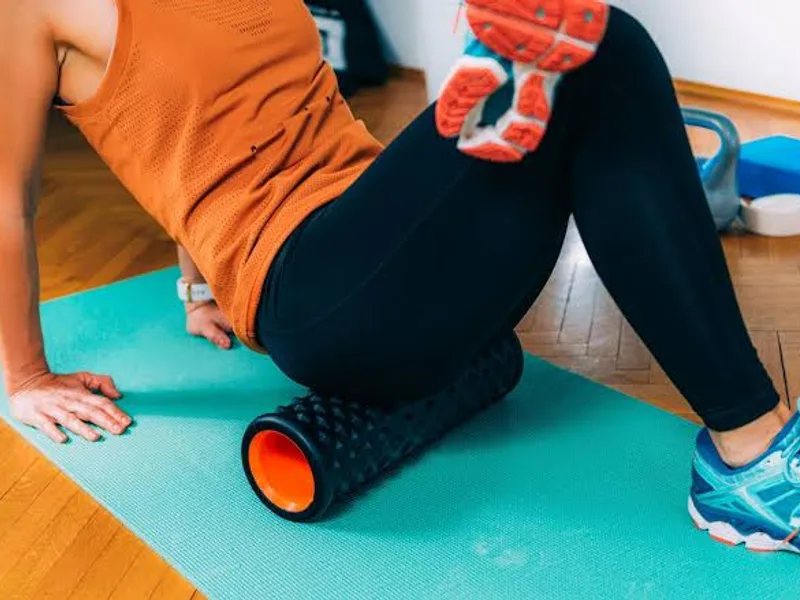
There's a particular face people make on a foam roller, somewhere between pain and satisfaction, like they're paying off a debt to their IT band. If you've done it, you know the look.
Foam rolling has become one of those default gym rituals, recommended for almost everything from tight hips to post-run soreness. Some of that reputation is earned. Some of it isn't, and it's worth being honest about which is which, especially since people sometimes use foam rolling to avoid dealing with a problem that actually needs a professional's attention.
What Foam Rolling Actually Does
Foam rolling is a form of self-myofascial release, a fancy way of saying you're applying pressure to muscle and the connective tissue around it using your own body weight against a foam cylinder.
The popular explanation is that it "breaks up adhesions" or "releases fascia," the connective tissue web that wraps around muscles. Honestly, the science on that specific mechanism is shakier than the marketing suggests. Fascia is dense, tough tissue, and there's real doubt about whether the pressure from a foam roller can meaningfully change its structure. What seems more likely, based on current research, is that foam rolling works partly through the nervous system, temporarily reducing how sensitive muscles feel to stretch and pressure, rather than physically reshaping tissue.
That's not nothing. A temporary reduction in muscle tension and perceived stiffness is a real, useful effect, even if the "I'm smoothing out my fascia" explanation isn't quite accurate.
The Benefits That Are Reasonably Well Supported
Short-term flexibility gains are one of the more consistent findings. Rolling a muscle group before stretching or activity tends to modestly increase range of motion for a short window afterward, which can be useful heading into a workout.
Reducing the discomfort of DOMS, delayed onset muscle soreness, is another area with decent support. Studies generally show a small to moderate reduction in perceived soreness when foam rolling is done in the day or two after a hard workout, compared to doing nothing at all. It's not dramatic, but if you're deciding between lying on the couch and spending ten minutes on a roller, the roller edges it out for comfort.
There's also a psychological piece that doesn't get talked about enough. In clinical practice, this is often missed because people assume the entire benefit has to be mechanical, when part of what foam rolling offers is simply a structured way to slow down, pay attention to a sore area, and reduce the mental tension that builds around pain. That's a legitimate benefit, not a placebo dismissal.
Where the Claims Get Ahead of the Evidence
Foam rolling doesn't fix poor posture on its own. It might temporarily ease the tightness that's contributing to a slouched position, but posture is mostly a strength, habit, and awareness issue, not a tissue-release one.
It's also not a substitute for proper rehab after an injury. Rolling around a strained muscle or a joint that's actually unstable can feel productive without addressing what's really wrong. If pain persists despite regular foam rolling, that's a signal to get it looked at rather than roll harder. A physiotherapist near you can tell you whether the issue is something rolling can help with, or something it's masking.
And rolling directly over a joint, a nerve, or an already injured area isn't a good idea without guidance. Pressure in the wrong spot, especially around the lower back or neck, can aggravate things rather than help. If you're not sure what you're dealing with, ask before assuming a foam roller is the safe default.
When to See Someone Instead of Rolling Harder
Ask yourself this: has the "tight spot" you keep rolling actually gotten better over the past few weeks, or are you just rolling the same spot out of habit?
If a specific area stays persistently sore, tender, or restricted despite consistent rolling and rest, it's worth getting checked rather than assuming you just haven't rolled enough. A general physician near you is a reasonable first stop, and they can refer you onward if needed.
Sharp pain, numbness, tingling, or swelling around a joint are not things foam rolling should be used to manage. Those symptoms deserve a proper evaluation. An orthopedist near you can assess whether something structural is going on, and if imaging is needed, a diagnostic center near you can arrange it.
Getting the Most Out of It
Rolling before a workout, spending a short amount of time on the target muscle group, tends to be more useful than one long, painful session hunting for "knots." Slow, controlled pressure generally works better than aggressive rolling that leaves bruising.
Pairing foam rolling with actual mobility and strength work gets better long-term results than relying on it alone. If you're recovering from a real injury rather than ordinary soreness, a structured plan from a physiotherapist near you is going to do more than a roller ever will.