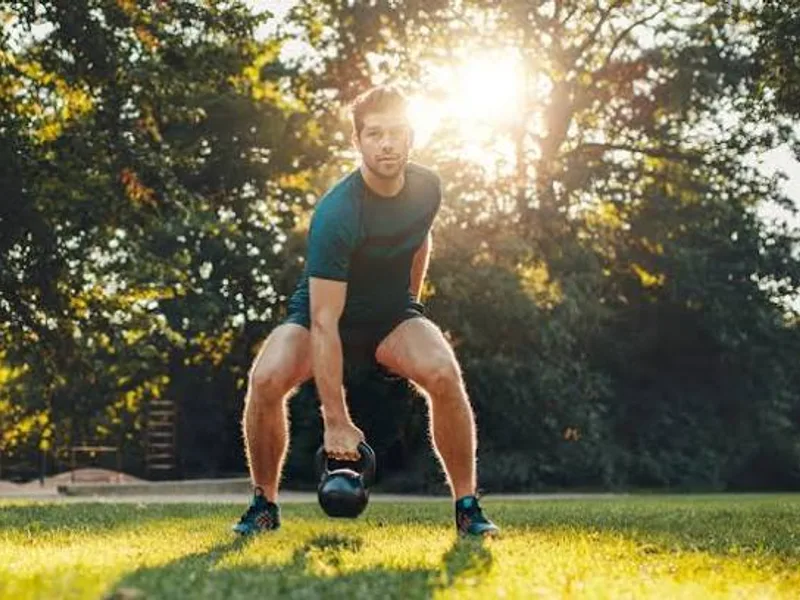
A workout is truly useful when its benefits follow you out of the gym. Functional fitness is built around that idea: training your body to perform everyday movements with greater strength, control, balance and confidence.
Getting out of a chair, lifting a suitcase, carrying shopping bags or climbing several flights of stairs may not look like exercise. But each task requires a combination of muscles and movement skills. Functional training tries to prepare the body for those demands rather than focusing only on isolated muscles.
What Is Functional Fitness?
Functional fitness is exercise designed around movements that resemble activities you perform in everyday life. Squatting, pushing, pulling, lifting, carrying, stepping, rotating and maintaining balance are common examples.
It does not require a particular piece of gym equipment. Bodyweight exercises, resistance bands, dumbbells and household objects can all be used when appropriate.
The goal is not to make every workout look like a real-life task. Instead, it is to improve the physical qualities behind those tasks: muscle strength, joint mobility, coordination, balance and stamina.
The World Health Organization recommends regular physical activity for adults, including muscle-strengthening activities involving the major muscle groups on at least two days each week. It also recommends that older adults include activities that emphasize balance and strength.
Why Functional Fitness Matters
Functional strength becomes noticeable when ordinary tasks become easier.
A stronger lower body can help with standing from a chair or climbing stairs. Better upper-body strength can make carrying bags or placing an object on a shelf less demanding. Improved balance and coordination can help you move more confidently.
This is where functional training differs from exercise aimed purely at appearance. A bigger muscle is not automatically a better-performing muscle. How well your muscles work together matters too.
A common point raised in clinical practice is that people sometimes focus on the area that hurts or the muscle they want to change while overlooking the movement itself. Training the whole movement pattern can be more useful, although the right approach depends on the person's health, fitness level and physical limitations.
For more on building strength safely, see Doctar's guide to Progressive overload guide
The Main Movements to Train
1. Squatting and Sitting
Squatting is closely related to everyday actions such as sitting down and standing up. A controlled chair squat is often a practical starting point because the chair provides a clear target.
You can gradually make the movement harder as your strength improves. Do not force a deep squat simply because someone else can do one. Comfortable range and good control matter more.
Doctar also covers which can complement lower-body training. Adductor exercises
2. Lunging and Stepping
Walking up stairs, stepping over an obstacle and getting in and out of a vehicle all require one leg to work differently from the other.
Lunges and step-ups can train this type of movement while also challenging balance. Beginners can hold onto a stable support if needed.
See Doctar's detailed guide to Lunges and balance
For a more demanding variation, the develops single-leg strength and stability. Bulgarian split squat
3. Pushing and Pulling
Opening a heavy door, moving furniture or pushing yourself up from a surface all involve pushing strength. Pulling strength is useful for tasks such as opening drawers or moving an object toward you.
Push-ups can be modified against a wall, countertop or sturdy surface. Rows using a resistance band or suitable weight can provide pulling resistance.
If shoulder strength is a weak point, Doctar's guide to offers several options. Resistance-band shoulder exercises
You can also read about.
4. Lifting and Carrying
Picking something up from the floor is a whole-body task. Your legs, hips, back and abdominal muscles all contribute to controlled lifting.
Functional training should therefore include learning to hinge at the hips and keep the load close rather than repeatedly bending and lifting with poor control.
Carrying is another useful movement. A farmer's walk, for example, combines grip, trunk stability, posture and walking.
5. Reaching and Overhead Movement
Reaching into a cupboard or placing luggage on a shelf requires adequate shoulder movement and upper-body control.
Limited shoulder mobility can make these simple tasks uncomfortable. Training should address both mobility and strength rather than repeatedly forcing a stiff joint into a position it cannot comfortably manage.
Doctar's guide to covers movements designed to improve shoulder range of motion. Shoulder mobility exercises
Don't Ignore the Core
The core is more than the abdominal muscles people see in a mirror. It includes muscles that help stabilize the trunk while the arms and legs move.
That stability matters when carrying groceries, climbing stairs, bending or changing direction.
Exercises such as side planks can train the muscles along the sides of the trunk. Doctar's explains beginner modifications and technique.
For people who prefer weights, provide another way to develop trunk strength.
Mobility Is Part of Functional Fitness
Strength alone is not enough if you cannot comfortably move through the range needed for a task.
Mobility refers to how freely a joint can move, while flexibility generally describes how much a muscle and surrounding tissues can lengthen. Both can influence movement quality.
A practical can support everyday movements such as bending, reaching and turning.
Upper-back movement also matters. Doctar's focus on movement through the middle and upper back.
How to Build a Functional Fitness Routine
A useful routine does not have to be complicated. You might combine a squat or chair stand, a push movement, a pull movement, a hip-strengthening exercise, a carry and a balance exercise.
The amount of resistance should allow controlled movement. As your ability improves, you can gradually increase the challenge. This principle, known as progressive overload, is a standard part of strength training, but increasing difficulty too quickly can raise the risk of injury. (DOCTAR)
People who are new to resistance training may find bodyweight exercises easier to control. Others may prefer bands, dumbbells or machines. Doctar compares and explains where each approach can fit.
Bodyweight training is another option. See Doctar's for a comparison.
Balance and Walking Matter Too
Functional fitness should not stop at strength. Balance, coordination and walking ability become especially relevant with ageing.
The CDC recommends that adults aged 65 and older include aerobic activity, muscle-strengthening activity and balance exercises each week.
Simple walking remains valuable. Doctar's discusses posture and everyday walking mechanics. Walking technique guide
People with limited mobility may need a different starting point. can provide seated options for strength, flexibility and balance. Chair exercises
When to Get Professional Guidance
Exercise is generally beneficial, but a new routine should not be treated as a substitute for medical assessment when symptoms are persistent or unexplained.
If you have significant joint pain, recent surgery, a major injury, severe dizziness, unusual breathlessness or a medical condition that affects exercise tolerance, speak with a doctor or qualified physiotherapist before increasing training.
People recovering from an injury may benefit from individualized rehabilitation. Doctar explains and how physiotherapy can support mobility and function. At-home physical therapy
For people with neurological movement problems, is a more condition-specific example of professional rehabilitation. Physical therapy for spasticity
Joint problems may also require modification rather than simply stopping all activity. Doctar's guide to discusses options and situations where professional advice is appropriate. Low-impact exercise for joint health
Functional Fitness for Different Ages
Functional training can be adapted rather than reserved for a particular age group.
Younger adults may use heavier resistance, faster movements or more complex exercises. Older adults may place greater emphasis on controlled strength work, balance, mobility and maintaining independence.
People with knee discomfort can explore while hip or lower-back discomfort may require a more individualized approach. Knee mobility exercises
For hip and lower-back concerns, Doctar also provides information on
The same principle applies to people with inflammatory joint conditions. Doctar discusses highlighting the need to adapt exercise to the individual. Strength training with psoriatic arthritis