Why a Tiny Fish Is Rewriting What We Know About Back Pain
Chronic lower back pain remains one of the most stubborn human afflictions. For decades, patients suffering from severe spinal disc degeneration have been handed the same limited playbook: temporary physical therapy, anti-inflammatory medications, or major surgery. But a new study led by the University of Edinburgh and the University of Bristol turns that traditional approach on its head.
Scientists examined zebrafish bred with a specific mutation in the collagen IX gene. As these fish aged, their spines underwent rapid deterioration that strikingly mirrors human spinal disc disease. Their flexible spinal cushion hardened, and adjacent vertebrae fused together into rigid bone.
Why study a aquatic creature to understand human back pain? Zebrafish might look nothing like us, but their genetic makeup and cellular mechanics show surprising parallels to human bone and cartilage development.
In clinical practice, this early breakdown is often missed because routine imaging focuses on bone structure rather than subtle matrix decay. Patients usually walk into an orthopedic doctor office only after chronic stiffness or nerve pinching has taken root. By tracking zebrafish from early development into adulthood, researchers caught the exact molecular moment when spinal disc health falls apart.
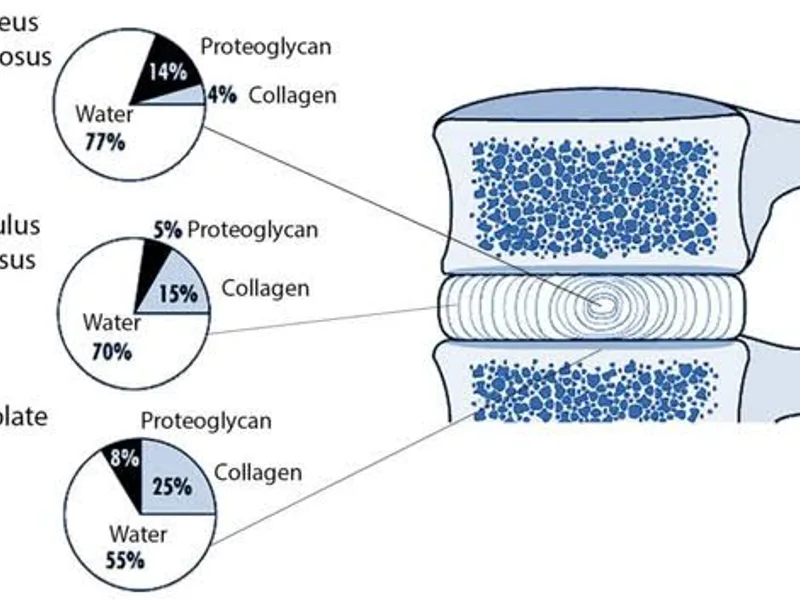
Collagen IX serves as a biological anchor. It weaves together structural fibers inside your spinal discs, providing the elasticity necessary to absorb daily physical shocks. When the col9a1b gene malfunctions, that vital internal grid unravels.
The team discovered something unexpected about how the spine hardens. The mineral deposits did not trigger the structural collapse. Instead, the collagen scaffolding broken down first, creating an unstable environment where minerals accumulated abnormally.
Think of it like a decaying concrete bridge. If the internal steel rebar rusts away, surrounding minerals leach in and turn the structure brittle.
Could human back pain be driven by this same sequence? Evidence points in that direction. Earlier genetic studies have repeatedly connected early-onset human disc issues to defects in collagen IX. Knowing that structural breakdown precedes calcification gives researchers a precise window for medical intervention.
If you are experiencing persistent lower back stiffness, scheduling a consultation with a spine specialist or an experienced orthopedic surgeon can help evaluate structural health before severe calcification occurs.
Metabolic Pathways and Mineral Accumulation
Beyond physical structure, the research team analyzed which genes turned on or off during spinal disc hardening. They discovered disruptions in several core biological pathways, including mTOR (which regulates cell growth), vitamin A signaling, and phosphate regulation.
Disrupted fat processing played a massive role in accelerating mineral buildup. When tissue cells fail to manage lipids and phosphate properly, calcium salts settle into soft disc tissue, transforming flexible collagen into rigid, bone-like material.
To verify this, researchers altered the diet of the zebrafish and introduced treatments that suppressed fat metabolism. The result? A noticeable drop in unwanted spinal fusions.
It is a fascinating reminder that back pain is not just a structural "wear and tear" issue. It is an active biochemical process tied to systemic metabolism.
For individuals exploring holistic recovery or seeking advice on metabolic wellness, booking an online doctor consultation with a general physician or a specialist at a rheumatology clinic can offer valuable guidance.
Repurposing Existing Osteoporosis Medications
Perhaps the most exciting finding involves a class of drugs already sitting on pharmacy shelves: bisphosphonates. These bone-protecting medications are widely prescribed for osteoporosis treatment to maintain overall bone health.
When researchers treated the mutant zebrafish with bisphosphonates, the drug blocked abnormal mineral deposits from forming inside the spinal discs.
Why does this matter so much? Developing a brand-new pharmaceutical from scratch takes over a decade. Repurposing a drug that has already passed human safety trials slashes that timeline significantly.
While we are not yet at the stage where doctors prescribe osteoporosis pills for routine disc disease, this study proves that disc hardening can be pharmacologically slowed or prevented.
If you are currently managing complex joint or spinal symptoms, exploring options at a dedicated pain relief clinic or getting a genetics consultation may assist in identifying underlying risk factors.
Diagnostic Insights and Modern Imaging
Understanding early disc degradation reinforces the importance of accurate diagnostic testing. Standard radiography might highlight advanced lumbar spondylosis or complete spinal fusion, but softer tissue changes require higher sensitivity.
When clinical suspicion arises, physicians often recommend advanced diagnostic imaging, such as an MRI scan booking or high-resolution digital X-ray services. Evaluating tissue density, calcium regulation, and a potential vitamin D assessment helps construct a comprehensive clinical picture.
Visiting a specialized orthopedics department ensures that diagnostic findings are paired with evidence-based interventions tailored to your specific condition.
For patients coping with chronic discomfort, structured physiotherapy services and individualized physical rehabilitation remain essential components of non-operative care.
Regular health tracking through a comprehensive preventive health checkup can also identify metabolic markers before they contribute to systemic inflammation or spinal stress. To read more expert medical insights and research summaries, browse the official Doctar health blog.
What This Means for You: Practical Takeaways
While human clinical trials are the necessary next step, this breakthrough alters how we think about spine preservation.
Focus on early prevention: Spinal disc disease begins long before bone-on-bone friction occurs. Address recurring back stiffness promptly rather than waiting for severe mobility loss.
Support your metabolism: Keep metabolic health in check. Balanced nutrition and routine physical activity support proper lipid and phosphate regulation, benefiting both cardiovascular and spinal systems.
Seek expert guidance: If you suffer from chronic lower back pain, back pain treatment strategies should be overseen by a specialist. Do not self-medicate with high-dose supplements without professional oversight.
Stay informed on new options: Targeted drug therapies for disc disease are transitioning from theory to reality. Work with your care team to stay updated on emerging clinical approaches for chronic pain management.
Connect with telehealth providers: If mobility is limited, you can easily consult a doctor online to review your options from home.