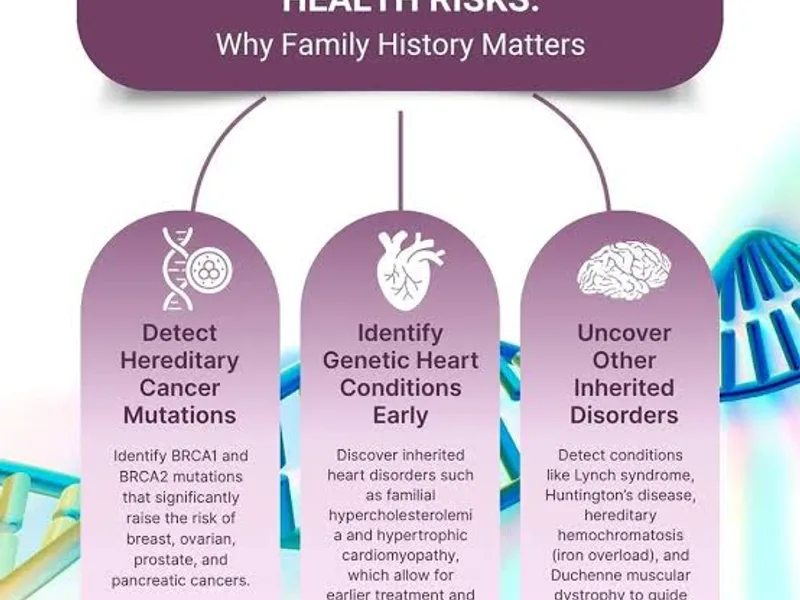
Genetic testing can turn a family medical history into useful medical information, but only when the right test is used for the right person.
A parent with cancer at an unusually young age, several close relatives with the same disease, or a rare condition appearing across generations may raise the question: is there an inherited cause? Sometimes there is. Often there isn't. Family members also share environments, habits and other risk factors, so a disease appearing in several relatives does not automatically prove that a gene is responsible.
That distinction matters because genetic testing can affect more than one person. A result may have implications for parents, siblings, children and other relatives who share some of the same DNA.
What genetic testing actually looks for
Genetic testing examines DNA for specific changes, commonly called variants. Some variants have no known health effect, while others can cause disease or increase the likelihood of developing a particular condition.
The test itself is usually straightforward. Depending on the test, a laboratory may use blood, saliva or another tissue sample. The harder part is deciding what should be tested and understanding what the result means.
Understanding genetic inheritance on Doctar.in
There is no single genetic test that checks for every inherited disease. Some tests examine one gene because a particular condition is strongly suspected. Others use a panel to examine several genes associated with a group of diseases.
Hereditary angioedema and genetic testing
Hereditary thrombocytopenia explained
Who should consider testing?
A strong family history is one reason a doctor may recommend genetic counseling or testing. The pattern matters more than simply counting the number of relatives who became ill.
For example, several close relatives with breast or ovarian cancer, cancer diagnosed unusually early, a known inherited mutation in the family, or particular combinations of cancers may prompt an assessment for hereditary cancer risk. The National Cancer Institute says family patterns, including the type of cancer and age at diagnosis, can help identify people who may benefit from testing.
Doctar.in's breast cancer guide
Breast cancer screening and genetic risk
Male breast cancer and inherited risk
Understanding hereditary ovarian cancer testing
A family history of colorectal cancer can also matter. Lynch syndrome and familial adenomatous polyposis are examples of inherited conditions that can substantially alter colorectal cancer risk.
Doctar.in's colon cancer guide
Colon cancer testing and hereditary risk
Colon cancer symptoms and genetic factors
Colon cancer complications and inherited risk
Inherited disease is not limited to cancer. Certain heart conditions, neurological disorders and kidney diseases can also have genetic causes.
Inherited cardiomyopathies and genetic risk
Hereditary ATTR cardiomyopathy
Is renal failure hereditary?
IgA nephropathy and genetic links
In clinical practice, this is often missed because families remember the disease but not the details that make the history useful: the exact diagnosis, age at diagnosis, whether it occurred on the mother's or father's side, and whether other related conditions were present.
Genetic counseling should come before or alongside testing
Genetic counseling is not simply a formality before giving a blood sample. A counselor or appropriately trained healthcare professional reviews the person's medical history and family history, then helps determine whether testing is appropriate and which test may be most informative.
Doctar.in's guide to hereditary angioedema diagnosis
Genetics and migraine
Familial hemiplegic migraine and inheritance
This step can prevent a common problem: ordering a very broad test and then discovering a genetic change whose medical meaning is uncertain.
That is where the term variant of uncertain significance, or VUS, may appear. It means a genetic change has been found, but current evidence is not strong enough to say whether it causes disease. A VUS should not automatically be treated as proof that someone has a hereditary disease.
Doctar.in's hereditary angioedema genetic testing guide
What do positive and negative results mean?
A positive result may identify a disease-causing inherited variant. But the implications depend on the condition, the particular gene and the person's wider medical history. A positive result usually means increased risk or confirmation of a genetic condition, not that illness is certain to occur in every situation.
A negative result also needs careful interpretation. It may mean that the specific genetic change being investigated was not found, but it does not necessarily eliminate every possible inherited or non-genetic risk.
This is especially important in hereditary cancer testing. Genetic testing looks for inherited changes, while tumor testing examines genetic changes that developed in cancer cells during a person's lifetime. These are different tests and serve different purposes.
Doctar.in's uterine cancer genetic testing guide
Doctar.in's esophageal cancer hereditary-risk guide
Breast biopsy results and genetic testing
What happens after a genetic test?
The result should be interpreted in context, not in isolation.
If a clinically important inherited variant is found, a doctor or genetic counselor may discuss whether relatives should consider testing. This process is sometimes called cascade testing, where relatives are offered targeted testing for a known family variant.
The result may also influence decisions about screening or monitoring. For some inherited cancer syndromes, for example, doctors may recommend different screening strategies from those used for people at average risk.
Doctar.in's breast cancer screening resource
Doctar.in's 3D mammogram guide
Doctar.in's breast lump guide
Breast changes and when to seek care
For some conditions, genetic information can also help clarify whether symptoms are part of an inherited disorder. Doctar.in's resources on ALS and genetics and Tourette syndrome and genetics illustrate how inherited risk can vary substantially between conditions.
The privacy and emotional side should not be ignored
A genetic result can carry emotional weight. Someone may feel relieved to have an explanation, while another person may worry about what the result means for their children or siblings.
There can also be practical questions about who should be told, how results are stored and how they may be used. Before testing, patients should ask the healthcare provider or laboratory about privacy, consent, record keeping and the implications of the specific test.
Doctar.in's guide to dominant and recessive inheritance
Menopausal hormone therapy and family cancer history
Breast cancer risk factors and family history
Should everyone get a genetic test?
Not necessarily. More testing is not automatically better testing.
Genetic testing is most useful when there is a clear medical question that the result can help answer. The CDC advises discussing testing with a healthcare provider, because the appropriate test depends on the person's symptoms, personal history, family history and the condition being investigated.
For anyone concerned about an inherited disease, the practical starting point is surprisingly old-fashioned: write down the family's medical history. Include diagnoses, ages at diagnosis and which side of the family was affected. Take that information to a doctor or qualified genetic counselor before ordering a test.