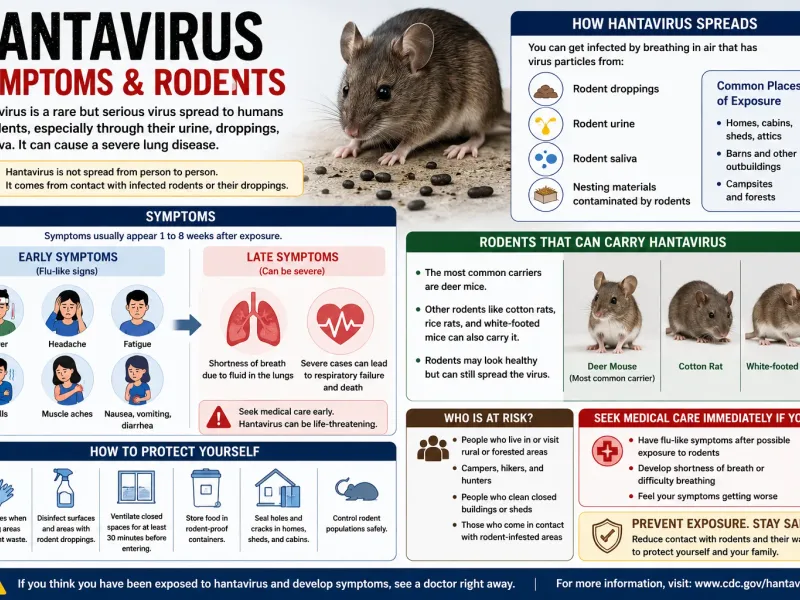
Hantavirus is a group of viruses carried by rodents that can cause severe and potentially fatal illness in humans, most commonly through inhaling air contaminated with infected rodent urine, droppings, or nesting material. In the United States, the most serious form — hantavirus pulmonary syndrome (HPS) — is most often caused by the Sin Nombre virus, carried primarily by deer mice. HPS is fatal in nearly 4 in 10 people who develop serious respiratory symptoms, according to the CDC. There is no vaccine and no specific antiviral treatment.
Hantavirus is not one virus but a family of more than 20 related viruses, each associated with a specific rodent host. In the Americas, these viruses cause two main types of illness: hantavirus pulmonary syndrome (HPS), which attacks the lungs and heart, and a milder non-pulmonary form with flu-like symptoms that typically resolves without severe complications.
HPS is found only in the Americas. In Europe and Asia, related hantaviruses cause a different illness called hemorrhagic fever with renal syndrome (HFRS), which attacks the kidneys rather than the lungs. The viruses that circulate in the United States do not cause HFRS.
From 1993 through 2023, a total of 890 laboratory-confirmed cases of hantavirus disease were reported in the United States, according to the CDC — an average of roughly 30 cases per year. The disease is rare but not uniformly distributed: 94% of US cases have occurred west of the Mississippi River, with New Mexico, Colorado, and Arizona historically accounting for the most cases.
Each hantavirus strain has a preferred rodent host. The host does not get sick — it carries and sheds the virus in its urine, feces, and saliva without showing any symptoms, which makes infected rodents indistinguishable from uninfected ones.
In North America, the rodent carriers include:
Deer mouse (Peromyscus maniculatus) — the primary carrier of Sin Nombre virus, the most common cause of HPS in the United States; found throughout the western US, Southwest, and parts of the Midwest
White-footed mouse (Peromyscus leucopus) — the carrier in the Northeast, linked to a less common hantavirus strain
Cotton rat and rice rat — carriers in the Southeastern United States
The deer mouse is the most significant risk. It is widespread in rural and semi-rural areas, particularly at higher elevations, and frequently enters cabins, sheds, barns, and homes — especially in autumn and winter when temperatures drop.
How Is Hantavirus Transmitted?
The most common route of infection is inhalation. When dried rodent urine, feces, or nesting materials are disturbed — by sweeping, vacuuming, or simply moving objects in an infested space — microscopic virus particles become airborne. Breathing that contaminated air is enough to cause infection, according to the Mayo Clinic.
Less commonly, hantavirus can spread through:
Direct contact with infected rodent materials, followed by touching the eyes, nose, or mouth
Rodent bites or scratches — rare but documented
In the United States, person-to-person transmission does not occur. The Sin Nombre virus and other North American strains are not contagious between people. This is an important distinction from the Andes virus, a South American strain that is the only hantavirus known to spread from person to person through close, prolonged contact, according to both the CDC and Mayo Clinic.
A 2026 outbreak aboard the M/V Hondius expedition cruise ship — caused by Andes virus — confirmed 9 cases and resulted in 3 deaths, prompting a CDC Health Alert Network advisory. The cruise had visited remote areas including Antarctica and South Georgia Island, where passengers likely encountered infected rodents in the environment. The outbreak served as a reminder that Andes virus presents unique risks not shared by the strains circulating in the continental United States.
Hantavirus Symptoms: Two Distinct Stages
HPS advances through two clearly defined stages. The early stage can look almost identical to influenza, making it easy to miss — particularly because HPS is rare and many clinicians may not think to test for it.
Stage 1: Early (Prodromal) Phase — Days 1 to 5
Symptoms begin 1 to 8 weeks after exposure, with most cases presenting within 2 to 4 weeks, according to the Washington State Department of Health. The early phase typically includes:
Fever — often high
Severe muscle aches — especially in the thighs, hips, and back
Headache and fatigue
Nausea, vomiting, abdominal pain, or diarrhea
There is no cough or shortness of breath in this phase. That fact is clinically significant: the absence of respiratory symptoms at this stage is deceptive. Without a known rodent exposure, early HPS is nearly impossible to distinguish from a severe viral illness.
Stage 2: Cardiopulmonary Phase — Days 5 to 7 (or Later)
The transition to Stage 2 can happen abruptly — sometimes within hours. This is the stage that makes HPS so dangerous.
The lungs rapidly fill with fluid (pulmonary edema), causing:
Shortness of breath — severe, often requiring mechanical ventilation
Cough
Low blood pressure and signs of shock
Heart dysfunction — HPS depresses heart function and can progress to cardiac failure
Most deaths occur within 24 to 48 hours of the cardiopulmonary phase beginning, according to the CDC's clinical overview for HPS. Patients with a blood lactate level above 4.0 mmol/L or low cardiac output have the poorest prognosis, per CDC clinician guidance.
[REVIEWER: add clinical insight here — e.g., how the clinical presentation of HPS differs from COVID-19 pneumonia or other causes of acute respiratory distress syndrome, and what laboratory findings or imaging patterns should prompt a clinician to consider hantavirus when a patient presents with rapid-onset respiratory failure]
Who Is Most at Risk?
Unlike many infectious diseases, hantavirus does not preferentially target people with weakened immune systems. Even healthy adults with no underlying conditions can develop fatal HPS after sufficient exposure. The risk is primarily tied to behavior and location.
High-risk situations include, according to the CDC and the New Mexico Department of Health:
Opening or cleaning buildings that have been closed for extended periods (cabins, barns, storage sheds) in areas where deer mice are common
Handling or disturbing rodent nests
Camping or hiking in areas with high rodent activity, particularly in the western US
Living or working in areas with visible rodent infestations
Hantavirus infections are reported more frequently in spring and summer, when rodent populations grow and people begin opening up structures that have been closed over winter. Seasonal outdoor workers, hikers, and people cleaning out rural buildings are at the highest practical risk.
Prevention: What Actually Reduces Risk
There is no vaccine for hantavirus. Prevention focuses entirely on avoiding contact with infected rodents and their waste.
Outdoors:
Do not disturb rodent burrows or nests
Avoid camping or sleeping near rodent signs (droppings, gnawed materials, burrow openings)
Store food and water in sealed, rodent-proof containers
Cleaning infested spaces (cabins, sheds, garages):
Air out the space for at least 30 minutes before entering — open doors and windows without going inside
Wear rubber or plastic gloves and, when available, an N95 or higher respirator
Do not dry-sweep or vacuum droppings or nesting material — this launches virus particles into the air
Wet the area with a bleach-based disinfectant solution (1.5 cups of bleach per gallon of water, according to CDC guidance) and let it soak for at least 5 minutes before wiping up
Double-bag all contaminated material and dispose of it outside
Preventing rodent entry at home:
Seal gaps larger than a dime around pipes, cables, and the foundation
Store food in metal or thick plastic containers
Keep woodpiles, brush, and debris away from the house perimeter
[REVIEWER: add clinical insight here — e.g., the practical guidance for patients who present after a potential exposure asking whether they need testing or monitoring, and how to advise someone who has already cleaned up rodent droppings without protection]
Treatment: What Happens If Someone Gets HPS?
There is no antiviral medication proven effective against HPS. Treatment is entirely supportive — managing the symptoms and keeping the body functioning while the immune system fights the virus.
The CDC recommends that any patient suspected of HPS be admitted to an intensive care unit as early as possible, even before a confirmed diagnosis. Immediate ICU care, oxygen therapy, mechanical ventilation, and careful fluid management can improve survival odds. The sooner a patient reaches specialized care, the better the outcome.
Intravenous ribavirin — an antiviral tested against HPS — was not shown to be effective in clinical studies, according to the CDC clinician brief for HPS. Research into treatments continues, but no specific approved therapy currently exists.
FAQ
How do you get hantavirus from rodents? The most common route is breathing air contaminated with dried rodent urine, droppings, or nesting material — particularly when disturbing these materials in enclosed spaces. Direct contact with rodent waste followed by touching the face can also cause infection. Rodent bites are a rare but possible route. In the US, hantavirus does not spread person-to-person.
What are the first signs of hantavirus infection? Early symptoms — appearing 1 to 8 weeks after exposure — include high fever, severe muscle aches (especially in the thighs, hips, and back), headache, fatigue, and nausea. There is typically no cough or breathing difficulty at this stage. The absence of respiratory symptoms makes early HPS easy to confuse with flu. Seek medical care immediately if these symptoms follow a potential rodent exposure.
Which mice carry hantavirus in the US? The deer mouse (Peromyscus maniculatus) is the primary carrier of Sin Nombre virus, the most common cause of HPS in the United States, according to the CDC and Mayo Clinic. It is found widely in the western US and Southwest. The white-footed mouse carries a related strain in the Northeast; cotton and rice rats are carriers in the Southeast.
Can hantavirus spread from person to person? In the United States, no. The North American strains — including Sin Nombre virus — do not spread between people. The only exception is the Andes virus, found in South America, which can spread through close, prolonged contact with a symptomatic person. A 2026 outbreak aboard a cruise ship confirmed this risk. The Andes virus is not endemic in the continental United States.
Is there a vaccine or cure for hantavirus? No. There is no approved vaccine or specific antiviral treatment for hantavirus. If HPS develops, ICU-level supportive care — oxygen therapy and mechanical ventilation — is the primary intervention. Early hospital admission significantly improves survival odds. HPS is fatal in approximately 38% of patients with severe respiratory symptoms, according to the CDC.
Practical Takeaway
If you are opening a cabin, shed, or garage that has been closed for months — especially in the western United States — treat it as a potential hantavirus risk. Air it out before entering, wear gloves and a respirator, and wet any droppings with disinfectant before cleaning. Never dry-sweep rodent waste. If you develop fever, severe muscle aches, and fatigue within six weeks of a rodent exposure, go to an emergency department and explicitly tell medical staff about the exposure. HPS deteriorates very fast. Early ICU care is the single most important factor in surviving it.
This article must be reviewed and attributed to a named, qualified medical reviewer — such as a board-certified infectious disease physician or emergency medicine specialist — before publishing. It is intended for general education only and does not constitute medical advice. If you suspect hantavirus exposure or infection, contact your healthcare provider or local health department immediately.
Sources
US Centers for Disease Control and Prevention (CDC). Clinician Brief: Hantavirus Pulmonary Syndrome (HPS).
CDC. Reported Cases of Hantavirus Disease, updated April 23, 2026.
CDC Health Alert Network (HAN). 2026 Multi-Country Hantavirus Cluster Linked to Cruise Ship, May 8, 2026.
CDC Health Alert Network (HAN). 2026 Hantavirus Outbreak: Testing for Potential Infection, May 19, 2026.
Mayo Clinic. Hantavirus Pulmonary Syndrome: Symptoms & Causes.
Johns Hopkins Medicine. Hantavirus Outbreak 2026, June 2026.
World Health Organization (WHO). Hantavirus Fact Sheet.
Washington State Department of Health. Hantavirus.
New Mexico Department of Health. Hantavirus Pulmonary Syndrome Guide.
National Emerging Special Pathogens Training and Education Center (NETEC). Understanding Hantavirus Pulmonary Syndrome: Risks, Symptoms, and Prevention, March 2025.
Category
Infectious Disease / Environmental Health / Public Health
Image Suggestion
A close-up editorial photograph of a deer mouse (Peromyscus maniculatus) in a natural setting — possibly at the entrance to a cabin or woodpile — paired with a visual cue such as a safety glove or cleaning supplies in the background. The image should convey the real-world setting of risk without being alarming. Use a wildlife or CDC-sourced photo rather than a generic brown rat image, which would misrepresent the actual carrier.
Schema Suggestion
MedicalWebPage + FAQPage MedicalWebPage signals E-E-A-T credibility for a YMYL health topic grounded in CDC, WHO, and Mayo Clinic sources; FAQPage enables rich result display for all five FAQ entries in Google Search and AI Overviews, including the high-traffic "can hantavirus spread person to person" query relevant to the 2026 Andes virus outbreak.