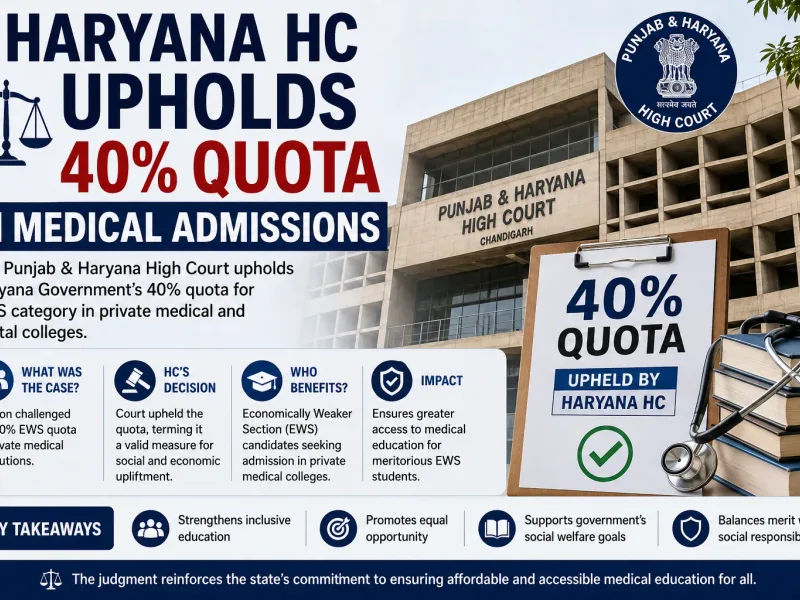
A courtroom decision in Chandigarh just settled — for now — a fight that's been simmering inside Haryana's government hospitals for almost two years. The Punjab and Haryana High Court has upheld the state's September 2024 policy allowing all in-service government doctors to apply for MD and MS admissions under the 40% in-service quota, even if they haven't completed two years of service in rural or remote postings.
If you're a doctor working through Haryana's counselling process, or a family member trying to make sense of a NEET PG news alert, here's what actually happened and why it matters.
What the Court Actually Said
The petitioners wanted the old rule back — the one that required in-service doctors to clock at least two years in rural or difficult areas before they could even apply for a postgraduate seat under this quota. Their argument, roughly, was that scrapping that condition rewards doctors who haven't done the harder rural stints as much as those who have.
The High Court didn't buy it. It said the state government has the authority to design a separate admission channel for in-service doctors and to set its own eligibility conditions for that channel. In other words, this isn't a call for judges to make — it's a policy choice that belongs to the government, and the court found nothing constitutionally wrong with how Haryana made it.
That's a fairly narrow, technical basis for a ruling, and it's worth sitting with for a second. Courts in India have repeatedly said reservation and quota design are matters of executive discretion unless they cross a specific legal line, like breaching the 50% overall reservation cap set by the Supreme Court decades ago. Here, the court didn't find that line was crossed.
Why This Case Went to Court in the First Place
In-service quotas exist because government hospitals — especially in rural Haryana — struggle to hold on to doctors. A postgraduate seat is one of the biggest incentives the state can offer a young MBBS doctor willing to work in a primary health centre far from a city. The idea is simple: serve first, then get priority for a PG seat later.
The problem is that "serve first" always needs a threshold, and thresholds create arguments. Doctors who'd already completed their two years in rural postings felt the September 2024 change diluted what they'd earned. Doctors who hadn't reached two years yet, understandably, welcomed a wider door. The High Court has now closed that argument, at least at this level.
What It Means for MD/MS Admissions in Haryana
Practically, this ruling keeps the counselling pipeline moving. According to reporting on the case, the Medical Counselling Committee had already withdrawn an earlier notification tied to this dispute and issued a fresh timeline for Round 2 registration, choice filling, and seat allotment. That's the immediate, real-world effect for anyone tracking dates on the DMER Haryana portal — the process resumes rather than getting stuck in limbo.
For doctors applying under the in-service quota this year, the eligibility bar is what the September 2024 policy said it was: you don't need two completed years in a rural or difficult posting to be considered. For MD/MS aspirants applying outside this quota, nothing changes on paper, but it's worth understanding how the in-service pool competes for its share of seats before assuming your own odds.
In Clinical Practice, This Debate Runs Deeper Than the Judgment
Having tracked postgraduate admission disputes across several states over the years, I'd say the legal question here is narrower than the real one doctors are actually arguing about. In clinical practice, this is often missed because the headline focuses on percentages and quotas, when the underlying tension is retention — how do you keep enough doctors willing to work a primary health centre in a district that nobody wants to be posted to? Every time a state loosens the eligibility bar for its in-service quota, it's implicitly saying the two-year rural rule wasn't doing enough on its own to pull doctors into those postings. Whether the new approach fixes that or just shifts who complains about it is a separate question from whether it's legal — and this judgment only answers the second one.
A Wider Pattern Across Indian Medical Education
Haryana isn't an outlier here. In-service quotas of around 40% have been challenged and upheld in other states too — West Bengal's version reached the Supreme Court back in 2021 and was dismissed on similar grounds. Reservation disputes in medical admissions come up constantly, whether it's domicile-based seats, sports quotas, or EWS categories in the All India Quota. Most of these cases turn on the same legal question: did the government stay within its constitutional authority to design the quota, and did it respect the overall reservation ceiling. Courts tend to defer to the state unless that ceiling is breached.
What Happens Next
The petitioners could appeal to the Supreme Court, and given how often PG medical quota cases end up there, that wouldn't be surprising. Until then, Haryana's policy stands, and Round 2 counselling proceeds under the eligibility rules the state set in September 2024.
If you're a doctor navigating this quota, or a family member trying to understand where a relative's application stands, the practical thing to do is check the official DMER Haryana notification directly rather than relying on secondhand summaries — court rulings on quota structure don't always translate into an obvious answer for an individual applicant's specific counselling round.
Related Reading & Resources on Doctar
For readers following the broader story of medical education access in India, our earlier piece on how private colleges now hold 54% of India's MBBS seats is a useful companion read — it covers the seat-availability side of the same admissions landscape this ruling touches.
If this article brought you here because you or a family member is currently a practising doctor weighing a PG application, or a patient trying to find care in the meantime, here's where Doctar can help directly:
Looking for a specialist right now instead of waiting on a counselling result? Search doctors across India or find doctors near you.
In-service quota doctors most often pursue postgraduate seats in high-demand clinical fields — you can browse cardiologists near you, gynecologists near you, pediatricians near you, dermatologists near you, pulmonologists near you, and endocrinologists near you to see the kind of specialist care these MD/MS seats eventually produce.
Rural service postings, the very thing at the centre of this case, are usually staffed by general physicians, general surgeons, and orthopedists — you can find verified profiles for each on Doctar.
Families dealing with a related medical need while this counselling process plays out can also check dentists near you, gastroenterologists near you, and doctors offering laparoscopy consultations.
If a family member needs a hospital rather than a clinic consultation, search hospitals near you or browse hospitals by city.
Need diagnostic tests done before a consultation? Find diagnostic centres near you or search diagnostics by location.
Elderly relatives who can't travel for a rural consult can use Doctar's home visit doctors, home visit nurses, or home physiotherapy services.
For urgent situations unrelated to this ruling, Doctar also lists emergency services near you and ambulance booking.
Need medicines delivered while you wait for a counselling update? Check pharmacies near you.
Considering a surgical procedure and want to compare providers? Browse surgeries and average pricing.
Want to consult a nutrition expert while managing a chronic condition? Find dietitians near you.
For sensitive health concerns that don't get discussed openly, Doctar also connects patients with sexologists near you.
If you'd rather browse specialists by category first, start with our full specialist directory or the general doctors near me listing.
For more health policy explainers like this one, visit our Health Today blog category or browse all Doctar health articles.
To understand how Doctar verifies the doctors and hospitals listed across this article's links, read About Doctar.
Editorial note: This article should be reviewed by a qualified legal or medical education counsellor, or a healthcare journalist with health-policy experience, before publishing, in line with standard editorial practice for health and policy content.