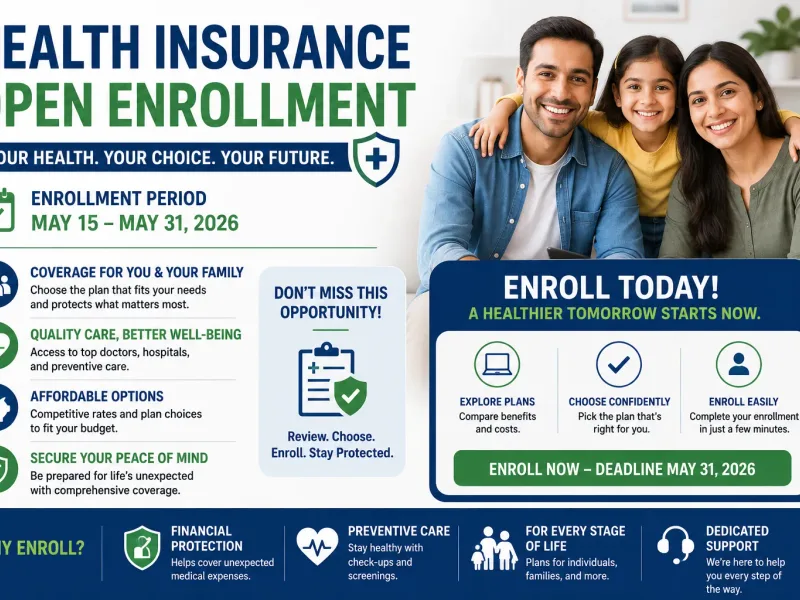
Open Enrollment for Health Insurance
Health insurance open enrollment sounds bureaucratic. It is. But missing it, or sleepwalking through it, can mean paying full price for a hospitalisation that should have cost you a fraction of that — or worse, having no cover at all when you need it most.
Open enrollment is the fixed period each year when individuals can enrol in, change, or cancel a health insurance plan without needing a special reason. Outside this window, you generally can't switch plans unless something significant changes in your life — a job loss, a marriage, the birth of a child. Those are called "qualifying life events," and they open a short Special Enrollment Period. Without one, you wait until next year.
In India, the rules vary by whether you're covered through an employer group plan, a government scheme like Ayushman Bharat, or a private policy. For employer-managed plans, HR usually sets the enrollment window — often just a few weeks. Miss the notice in your inbox, and you might miss the whole thing.
Why So Many People Choose the Wrong Plan
Here's something that's genuinely underappreciated: most people don't re-read their plan documents every year. They auto-renew whatever they had last year and assume nothing has changed. But premiums go up, co-pays shift, networks change. A hospital that was covered in your plan twelve months ago may no longer be in-network this year.
If you've been managing a chronic condition — diabetes, hypertension, thyroid disorders — it's worth checking whether your current general physician or specialist is still included in the plan's network before you commit for another year. A five-minute check now can prevent a very unpleasant bill later.
The same applies to medications. Plans often change their drug formulary — the list of medicines they cover — year over year. If you take a specific drug regularly, verify it's still covered before enrollment closes.
The Basic Plan Types You'll Encounter
Most people feel overwhelmed by plan types, but there are really only a few structures to understand.
Health Maintenance Organization (HMO): You stay within a defined network of doctors and hospitals. Costs are lower, but you need referrals to see specialists. Think of it as a managed system — efficient, but not flexible.
Preferred Provider Organization (PPO): More freedom to see out-of-network providers, but you pay more for that flexibility. Better if you travel frequently or already have a doctor you like outside any network.
High-Deductible Health Plan (HDHP): Lower monthly premium, but you pay significantly more out of pocket before the insurance kicks in. These plans pair well with a Health Savings Account (HSA), which lets you set aside pre-tax money for medical expenses.
For those relying on hospitals near you, confirming that your preferred facility is in-network before signing up is non-negotiable. Not all hospitals participate in all plans.
The Numbers That Actually Matter
People spend too much time comparing monthly premiums and not enough time looking at the total cost of care. The premium is just one part of the equation.
Deductible: The amount you pay out of pocket before your insurance begins covering costs. A plan with a ₹10,000 deductible means you're covering the first ₹10,000 of expenses yourself.
Co-pay: A fixed amount you pay per visit or service — say, ₹500 every time you see a specialist near you.
Out-of-pocket maximum: The most you'll ever pay in a year. Once you hit this cap, the insurer covers 100%. This number matters enormously if you have a serious health event.
Don't optimise only for the lowest monthly premium. If you have ongoing healthcare needs — regular visits to a cardiologist, a gynecologist, or a pediatrician for your child — a slightly higher premium with a lower deductible often saves more overall.
Deadlines: The Part No One Reads Carefully Enough
In the US, the Affordable Care Act marketplace typically opens enrollment in November and closes in January. Miss it, no coverage until next year unless you qualify for a Special Enrollment Period.
In India, employer group policies usually follow the financial year, with HR communicating a narrow window — sometimes as short as two weeks — in which you can make changes. Individual policies from insurers like Star Health, HDFC Ergo, or New India Assurance have their own renewal timelines, typically around your policy anniversary date.
One point that's easy to overlook: renewal is not the same as re-enrollment. A policy that auto-renews may carry forward outdated information — an old address, last year's sum insured, or family members who should have been added or removed. Check the policy document, not just the renewal notice.
What to Actually Do Before Enrollment Closes
Start with your healthcare usage over the past year. How many times did you visit a doctor near you? Did you use a diagnostic center for blood work or imaging? Did you need a specialist — an orthopedist, a gastroenterologist, a dermatologist? Estimate what you actually spent, not what you fear you might spend.
Then look at what's changing in the new plan year. If your insurer sent a Summary of Benefits and Coverage, read the comparison tables — they're required to be in plain language for exactly this reason.
If you're adding a family member, verify that your preferred pediatrician is listed under the plan. If you're expecting a pregnancy, confirm gynecology and obstetric services are fully covered.
For seniors, double-check whether the plan covers physiotherapy at home or home visit doctors — these are often used more heavily with age and can represent a significant out-of-pocket cost if not covered.
Prescription Coverage: A Genuinely Overlooked Area
If you or a family member takes regular medication, the plan's drug formulary deserves serious attention. Most plans organise drugs into tiers — generics are cheapest, brand-name drugs cost more, and specialty drugs (biologics for conditions like rheumatoid arthritis or certain cancers) can be very expensive even with insurance.
Before enrollment closes, look up every medication you take on the insurer's formulary. If a drug you rely on has moved to a higher tier or been dropped entirely, you may need to factor that into your decision — or ask your general physician whether a covered alternative is appropriate for your condition. That's a medical conversation worth having before you commit to a plan, not after you're already locked in.
For ongoing medication needs, building a relationship with a pharmacy near you that's in your plan's network can also reduce costs significantly.
Special Situations Worth Knowing
Job change: Losing employer-sponsored coverage is a qualifying event. You usually have 30 to 60 days to find new coverage. Don't wait.
New baby or adoption: Adds a qualifying event and allows you to add the child to your plan. The clock starts at the date of birth or adoption, not when you find time to call HR.
Moving: Depending on the plan type, changing your address (especially to a new coverage area) may trigger a Special Enrollment Period.
Income change: If your income drops significantly, you may qualify for government-subsidised coverage or Medicaid. In India, major income shifts can affect eligibility for schemes like PM-JAY (Pradhan Mantri Jan Arogya Yojana).
If you've been diagnosed with a new condition during the year — say, your endocrinologist confirmed a thyroid disorder or your pulmonologist flagged a breathing issue — that's not typically a qualifying event on its own. But it should absolutely change how you evaluate plans during open enrollment.
How a Good Doctor Relationship Changes Everything
One thing that gets lost in all the insurance talk: a plan is only as useful as the doctors in its network. If you're starting fresh in a city, finding a doctor near you who actually knows your history is worth more than a marginally cheaper premium.
Platforms like Doctar help you find verified specialists, check their availability, and book appointments — so when your plan year begins, you're not scrambling to locate a covered provider in the middle of a health crisis. That preparedness is, oddly, the kind of thing open enrollment is supposed to enable.
For urgent needs, knowing which emergency services are covered under your plan in advance — rather than finding out during a crisis — can make an enormous practical difference. Similarly, if you might need surgery, checking whether your insurer covers procedures at hospitals near you before you enroll (not after you're admitted) is the kind of detail that saves families from devastating surprise bills.