Why Health Ministry announcements matter to patients
A new health guideline can look like bureaucratic paperwork until it changes what happens at a clinic, hospital or health centre. Government decisions can influence screening programmes, hospital standards, insurance coverage, digital health services and access to preventive care.
That is why patients should distinguish between an announcement, an operational guideline and an active benefit. A scheme may be announced nationally but still require state-level implementation, staff training, funding or hospital enrolment before people can actually use it.
Doctar's overview of India's healthcare policies and access explains how government programmes, public hospitals and private providers fit into the wider healthcare system.
Recent changes worth watching in 2026
Several announcements from the Union Health Ministry this year have practical implications for patients.
One major development was the release of the RBSK 2.0 guidelines for child health. The revised programme strengthens the existing screening approach for children from birth through 18 years and adds greater emphasis on emerging health concerns, digital systems and continuity of care.
The programme has since been described by the government as covering 38 common childhood health conditions, including diabetes, hypertension, mental-health conditions and behavioural concerns. Mobile health teams and digital tracking are also part of the revised approach.
For families, that could mean more attention to health problems that were once treated mainly as adult conditions. But exactly what a child receives will depend on how the programme operates locally.
Anemia programme gets a new framework
Another significant announcement concerns Anemia Mukt Bharat Abhiyaan.
The updated operational guidelines move beyond prevention alone and place greater emphasis on testing, treatment, communication and follow-up. The framework uses a “Test, Treat, Talk and Track” approach and introduces a unified digital platform for monitoring anemia-related services.
The revised framework also expands the programme's 7x7x7 approach and includes low-birth-weight babies as a beneficiary group.
This matters because anemia is not simply a matter of taking an iron tablet. The reason for low haemoglobin can vary, and patients may need assessment by a healthcare professional rather than self-treatment.
Doctar's information on affordable health check-ups in India explains how routine investigations can help identify problems such as anemia, diabetes and abnormal cholesterol levels.
Ayushman Bharat continues to expand
Government health insurance remains one of the most closely watched areas of healthcare policy.
In March 2026, the government reported that 43.52 crore Ayushman cards had been created and that 36,229 hospitals were empanelled under AB-PMJAY as of February 28. The national health benefit package covered 1,961 procedures across 27 medical specialties.
The programme also includes coverage for eligible people aged 70 and above irrespective of socioeconomic status, under the expansion announced previously by the government.
West Bengal then became the 36th State/Union Territory to implement AB-PMJAY in June 2026. The government said the move would extend the scheme's benefits to approximately 1.43 crore families in the state.
Patients should still check their own eligibility and the current list of empanelled hospitals. Doctar's guide to health insurance access in 2026 discusses how government and private health coverage affect access to treatment.
Hospital standards are also changing
The ministry has been working on the Indian Public Health Standards, known as IPHS, which set expectations for infrastructure, staffing and services at public health facilities.
In a March 2026 update, the government said all healthcare facilities had been assessed against IPHS requirements as of March 6, while 63% had scored above 50%. It also said an open-source toolkit and dashboard were being used to monitor compliance and identify gaps.
That sounds technical, but the effect can be very practical. Better adherence to facility standards can influence whether a centre has appropriate staff, equipment and services for the population it serves.
Doctar's guide to government hospitals and healthcare access offers a useful patient-level view of how public hospitals, primary centres and referral facilities work together.
Digital health is becoming a bigger part of policy
The Health Ministry also announced a group of digital-health initiatives in June 2026, including Aarogya Setu 2.0, the Ayushman Sarathi chatbot, the Ayushman App, e-Sushrut Clinic and health-data standards designed to improve interoperability.
The larger goal is to make health information and claims systems work together more effectively. That could eventually make it easier for patients to move between facilities without repeatedly explaining their medical history.
Doctar's telemedicine guide explains how remote consultations can improve access, particularly when distance makes an in-person visit difficult.
Its medical-record transfer guide also explains why keeping reports and health records organised matters when care moves between doctors.
What should patients do when a new scheme is announced?
Don't assume a headline means you are automatically covered. Check the official notification, eligibility criteria, start date and implementing authority.
Patients should ask four basic questions:
Who qualifies? A national programme may target a particular age group, income category, disease group or geographic area.
What is actually covered? “Healthcare coverage” does not necessarily mean every consultation, medicine, test or procedure is free.
Where can I use it? Some benefits require treatment at an empanelled or designated facility.
When does it start? An announcement may precede operational implementation.
Doctar's guide to government health schemes and healthcare access is useful for understanding the difference between national programmes and the services patients encounter locally.
Don't rely on social-media forwards
Healthcare announcements are unusually vulnerable to misinformation. A WhatsApp message saying “free treatment for everyone” is not the same as an official scheme notification.
In clinical practice, this is often missed because patients arrive with screenshots or forwarded messages and assume the benefit applies to them. The safer approach is to verify the information through the relevant government department, scheme administrator or participating hospital.
Doctar's guide to healthcare without insurance discusses government hospitals, community health centres and other options for people facing healthcare costs.
What new guidelines mean for families
New guidelines often affect prevention before they affect hospital treatment.
For children, the revised RBSK framework brings greater attention to conditions such as diabetes, hypertension and mental health. For anemia, the updated national programme puts more emphasis on identifying and managing the problem rather than relying only on preventive supplementation.
Families should therefore pay attention to screening invitations, school or Anganwadi health programmes and advice from public-health workers. Doctar's maternal and child healthcare guide also describes government programmes supporting pregnancy, newborn and child care.
Older adults have their own policy considerations. Doctar's senior-citizen healthcare guide discusses government schemes and other healthcare financing options for older people.
What about medicines and treatment costs?
Government policy does not only affect hospitals. Medicine affordability is another major issue.
Doctar's guide to affordable medicines discusses patient-assistance programmes, NGOs and government initiatives such as the Jan Aushadhi programme.
Patients with chronic illnesses should also understand how insurance and government programmes interact. Doctar's guide to managing health coverage explains why changes in eligibility, documentation or scheme rules can affect access to benefits.
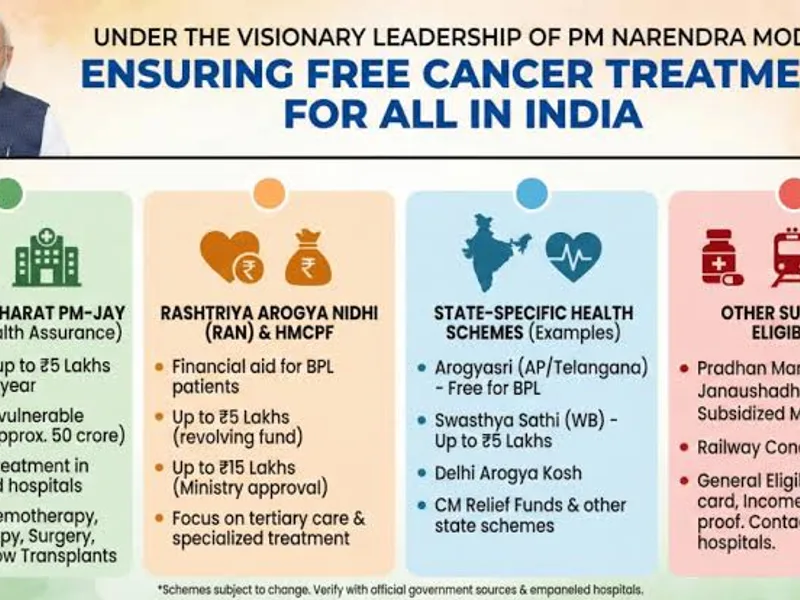
For serious conditions such as cancer, coverage details can become even more important. Doctar's cancer-treatment coverage guide discusses government schemes, insurance restrictions and treatment-related expenses.
The practical question: has the policy reached your area?
A national announcement is only the beginning.
Implementation can involve central ministries, state health departments, district authorities, hospitals, frontline workers and technology systems. That is why two patients in different states may experience the same programme differently during its early stages.
Doctar's guide to government hospitals in India illustrates how local public facilities remain an important access point even as national schemes expand.
For routine care, patients can also consider doctor consultation options, while remote follow-up may sometimes be possible through telemedicine services.
The point is simple: policy becomes useful only when people can actually access it.
A note about changing guidelines
Government health programmes evolve. Operational rules, eligibility criteria, hospital lists and implementation dates can change after an announcement.
That is particularly relevant for patients making financial or treatment decisions. Doctar's health insurance access update is useful background, but patients should verify current scheme rules with the relevant government authority before relying on them.