What the New Study Actually Found
A team at the Skolkovo Institute of Science and Technology asked an interesting question. If medicine could somehow fix every reversible part of aging, what would still eventually kill a person? Their answer, published in npj Aging, points to something we can't currently reverse: random DNA damage that builds up in cells throughout life, known as somatic mutations.
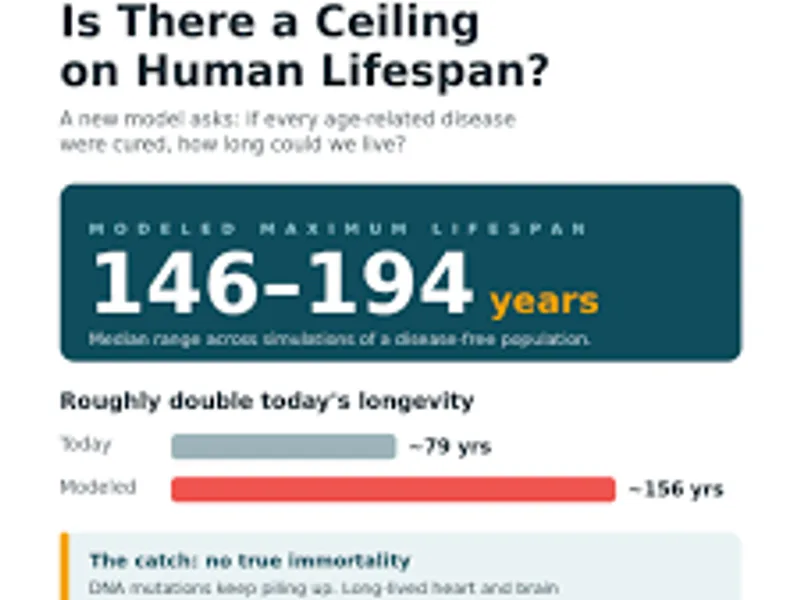
Using a mathematical model, the researchers estimated that even with nearly every other aging process eliminated, somatic mutations alone would still cap the median human lifespan somewhere between 146 and 194 years, with 156 years as the central estimate. That's roughly double what most people live today. It's a striking number, but it's worth repeating: this came from a model, not from anyone actually living that long.
Why Brain and Heart Cells Are the Bottleneck
Here's the part that got less attention in the viral headlines but matters more. The researchers found that tissues capable of regenerating, like skin and liver, could theoretically keep replacing themselves for an extraordinarily long time. The real limit came from tissues that don't regenerate well: neurons in the brain and cardiomyocytes, the muscle cells that make up your heart.
Those cells last a lifetime without dividing much, so any DNA damage they pick up along the way simply stays there and accumulates. It's a bit like a car where most parts can be replaced except the chassis. Eventually, damage to that one irreplaceable structure becomes the thing that limits everything else.
This tracks with what Doctar has covered on how resting heart rate reflects cardiovascular aging over time, and why brain health pieces on memory and cognitive changes with age tend to focus so heavily on prevention rather than reversal. Cells that don't regenerate are, biologically speaking, the ones we have to protect early, because there's no do-over once damage sets in.
194 Years Is Theoretical, Not Achievable Today
In clinical practice, this is often the part that gets lost when a study like this goes viral: a mathematical ceiling isn't a promise, and it definitely isn't a treatment. The researchers eliminated things like disease, hormonal decline, and cellular dysfunction in their model to isolate the effect of one variable. Real human bodies don't get to skip those problems.
The longest verified human lifespan on record belongs to Jeanne Calment, who died in 1997 at 122 years old. That's still dramatically short of even the low end of this study's 146-year estimate, and it hasn't been matched since. Current global life expectancy sits in the 70s to low 80s depending on the country, nowhere close to triple digits for most people.
Does that mean the study is pointless? Not at all. It gives researchers a clearer target: somatic mutations account for roughly half the gap between theoretical immortality and how long we actually live. Figuring out the other half is where a lot of future longevity research is now headed.
What Actually Moves the Needle on Your Own Lifespan
Nobody reading this is going to reach 194 through a supplement or a hack, and it's worth being blunt about that. What the evidence does support, consistently and without needing a mathematical model, is that everyday habits shift how long and how well people live within the range we already know is achievable.
Regular movement is one of the better-studied levers here. Doctar's piece on walking an hour a day and the guide to staying active in older adulthood both cover ground that's directly relevant, since inactivity accelerates a lot of the age-related decline that this new study is trying to explain mechanistically. Something as simple as a morning walking habit or walking after meals supports the cardiovascular system that the study identifies as one of the two bottleneck tissues.
Diet plays a comparable role. Doctar's practical guide to everyday eating and movement habits and its coverage of managing chronic conditions like diabetes both point at the same underlying idea: chronic inflammation and blood sugar swings put ongoing strain on organs that already have limited repair capacity. A conversation with a dietitian or a visit to a nutrition and wellness centre is a more useful place to start than chasing anti-aging supplement claims.
Sleep and gut health matter more than people give them credit for too. If digestion feels off, Doctar's piece on gentle movement for gut health is a reasonable starting point, and pairing steady, low heart rate training with rest days, as covered in how often you should really do cardio, avoids the kind of chronic strain that speeds up wear on joints and the heart alike. Keeping joints strong matters for mobility later in life even if it doesn't directly touch the somatic mutation story.
Watch Out for Where This Story Gets Twisted
I'll be honest, this is the kind of study that gets weaponized fast by wellness marketing. Expect to see "science says you can live to 194" plastered on supplement ads within weeks. That's not what the paper says, and no legitimate researcher involved is claiming it. If a product references this study to sell you something, that's a red flag worth noticing, not a reason to buy in.
Cognitive health also deserves a mention here, since the study singles out neurons as one of the two limiting tissues. Doctar's coverage of medications that can affect dementia symptoms and how multitasking affects memory are both relevant if brain longevity is genuinely your concern, alongside routine checks like an eye exam for age-related vision changes, since visual decline often tracks with broader neurological aging. Persistent unexplained symptoms like fatigue are worth getting checked rather than assumed.
If you're supporting an aging parent or relative, practical resources matter as much as the science. Doctar's guide to nutritional support programs for seniors and its review of health-tracking tools like the BetterMe app can help translate long-term health goals into something manageable day to day. For structured support, options like a weight management centre, a cardiologist, a joint and bone specialist, an osteopath, or a nutritionist are reasonable next steps for anyone with a specific health concern rather than a general curiosity about longevity science.